Cashback Credit Cards in Singapore Compared

Singapore cashback cards advertise high rates like 'up to 8%', but that applies only to a few categories such as dining, petrol or groceries, needs a minimum monthly spend, and is capped — so the cash you actually get back each month is limited.
On this page4 sections · tap to jump
A cashback card pays you back a slice of what you spend — but in Singapore the headline “up to 8%” or “up to 10%” is always narrower than it looks. The high rate applies to a short list of categories, needs a minimum monthly spend to switch on, and stops at a monthly or quarterly cap. Here is how the main cashback cards compare, as of October 2026.
How cashback cards really work
Three dials decide what you actually earn, and the advertised rate only tells you the first one:
- Category rate: the high percentage applies to named categories (dining, groceries, petrol, transport, lifestyle). Everything else earns a small base rate, often 0.2-0.3%.
- Minimum spend: most cards switch the bonus on only if you spend above a threshold (commonly S$800 a month). Below it, all spend earns the base rate.
- Cap: a maximum cashback per statement month or quarter. Once you reach it, extra spending earns nothing extra.
Because of the cap, a “higher %” card is not automatically better — a generous rate with a low cap can pay less than a modest rate with a high cap. One more wrinkle: minimum spend and cashback are usually pooled across the principal and supplementary cards on the same account, so a household card can reach the threshold faster, but it also shares the single monthly cap rather than getting its own.
The cards, side by side
| Card | Top categories & rate | Minimum spend | Cashback cap |
|---|---|---|---|
| Citi Cash Back | 8% petrol & private commute; 6% dining & groceries (0.2% base) | S$800 / month | S$80 / month |
| OCBC 365 (from 1 Nov 2026) | 6% dining, groceries, land transport & petrol (0.25% base) | S$800 / month | S$160 / month |
| UOB One Card | Up to 10% on Grab, McDonald’s, Shopee SG, SimplyGo; up to 3.33% base cashback | S$600 / S$1,000 / S$2,000 a month (min 10 transactions) | Up to S$200 / quarter base, paid quarterly |
| HSBC Live+ | Up to 8% dining, shopping & entertainment (5% base + 3% for the first two quarters); 5% petrol | S$1,000 / quarter | S$250 / quarter |
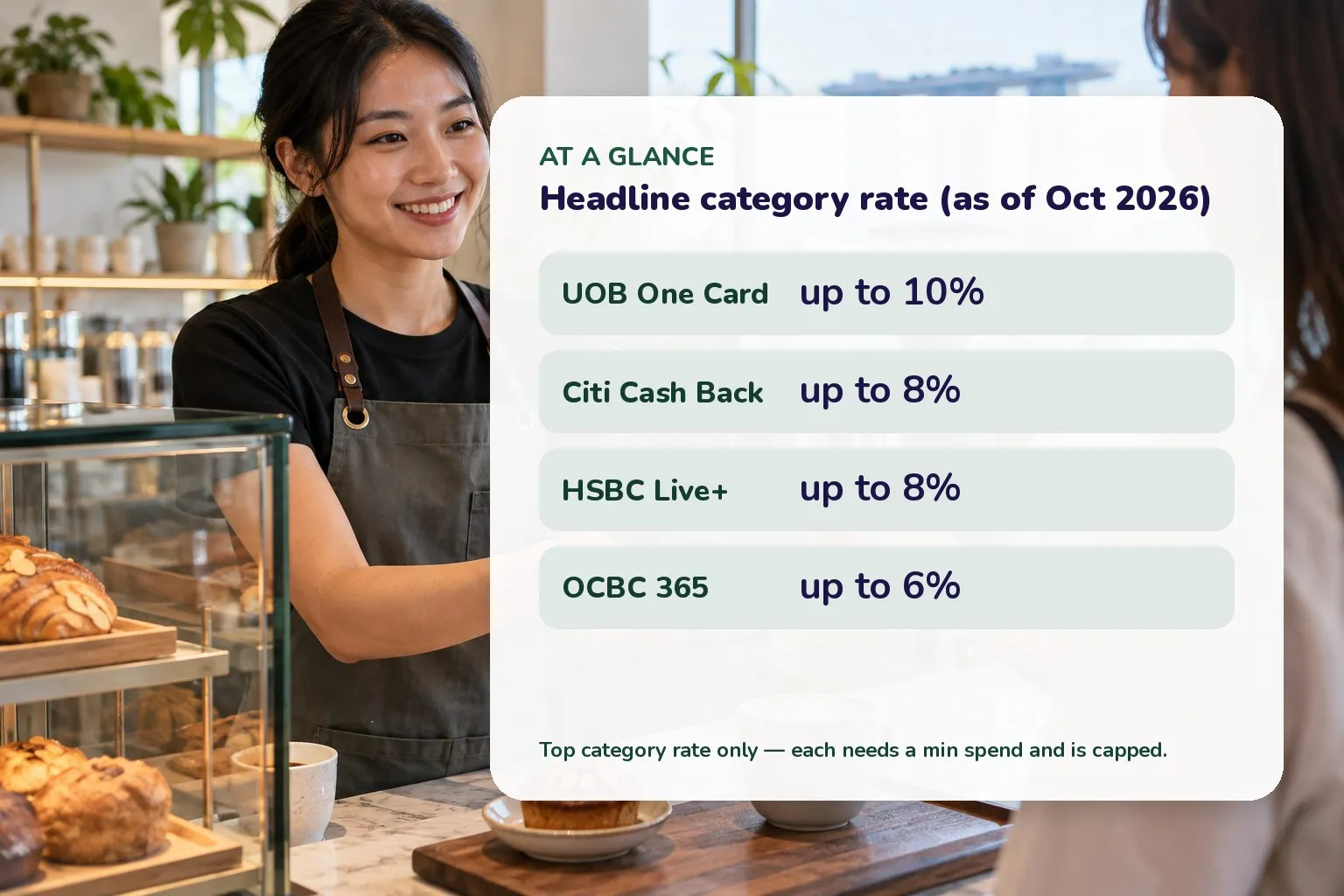
Each card’s top advertised category rate. All require a minimum spend and are capped — see the table above. Source: each bank’s official pages, as of Oct 2026.
Rates and caps are each from the card issuer’s own page, as of October 2026. OCBC’s figures are the refreshed structure the bank has confirmed takes effect 1 November 2026 (previously 5% dining, 3% groceries/transport, with an S$80 cap at the S$800 tier).
Reading past the headline rate
The advertised percentage is the ceiling on a narrow slice of spending, not an average across your whole bill.
HSBC Live+ shows another catch: its 8% is 5% base plus a 3% boost that applies only for the first two calendar quarters, after which the everyday rate is 5% on its lifestyle categories. Read whether a headline rate is permanent or promotional.
What to check before you pick one
Work through these:
- Where do you actually spend? Add up a typical month by category. A driver who spends on petrol and private hire wants a different card from someone whose spend is dining and online shopping.
- Can you clear the minimum every month? If you can’t reliably hit the threshold, you’ll keep dropping to the 0.2-0.3% base rate and the card is pointless.
- Does your spend fill — but not overflow — the cap? The sweet spot is spending that reaches the cap without wasting high-rate spending above it.
- Will you pay in full? Cashback is wiped out many times over by interest if you revolve a balance. MoneySense explains how credit card interest and charges work; the effective rate is commonly around 26-28% a year.
Related
- High-interest savings accounts compared
- Where to park your emergency fund
- Is your money protected? SDIC explained
General information on cashback cards, not financial advice. Categories, caps and minimum spends change often; confirm the current terms on each bank’s official page before you apply.
Sources
- Citi Cash Back Card (cashback rates, minimum spend and cap) — Citibank Singapore (as of October 2026)
- OCBC 365 Credit Card (cashback structure from 1 November 2026) — OCBC Bank (as of October 2026)
- UOB One Card (quarterly cashback tiers) — United Overseas Bank (as of October 2026)
- HSBC Live+ Credit Card (cashback rates, minimum spend and cap) — HSBC Singapore (as of October 2026)
- Understanding credit card interest and charges — MoneySense (MAS) (as of October 2026)