Where to Park Your Emergency Fund

For an emergency fund, liquidity and capital safety matter more than yield. A savings account gives instant access; Singapore Savings Bonds redeem any month without penalty; T-bills lock money until maturity. Spread it across tiers so you always have cash on hand.
On this page3 sections · tap to jump
An emergency fund exists to cover sudden costs — a job gap, a medical bill, an urgent repair. Its first job is to be there when you need it, in full. That means the right place for it is chosen on access and capital safety first, and yield second.
The three things to weigh
- Liquidity — how fast can you turn it back into spendable cash?
- Capital safety — will you definitely get your principal back?
- Yield — what does it earn while it waits?
How common options compare
| Option | Access | Capital safety | Notes |
|---|---|---|---|
| High-interest savings account | Same day | SDIC up to S$100,000 | Base rates are low; bonus rates need conditions |
| Singapore Savings Bonds (SSB) | Redeem any month | Government-backed | Principal returned by 2nd business day of next month |
| 6-month T-bill | At maturity (or sell on secondary market) | Government-backed | Recent cut-off above savings base rates (see latest above); locks the money |
| Fixed deposit | At maturity | SDIC up to S$100,000 | Breaking early usually forfeits interest |
| Money-market / cash fund | Usually 1–3 business days | Not capital guaranteed | Value can move; not a deposit |
A tiered buffer
A practical structure is to layer the fund:
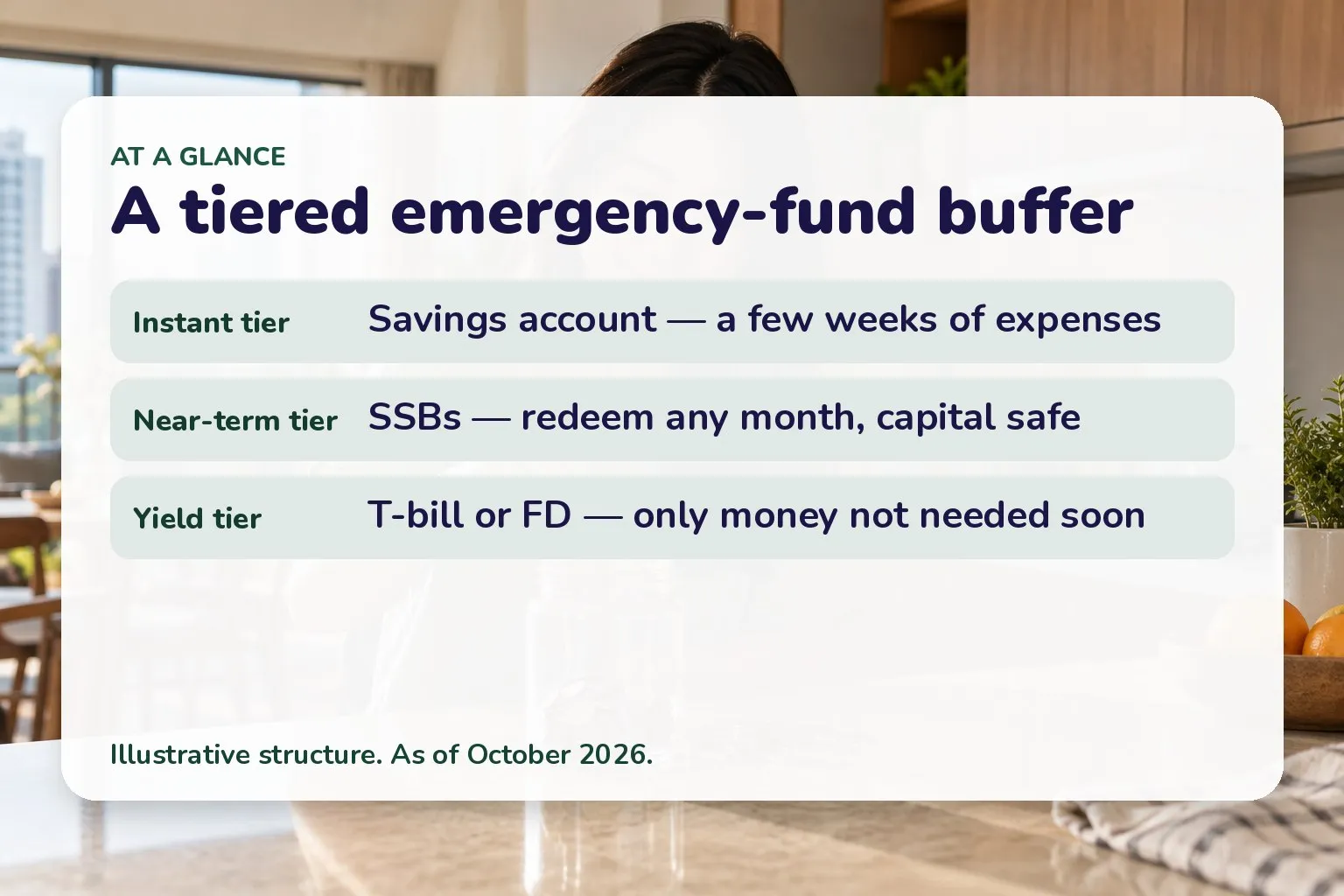
Layer by how quickly you may need the money. Source: MAS, SDIC.
- Instant tier — a few weeks of expenses in a savings account you can tap today.
- Near-term tier — the bulk in something capital-safe but still quick to access, such as SSBs you can redeem any month.
- Optional yield tier — only money you are confident you won’t need soon can go into a T-bill or fixed deposit, where it is locked until maturity.
This keeps cash on hand for a true emergency while the rest still earns something. To size the yield tier, try the savings account APY calculator or compare FD, T-bill and SSB returns. For the trade-off between locking and liquidity, see T-bill vs fixed deposit and Singapore Savings Bonds explained.
Related
General information to help you compare options, not financial advice. Rates and terms change; confirm current figures with the providers and official sources.
Sources
- Singapore Savings Bonds (features and redemption) — Monetary Authority of Singapore (as of October 2026)
- Treasury Bills auction results (listbondsandbills API) — Monetary Authority of Singapore (as of 22 October 2026)
- Deposit Insurance Scheme (coverage) — Singapore Deposit Insurance Corporation (as of October 2026)