Singapore Savings Bonds (SSB) Explained

A Singapore Savings Bond (SSB) is a Government-backed bond for individuals with a term of up to 10 years. Interest 'steps up' each year, you can redeem in any month with no penalty, and your capital is always returned in full. The current Nov 2026 issue pays 1.67% in year 1, rising to a 2.45% average if held for 10 years.
A Singapore Savings Bond (SSB) is a bond issued by the Singapore Government specifically for individual savers. It runs for up to 10 years, but you are never locked in: you can redeem it in any month, with no penalty, and always get your capital back in full. It is one of the lowest-risk ways to hold Singapore-dollar savings.
How the step-up interest works
SSB interest “steps up” — it starts low and rises the longer you hold. Each issue’s rates are based on the average Singapore Government Securities (SGS) yields of the month before, so they change from issue to issue.
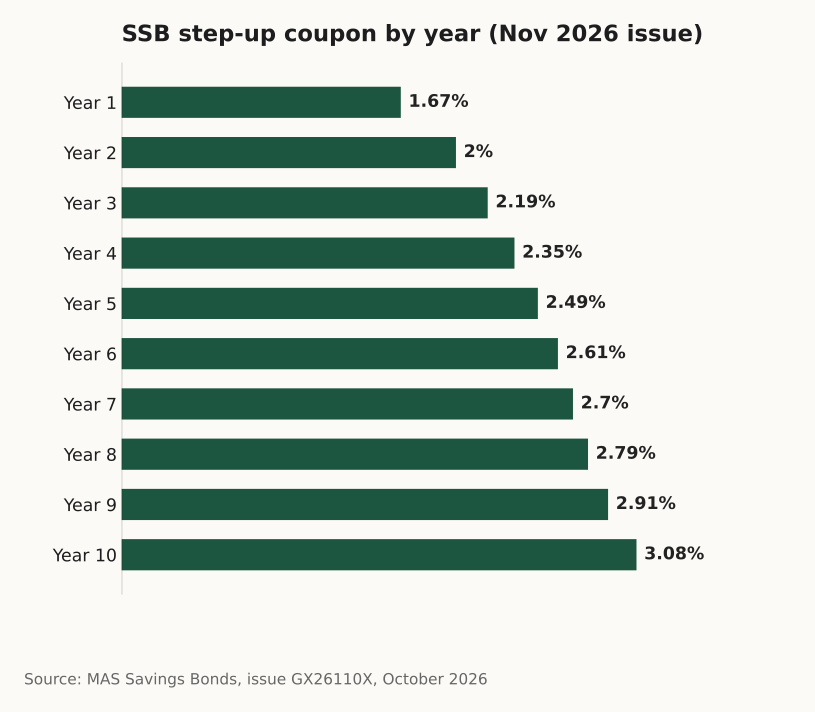
The coupon rises each year, from 1.67% in year 1 to 3.08% in year 10. Source: MAS.
For the current issue (November 2026, applications close 27 October 2026), the coupon rises from 1.67% in year 1 to 3.08% in year 10. Because the early years pay less, the average return depends on how long you hold:
| If you hold for | Average return per year |
|---|---|
| 1 year | 1.67% |
| 5 years | 2.13% |
| 10 years | 2.45% |
Interest is paid every 6 months and the rates are locked in for your bond when you buy it, regardless of what later issues pay.
The rules that matter
- Minimum S$500, in multiples of S$500.
- Maximum S$200,000 per person, across every SSB you hold.
- Only individuals aged 18 and above can hold SSBs.
- A new issue every month, so you can buy in whenever you like.
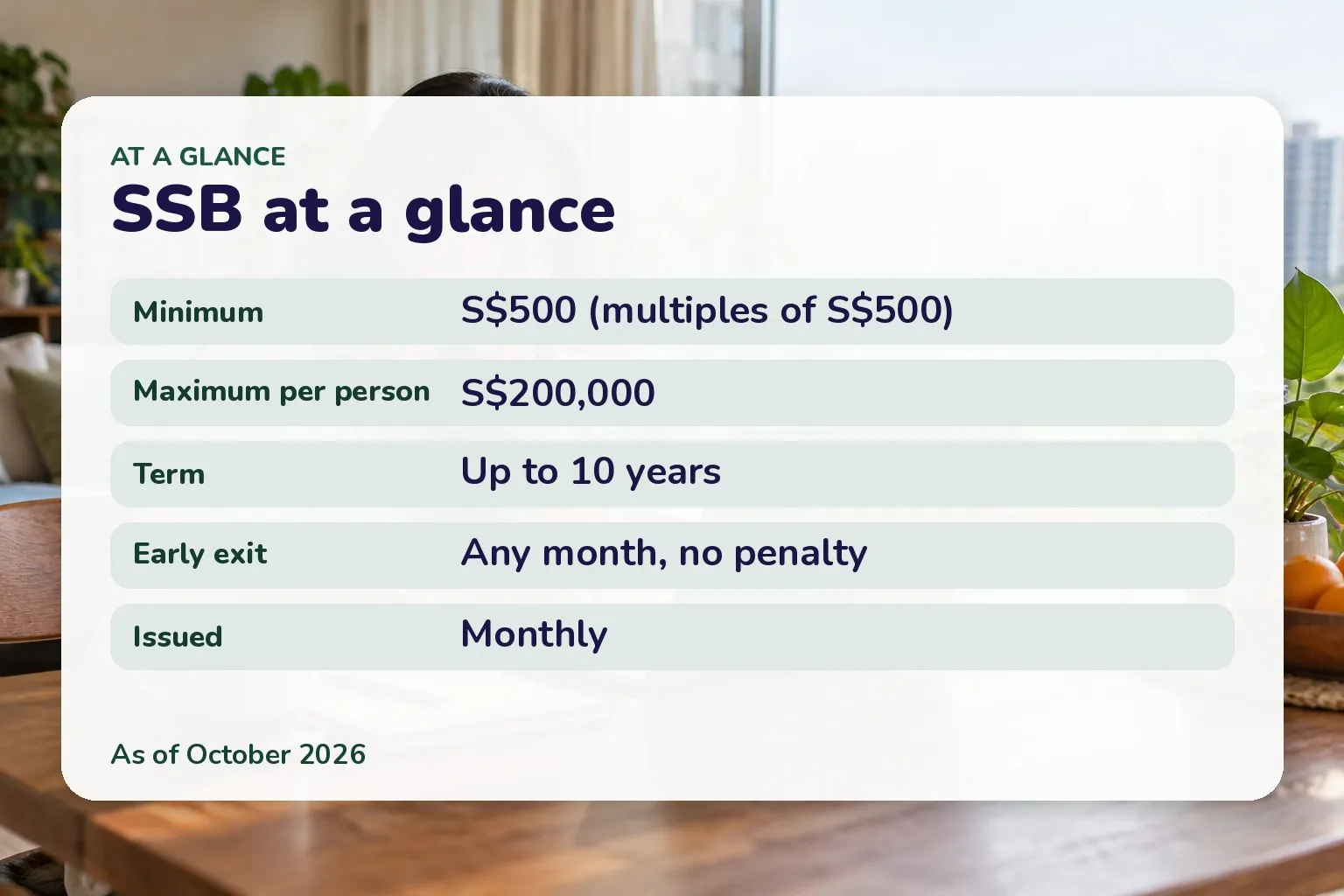
Key SSB parameters. Source: MAS.
Redeeming early
This is the feature that sets SSBs apart from a fixed deposit or a T-bill. You can ask to redeem any bond in any month with no penalty — you receive your principal plus any accrued interest by the second business day of the following month. There is a small transaction fee (about S$2) charged by the bank per request.
Because you can always exit at par, an SSB behaves like flexible, capital-safe savings that pays more the longer you leave it.
How it compares
SSBs trade yield for flexibility. A 6-month T-bill recently cut off at a higher 1.95% (22 October 2026), but it locks your money until maturity. An SSB pays less upfront but lets you exit any month. See T-bill vs fixed deposit and where to park your emergency fund for how they fit together.
Next steps
General information on how SSBs work, not financial advice. Rates are for the stated issue and change monthly; check the latest issue on the MAS website before you apply.
Sources
- Singapore Savings Bonds (overview) — Monetary Authority of Singapore (as of October 2026)
- Savings Bonds interest rates (savingbondsinterest API) — issue GX26110X — Monetary Authority of Singapore (as of October 2026)
- Savings Bonds FAQs (application and redemption) — Monetary Authority of Singapore (as of October 2026)