How to Buy Singapore T-Bills: Step by Step
You buy Singapore T-bills by placing a bid at an auction through a bank. Apply with cash (DBS/OCBC/UOB ATM or internet banking), CPF funds (through your bank's CPFIS channel) or SRS. Bank channels usually close 1–2 business days before the auction, so apply early. T-bills pay no coupon; you buy at a discount and are repaid face value at maturity.
Singapore Treasury bills (T-bills) are short-term debt issued by the Government through the Monetary Authority of Singapore (MAS). They come in 6-month and 1-year tenors and are sold at auction. You do not buy them from MAS directly — you apply through a bank, and the price you pay is decided by the auction.
The short version
- Decide the funding source — cash, CPF Ordinary/Special Account, or SRS. Each uses a different channel.
- Place your bid before the cut-off — bank channels usually close 1–2 business days before the auction.
- Wait for allotment — if successful, the T-bill is issued a few days later; at maturity you are repaid the full face value.
How T-bills actually pay you
T-bills are non-coupon (zero-coupon) securities. Prices are quoted per S$100 of face value, and the minimum application is S$1,000 (in multiples of S$1,000). You pay below face value and receive the full face value at maturity; the gap is your return. For example, at the 22 October 2026 cut-off price of S$99.028 per S$100, a S$10,000 application cost about S$9,902.80 and repays S$10,000 after six months.
The headline number is the cut-off yield — the highest accepted yield at the auction, which every successful allotment receives. At the most recent 6-month auction (22 October 2026), the cut-off yield was 1.95% p.a. (median 1.90%, average 1.83%).
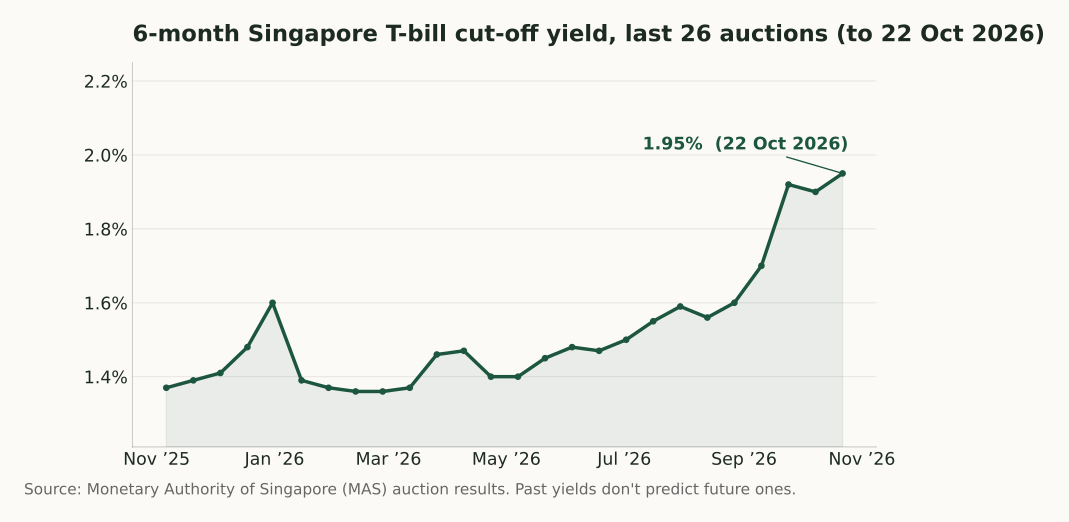
Cut-off yields move with each auction. Source: MAS.
Choosing how to apply
| Funding source | Where to apply | Key point |
|---|---|---|
| Cash | DBS/POSB, OCBC or UOB ATM, or internet banking | Simplest; at maturity the face value is credited to the bank account linked to your CDP Direct Crediting Service |
| CPF Ordinary Account (CPF-OA) | Your CPF Investment Scheme (CPFIS-OA) agent bank — DBS, OCBC or UOB | Only OA savings above S$20,000 can be invested; you need a CPFIS Investment Account and, as a new investor, must complete CPF’s Self-Awareness Questionnaire. Weigh the yield against the 2.5% OA interest you give up |
| CPF Special Account (CPF-SA) | A CPFIS bond dealer (DBS/POSB, OCBC or UOB), using that bank’s supported channel | Only SA savings above S$40,000; the SA is closed for members aged 55 and above. CPF-SA earns 4.0% (Oct–Dec 2026), a higher hurdle to beat |
| SRS | Your SRS operator bank | Keeps funds inside the SRS tax wrapper |
If you are weighing CPF-OA funds, see our guide to using CPF-OA to buy T-bills for the break-even maths.
Competitive vs non-competitive bids
- Non-competitive bid: you state only the amount, not a yield. You are allotted first, up to 40% of the issue; if non-competitive applications exceed that, allotments are pro-rated, so you may get less than you applied for. Whatever is allotted earns the cut-off yield. Best for most individuals.
- Competitive bid: you specify the minimum yield you are willing to accept. Bids are filled from the lowest yield upwards until the issue is exhausted, so a bid above the cut-off yield gets nothing, a bid below it is allotted in full, and a bid exactly at the cut-off may be only partly allotted. All successful bidders pay the same cut-off price.
The timing that trips people up
Applications through bank ATMs and internet banking close 1 to 2 business days before the auction date — not on the auction day. The exact cut-off time varies by bank and by channel (and some CPF channels close earlier), so always check with your own bank. Miss it and you wait for the next auction (6-month T-bills are auctioned roughly every two weeks).
Where to go next
- Compare returns and liquidity in T-bill vs fixed deposit.
- See how we source and date every figure on our methodology page.
This is general information on how the T-bill auction process works, not financial advice. Yields change at every auction; always check the latest figures on the MAS website before applying.
Sources
- Auction: T-bill — how to apply — Monetary Authority of Singapore (as of October 2026)
- Treasury Bills auction results (listbondsandbills API) — Monetary Authority of Singapore (as of 22 October 2026)
- CPF interest rates (earning attractive interest) — Central Provident Fund Board (as of October 2026)