T-Bill vs Fixed Deposit: Which Pays More?

Over 6–12 months, T-bills and fixed deposits (FDs) can pay in a similar range, and which pays more changes over time. T-bills are Government-backed and priced at auction (latest 6-month cut-off: 1.95% p.a. on 22 Oct 2026); FDs fix a rate upfront, and eligible S$ FDs are SDIC-insured up to S$100,000 per depositor. Compare both for the same tenor.
Both T-bills and fixed deposits are places to park cash safely for 6–12 months. The honest answer to “which pays more?” is: it depends on the week you buy, because T-bill yields move at every auction while FD promos change bank by bank. Here is how to compare them properly.
Side by side
| Feature | T-bill | Fixed deposit |
|---|---|---|
| Who issues it | Singapore Government (via MAS) | A bank |
| How the rate is set | Auction, by demand (cut-off yield) | Fixed by the bank when you deposit |
| Latest benchmark | 1.95% p.a. (6-month, 22 Oct 2026) | Varies by bank and promo |
| Safety | Government-backed | Eligible S$ deposits SDIC-insured to S$100,000 per depositor per Scheme member |
| Tenors | 6 months, 1 year | A range of tenors, varies by bank |
| Early exit | Sell in secondary market (price not fixed) | Depends on the bank’s terms; often reduced or no interest |
| Minimum | S$1,000 | Set by each bank; varies |
| Can use CPF/SRS? | Cash, SRS, CPFIS-OA and, for eligible members under 55, CPFIS-SA (CPF investment limits apply) | CPFIS: very limited — check CPF’s list of participating FD banks. SRS: depends on your SRS operator |

Both are low-risk; the real differences are how the rate is set and how easily you can get your money back.
How to read the rates fairly
A T-bill cut-off yield is already an annualised figure, so compare it directly to an FD’s per-annum rate for a similar tenor. Watch three things with FDs:
- Minimum sum and fresh-funds rules — the headline promo rate often needs a large minimum or money not already with the bank.
- Tenor — a 1.95% 6-month figure is not comparable to a 12-month FD rate; match the holding period.
- How the return is paid — a T-bill is a zero-coupon security (you buy at a discount and are repaid face value), while a short FD typically pays its interest at maturity; over 6–12 months neither gives much compounding advantage.
Because bank promotions change often and differ per bank, always check the current best FD rate for your tenor and minimum, then set it against the latest T-bill cut-off.
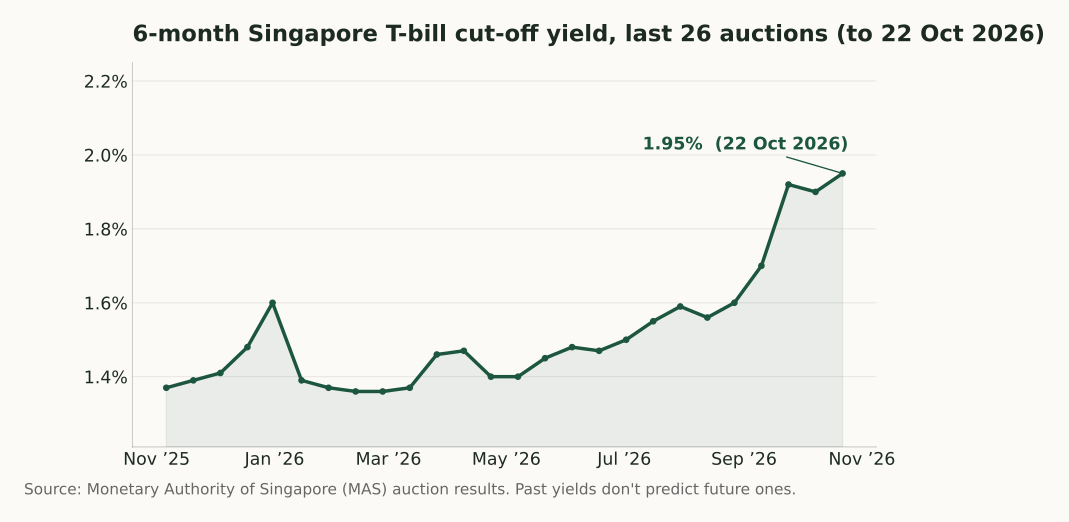
T-bill yields change every auction, so compare against an FD rate quoted the same week. Source: MAS.
Liquidity: the real deciding factor
If you might need the money early, the difference matters more than a few basis points:
- T-bill: you can sell it before maturity on the secondary market through a bank, but the price depends on prevailing rates — you could get back more or less than you paid.
- FD: premature withdrawal rules depend on the bank; you typically receive reduced or no interest, and some banks charge fees.
The CPF-OA twist
If you are funding with CPF-OA, the comparison is not against the FD rate but against the 2.5% CPF-OA interest you give up (Oct–Dec 2026). The T-bill yield must beat 2.5% and cover the way CPF stops paying interest from the month the funds are withdrawn and resumes only after they are refunded — so a 6-month T-bill often costs seven or more months of CPF interest. That puts the rough break-even at about 3.0–3.3% p.a. before bank charges, depending on timing. Work through this in our CPF-OA T-bill guide.
Bottom line
For cash you will not touch for the full term, pick whichever is paying more right now for your tenor. For money you might need early, an FD’s contractual early-withdrawal terms may be easier to assess than a T-bill’s uncertain secondary-market sale price — but check the bank’s terms first. New to T-bills? Start with how to buy Singapore T-bills.
General information on product mechanics, not financial advice. Rates shown are as of the dates stated and change frequently.
Sources
- Treasury Bills auction results (listbondsandbills API) — Monetary Authority of Singapore (as of 22 October 2026)
- SGS and T-bills — about Treasury bills — Monetary Authority of Singapore (as of October 2026)
- Deposit Insurance Scheme coverage — Singapore Deposit Insurance Corporation (as of October 2026)
- CPF interest rates (earning attractive interest) — Central Provident Fund Board (as of October 2026)