Using CPF-OA to Buy T-Bills

Buying T-bills with CPF-OA only makes sense if the T-bill yield beats the 2.5% p.a. your CPF-OA already earns — and by enough to cover the interest CPF stops paying while the money is out. CPF-OA interest is not earned for the deduction month and resumes only after maturity, so a 6-month T-bill ties up about 7–8 months of CPF interest.
Using CPF Ordinary Account (CPF-OA) money to buy T-bills can work, but the hurdle is higher than it looks. Your CPF-OA already earns a guaranteed 2.5% per annum (Oct–Dec 2026, the legislated floor). A T-bill only adds value if it beats that — after accounting for the interest CPF stops paying while your money is out.
The break-even, properly counted
A simple “T-bill yield vs 2.5%” check understates the cost, because of the timing of withdrawals and refunds:
- CPF computes interest monthly and credits it yearly; money that has left your account does not earn CPF interest.
- The month you deduct funds to buy the T-bill, that money earns no CPF interest.
- At maturity the proceeds go to your CPF Investment Account, not straight back to your OA. Interest only resumes once the money is back in your CPF-OA: you can ask your agent bank to return it, otherwise CPF returns an unused Investment Account balance automatically only at the end of the second month.
So a 6-month T-bill does not cost you just “6 months of CPF interest” — once you count the deduction month and the refund lag it is closer to seven to eight months of foregone 2.5% interest.
A worked illustration
This example is illustrative, using round numbers:
| Item | Value |
|---|---|
| T-bill face value | S$10,000 |
| Amount deducted from CPF-OA (at cut-off price) | ~S$9,903 |
| T-bill tenor | 6 months |
| T-bill cut-off yield (illustrative) | 1.95% p.a. |
| T-bill interest earned (~6 months) | ~S$97 |
| CPF-OA interest foregone on ~S$9,903 (~8 months at 2.5%) | ~S$165 |
| Net effect vs leaving it in CPF-OA (before bank charges) | about −S$68 |
At a 1.95% cut-off, the T-bill earns less than the CPF-OA interest it displaces, so the CPF-OA route loses money in this illustration. The break-even yield for a 6-month T-bill funded by CPF-OA works out to roughly 3.0–3.3% p.a. before bank charges, assuming you move the proceeds back to your OA promptly once the extra lost-interest months are included (the exact figure depends on refund timing) — well above recent cut-offs.
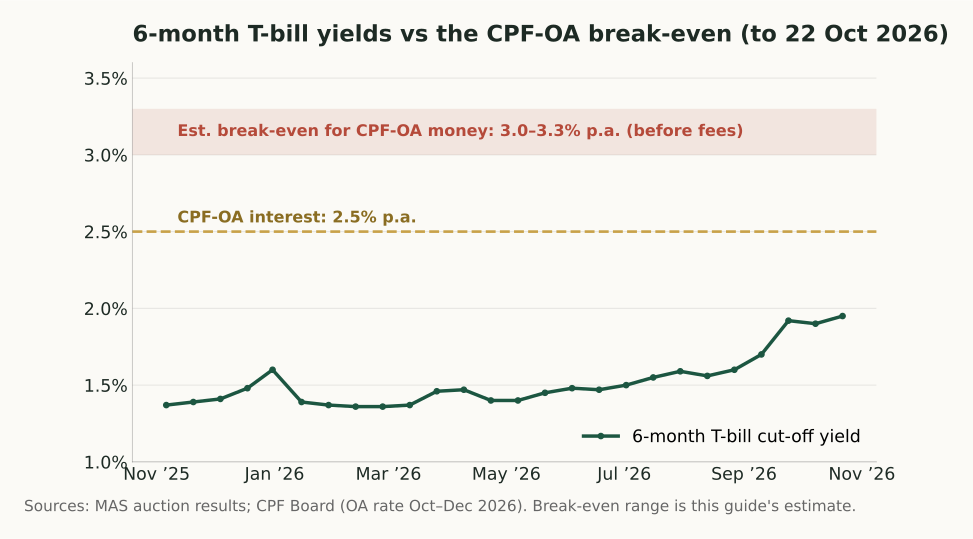
Recent cut-offs have stayed below even the 2.5% OA rate, let alone the break-even. Sources: MAS, CPF Board.
Before you consider it
- Only CPF-OA savings above the first S$20,000 may be invested under the CPF Investment Scheme (CPFIS-OA).
- You need a CPFIS Investment Account with an agent bank (DBS, OCBC or UOB) opened before you can bid.
- Agent banks may charge transaction and quarterly service fees, which further raise the break-even.
Bottom line
With CPF-OA at its 2.5% floor and recent 6-month cut-off yields near 1.95%, the CPF-OA route usually does not clear its break-even. Cash or SRS funding faces no such 2.5% hurdle. Always check the latest auction yield and run your own numbers.
New to the process? See how to buy Singapore T-bills and T-bill vs fixed deposit.
General information on how CPF and T-bill mechanics interact, not financial advice. Figures are illustrative and as of the dates stated.
Sources
- CPF interest rates (earning attractive interest) — Central Provident Fund Board (as of October 2026)
- Treasury Bills auction results (listbondsandbills API) — Monetary Authority of Singapore (as of 22 October 2026)
- Auction: T-bill — applying with CPFIS/SRS — Monetary Authority of Singapore (as of October 2026)
- Investing your CPF savings (CPFIS) — Central Provident Fund Board (as of October 2026)