Building an SSB Ladder

An SSB ladder means spreading money across several monthly Singapore Savings Bond issues instead of one big lot. Because SSBs redeem any month without penalty, a ladder is about averaging into different rate environments and managing the S$200,000 cap. The Nov 2026 issue pays 1.67% in year 1, rising to a 2.45% average over 10 years.
A “ladder” usually means buying bonds with staggered maturities so some matures each year. With Singapore Savings Bonds (SSBs) the idea is a little different, because an SSB is already flexible — you can redeem any issue in any month without penalty. So an SSB ladder is really about spreading your entry over time rather than unlocking money. If SSBs are new to you, read Singapore Savings Bonds explained first.
Why spread entries at all?
Each SSB issue’s rates are set from the previous month’s average SGS yields and are fixed for that bond when you buy it. Rates move month to month. If you put a lump sum into a single issue, you are tied to that one month’s rates. Buying smaller amounts across several monthly issues averages the rates you lock in — useful when you can’t tell whether rates are about to rise or fall.
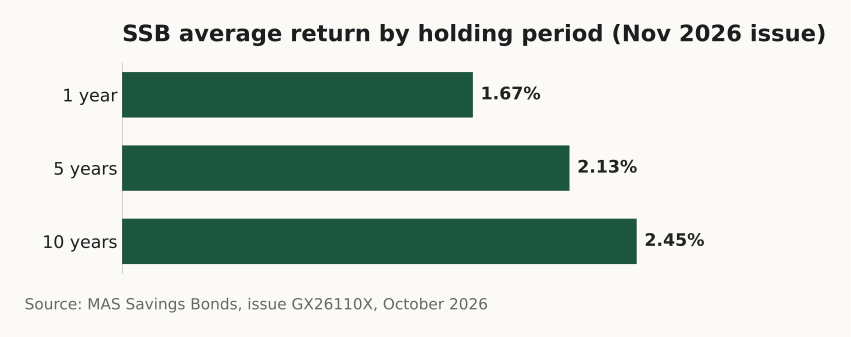
An issue’s average return rises the longer you hold. Source: MAS.
A simple way to ladder
This example is illustrative:
| Month | Amount | Locked year-1 rate |
|---|---|---|
| Buy into issue 1 | S$10,000 | the issue’s rate |
| Buy into issue 2 | S$10,000 | next issue’s rate |
| Buy into issue 3 | S$10,000 | following issue’s rate |
After three months you hold S$30,000 blended across three issues. Because any issue can be redeemed in any month, you keep full flexibility while smoothing out rate timing. The November 2026 issue, for reference, pays 1.67% in year 1 and averages 2.45% over 10 years.
Keep the cap in view
The S$200,000 per-person limit applies across every SSB you hold. Decide your target total first, then ladder up to it. When you redeem a bond, that headroom frees up again.
Pairing with T-bills
SSBs are flexible but start at modest rates. If you have cash you are comfortable locking for six months, a T-bill can sit alongside the ladder — the 6-month T-bill cut off at 1.95% on 22 October 2026, above the current SSB year-1 rate, but it ties the money up until maturity. See T-bill vs fixed deposit and where to park your emergency fund.
Related
General information, not financial advice. Rates are for the stated issue/auction and change over time; check the latest figures on the MAS website.
Sources
- Singapore Savings Bonds (overview and features) — Monetary Authority of Singapore (as of October 2026)
- Savings Bonds interest rates (savingbondsinterest API) — issue GX26110X — Monetary Authority of Singapore (as of October 2026)
- Treasury Bills auction results (listbondsandbills API) — Monetary Authority of Singapore (as of 22 October 2026)