High-Interest Savings Accounts in Singapore Compared

Singapore's high-interest savings accounts pay a tiny base rate plus bonus interest only when you credit your salary, spend and save each month. The advertised 'up to' rate assumes you hit every bonus category, so the everyday rate is usually far lower.
On this page4 sections · tap to jump
A “high-interest” savings account in Singapore pays almost nothing on its own — the headline rate only appears when you route your salary, spending and saving through the bank each month. The big banks market “up to” figures of 4% or more, but those assume you tick every bonus box, including some you may never use. Here is how the main accounts actually work, as of October 2026.
How these accounts actually work
Every account here pays two layers of interest:
- A base rate of about 0.05% p.a. on your whole balance — what you earn if you qualify for nothing.
- Bonus interest stacked on top when you meet monthly conditions, usually some mix of crediting your salary, spending on the bank’s card, growing your balance, and (for the highest tiers) buying the bank’s insurance or investment products.
Two features matter as much as the rate. First, the bonus applies only up to a balance cap — commonly the first S$100,000. Second, the bonus is assessed every month: skip a condition and you drop back towards the base rate for that month.
The accounts, side by side
| Account | Max advertised rate | Bonus cap | Main conditions for the top rate |
|---|---|---|---|
| Standard Chartered Bonus$aver | Up to 5.85% p.a. (from 1 May 2026) | First S$100,000 | Salary ≥ S$3,000, card spend ≥ S$1,000, invest ≥ S$30,000 and insure (≥ S$24,000 annual premium) |
| OCBC 360 | Up to 4.45% p.a. (from 1 May 2026) | First S$100,000 | Salary, save and spend, plus insure and invest |
| DBS Multiplier | Up to 4.10% p.a. | First S$100,000 | Credit income and transact across up to three categories (card/PayLah!, home loan, insurance, investments); higher monthly transaction totals lift the tier |
| UOB One | 1.90% p.a. blended EIR (top slice 3.40%) | First S$150,000 | Spend ≥ S$500 on a UOB card and credit ≥ S$1,600 salary via GIRO/PayNow |
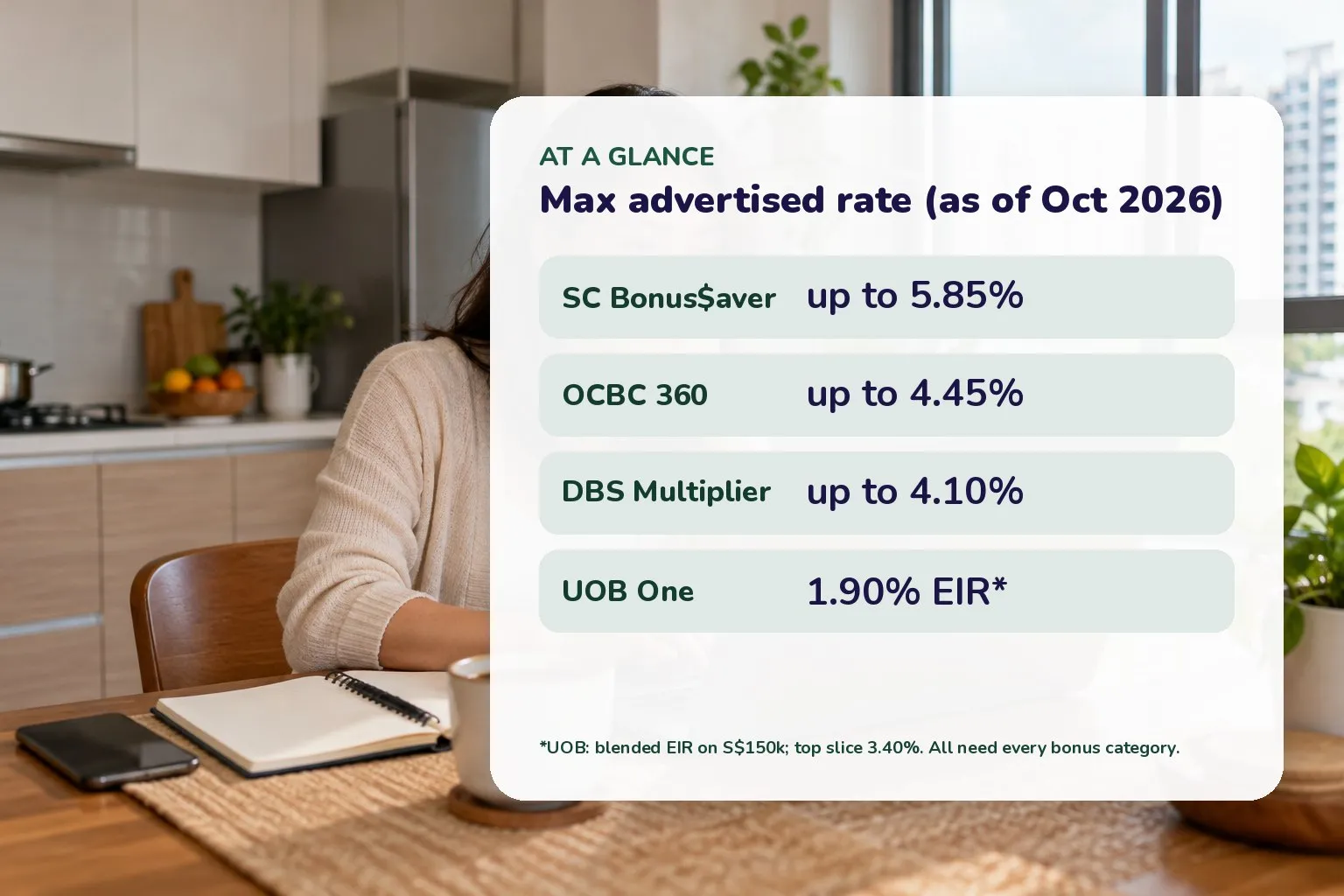
Maximum advertised rates on the first S$100,000 (UOB: S$150,000). Source: each bank’s official pages, as of Oct 2026.
All four pay roughly 0.05% p.a. on balances when you do not qualify. Standard Chartered Bonus$aver is technically a current account paired with a card rather than a pure savings account.
Why the “up to” rate is rarely what you earn
The advertised maximum is the sum of every bonus slice, and the largest slices are usually the ones tied to buying investment or insurance products.
UOB One shows the same gap in a different way. Its marketing mentions 3.40% p.a., but that rate applies only to the slice of your balance between S$125,000 and S$150,000, and only on the salary path. Spread across the whole S$150,000, the blended effective rate is about 1.90% p.a. — and if you only spend on the card without crediting salary, you earn about 0.65% p.a. on the first S$75,000.
What to check before you switch
Work through these before moving money:
- Which conditions do you already meet? Salary credit and a card you’d use anyway are “free”; insurance and investment purchases are not — count only the bonus you’ll genuinely earn. The effective APY calculator blends a base rate and a capped bonus into one honest figure.
- Where does the cap sit? Above the bonus cap (S$100,000 for most, S$150,000 for UOB One), extra cash earns the base rate — at which point a Singapore Savings Bond or T-bill may pay more.
- Fees and minimums. Some accounts have a fall-below fee; DBS Multiplier has no minimum balance or fall-below fee. Check the current terms.
Whichever you choose, your deposits are insured up to S$100,000 per depositor per bank under the SDIC scheme — see how SDIC deposit insurance works. That cap is another reason not to pile everything into one account.
Related
- Savings account effective APY calculator
- Where to park your emergency fund
- Is your money protected? SDIC explained
General information on savings accounts, not financial advice. Rates, caps and conditions change often; confirm the current figures on each bank’s official page before you act.
Sources
- DBS Multiplier Account (bonus interest and tiers) — DBS Bank (as of October 2026)
- OCBC 360 Account (bonus interest categories, rates from 1 May 2026) — OCBC Bank (as of October 2026)
- UOB One Account (tiered rates, revision effective 1 December 2025) — United Overseas Bank (as of October 2026)
- Standard Chartered Bonus$aver (rates from 1 May 2026) — Standard Chartered Bank (Singapore) (as of October 2026)
- Domestic Interest Rates (deposit rate context) — Monetary Authority of Singapore (as of October 2026)