What Is SORA and Why It Matters

SORA (Singapore Overnight Rate Average) is the volume-weighted average rate of unsecured overnight interbank borrowing, published by MAS each morning. It replaced SIBOR and SOR as the benchmark for Singapore-dollar loans, and home loans are priced on its 1, 3 or 6-month compounded average.
If you have a floating-rate home loan in Singapore, or you are shopping for one, you keep seeing the word SORA. It is the benchmark your interest rate is built on — and since the end of 2024 it is the only one left. This guide explains what SORA is, why loans use a compounded version of it, what it replaced, and how to read the official figures.
What SORA is
SORA stands for the Singapore Overnight Rate Average. It is the volume-weighted average rate of borrowing transactions in the unsecured overnight interbank Singapore-dollar cash market, between 8.00am and 6.15pm each business day. In plain terms: it is the average interest banks actually paid to borrow Singapore dollars from each other, overnight, that day.
Two features make it trustworthy as a benchmark. First, it is computed from real transactions, not estimates — so it cannot be nudged by what a bank says it would pay. Second, it has a long history: MAS has administered and published SORA since 1 July 2005, and it meets the international IOSCO standards for financial benchmarks. SORA for a given business day is published by 9am the next business day on the MAS website.
What SORA replaced
For decades, Singapore-dollar loans were priced on SIBOR (the Singapore Interbank Offered Rate) and SOR (the Swap Offer Rate). Both have now been retired:
- SOR was discontinued after 30 June 2023.
- SIBOR was discontinued after 31 December 2024.
The difference is in how they were built. SIBOR was based on daily estimates submitted by a panel of banks — what each thought it would have to pay to borrow — and might not be backed by actual trades. SOR was a synthetic rate: the effective cost of borrowing Singapore dollars by borrowing US dollars and converting them in the FX market, which made it sensitive to currency swings. SORA, by contrast, reflects only real, completed SGD transactions. The shift mirrors a worldwide move toward transaction-based benchmarks such as SOFR (US), SONIA (UK) and TONA (Japan).
Overnight vs compounded SORA
Here is the part that confuses people. The daily SORA is an overnight rate, and overnight rates jump around — one quiet day, one tight day. Loans do not use that raw daily number directly. Instead, SORA loan packages are priced on the compounded average of daily SORA over the past one, three or six months.
Averaging over weeks smooths out the noise. MAS publishes these smoothed series — 1-month, 3-month and 6-month Compounded SORA — alongside the daily rate and a SORA Index every morning. The result is that “the interest rate applied to such loans tends to be less volatile” than the old single-day SIBOR or SOR fixings, which could lurch on quarter-end or year-end stress.
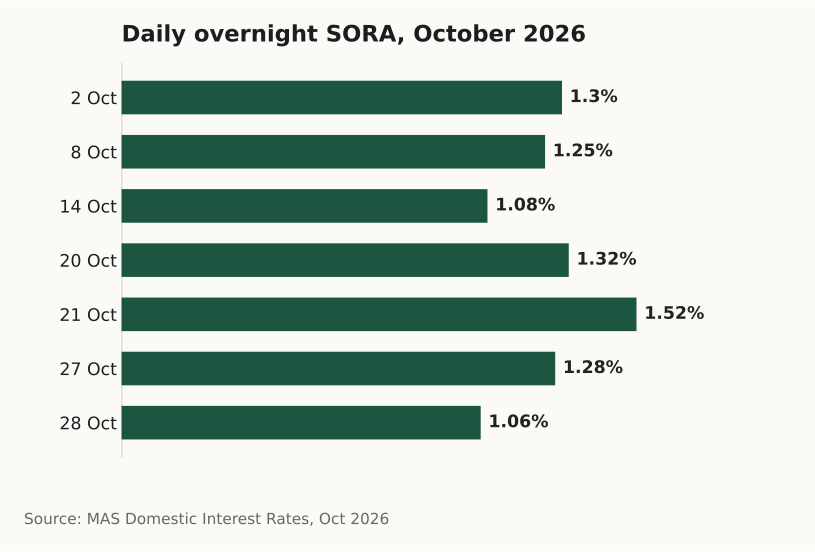
Daily overnight SORA swings day to day; the 3-month compounded average (see text) stayed near 1.25-1.27%. Source: MAS, October 2026.
The chart makes the point visually: over October 2026 the daily overnight SORA ranged from about 1.05% to 1.52%, while the 3-month compounded SORA barely moved, sitting around 1.25–1.27%. A loan priced on the compounded rate therefore changes gently, not day to day.
SORA today
As of the publication on 29 October 2026, the daily overnight SORA was 1.0571%, and the compounded rates were 1.3253% (1-month), 1.2683% (3-month) and 1.2159% (6-month). A few days earlier, on 21 October, the overnight figure had spiked to 1.5224% — the kind of one-day move that a compounded loan rate deliberately ignores.
What SORA means for borrowers
Your floating home-loan rate is almost always quoted as compounded SORA + a fixed bank spread — for example, “3-month compounded SORA + 0.8%”. The SORA part moves with the market; the spread is set by your package and usually holds for the loan (sometimes stepping up after the first few years). So:
- When you compare two SORA packages, the benchmark is the same for both — compare them on the spread and the lock-in terms, not on the SORA number, which neither bank controls.
- Because the compounded rate is backward-looking, you can roughly work out your next reset from recent published data before the bank’s letter arrives, rather than being blindsided by one volatile day.
- A 3-month package resets less often and reacts faster to rate moves than a 6-month one; a 6-month package is steadier but slower to fall when rates drop.
If you still have a SIBOR or SOR loan
If you were on SOR and never actively switched, your bank converted you to a SORA Conversion Package. The conversion was not a simple swap: SORA is typically lower than SOR because SOR carried term and credit risk that an overnight rate does not. To keep the economics fair, banks applied an Adjustment Spread (Retail) on top of your original loan margin.
That adjustment spread was computed as the average difference between SOR and 3-month compounded-in-advance SORA over the preceding three months, subject to a floor of zero. In practice it means your post-conversion rate is comparable to what you were paying, not a sudden drop or jump. If you are unsure which package or spread you ended up on, ask your bank for your current margin in writing.
What SORA means for savers
SORA is a borrowing benchmark, not a deposit rate, so banks are under no obligation to pass it through to savings and fixed-deposit rates. In practice deposit rates tend to drift in the same direction as SORA over time — when the benchmark is high, promotional deposit and T-bill yields are usually firmer too — but the link is loose and lagged. If you are comparing where to hold cash, look at the actual quoted deposit and T-bill rates rather than assuming they track SORA one-for-one.
Where to check SORA
The authoritative source is the MAS Domestic Interest Rates page, which publishes the daily SORA, the 1-, 3- and 6-month compounded rates, the SORA Index and transaction volumes every business morning by 9am. The methodology lives on the MAS SORA benchmark page. Note that the old industry SOR/SIBOR-to-SORA microsite has not been updated since 25 February 2025, so rely on the MAS page for live figures.
FAQ
Is SORA set by MAS? MAS administers and publishes it, but it is not set by decree — it is computed from the actual overnight transactions banks reported that day.
Why is my loan rate different from the SORA I see? Your rate is compounded SORA (a multi-month average, not the daily figure) plus your bank’s fixed spread.
Does a falling SORA cut my repayment immediately? No. It feeds in at your next reset through the compounded average, so changes arrive smoothed and with a lag of one to six months depending on your package.
Can I still get a SIBOR loan? No. SIBOR was discontinued after 31 December 2024 and SOR after 30 June 2023; new floating loans reference SORA.
Bottom line
SORA is Singapore’s transaction-based benchmark interest rate, published by MAS each morning. The raw daily figure is volatile by design, which is why loans use its smoother 1-, 3- or 6-month compounded average. For borrowers, the number that varies between banks is the spread, not SORA itself — so compare on that. For the current figures, check the MAS page; to see how short-term savings rates stack up, see T-bill vs fixed deposit.
General information on how SORA works, not financial advice. Rates shown are as of their stated publication date and change every business day.
Sources
- About SORA — Association of Banks in Singapore (as of 30 October 2026)
- Switching to SORA: What you need to know — MoneySense (MAS) (as of 30 October 2026)
- Domestic Interest Rates (daily SORA and compounded SORA) — Monetary Authority of Singapore (as of 30 October 2026)
- SORA Interest Rate Benchmark (methodology) — Monetary Authority of Singapore (as of 30 October 2026)