Cashback vs Miles: Which Credit Card Type?

Choose cashback if most of your spending is local and you want simple, guaranteed savings of about 1.5–6%. Choose miles only if you fly often — especially long-haul or premium — and will manage transfers, as a mile is worth roughly 1–2 cents. Both need paying in full.
Cashback and air-miles cards reward the same spending in two very different currencies. Cashback hands you a slice of each bill back as money, automatically. Miles are points you collect and later redeem for flights — worth a lot if you fly premium, very little if you don’t. The right type is not the one with the biggest headline number; it is the one whose rewards you will actually use. Here is a plain framework to decide, as of October 2026.
The quick decision
There is no universal winner — it depends on how you spend and whether you travel.
- Pick cashback if most of your spending is in Singapore, you want a simple, guaranteed return, and you would rather not track airline programmes. A good category card returns up to 6% on everyday spend, and a flat card gives around 1.5% on everything — as cash, with no redemption step.
- Pick miles if you fly often, especially long-haul or in premium cabins, and you are willing to manage transfers to an airline programme. Miles only beat cashback when you redeem them for high-value flights; for economy hops or cash-equivalent redemptions, they usually do not.
- Pick a flat-rate cashback card if your spending is scattered across categories a bonus card would not reward — you still earn on everything, with no categories to chase.
Who should not chase miles: anyone who flies rarely, redeems for economy or “pay with points” at poor value, or won’t track an airline programme. For them the certainty of cashback wins. See the specific picks in cashback cards compared and air-miles cards compared.
How the two reward types differ
The core difference is certainty of value. A dollar of cashback is always worth a dollar. A mile is worth whatever your redemption makes it — commonly estimated at roughly 1 to 2 Singapore cents, but that figure is entirely in your hands: redeem 60,000 miles for a long-haul business seat and each mile can be worth several cents; redeem the same miles for an economy ticket or merchandise and each is worth well under a cent.
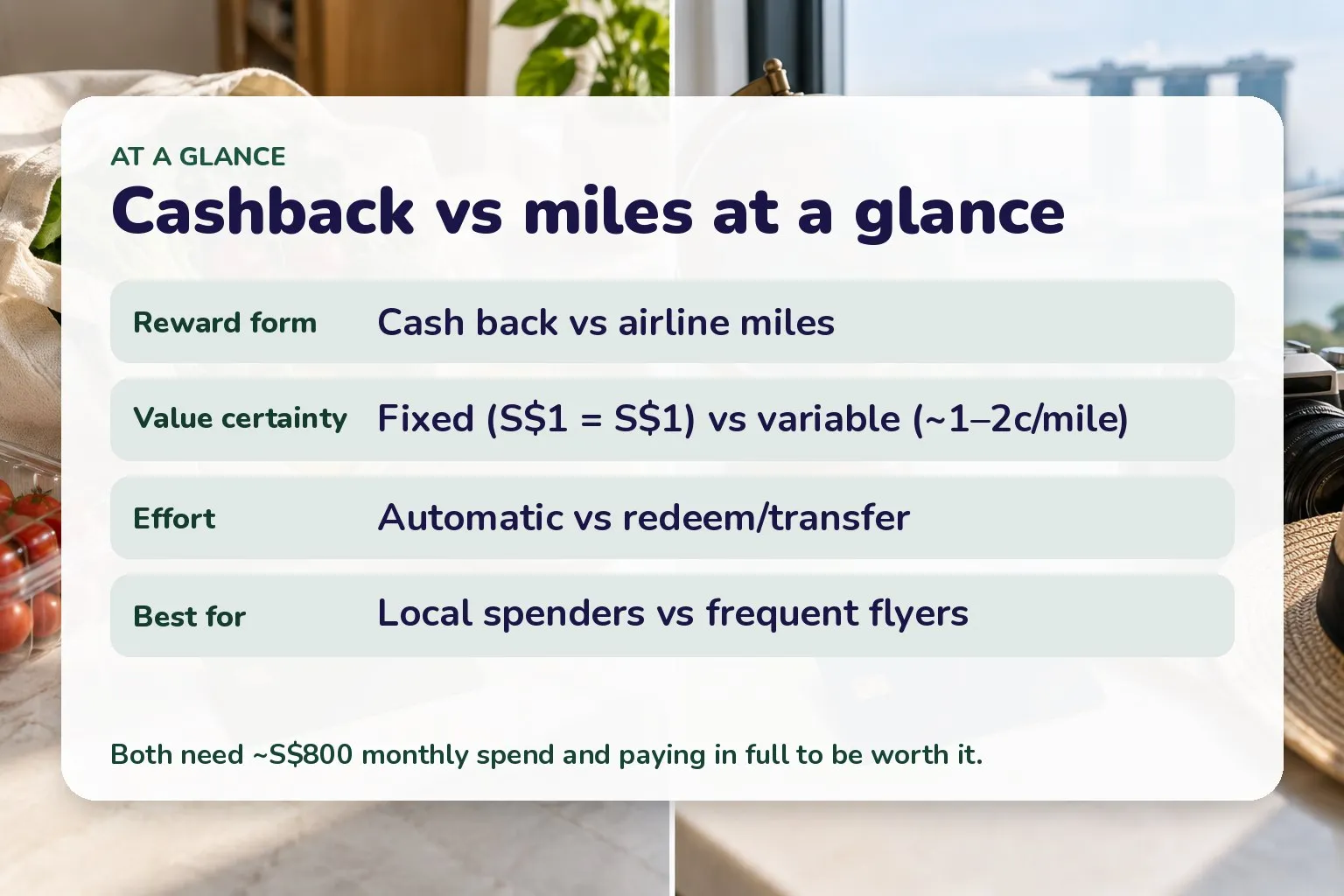
How the two reward types compare on value, effort and fit. Mile values are illustrative. Source: issuer pages and MoneySense, Oct 2026.
Two other differences matter. First, effort: cashback is credited to your statement with nothing to do; miles must be pooled, sometimes transferred to an airline, and spent before they expire. Second, where you earn: for most Singapore households the bulk of spending is local, so a card’s local earn rate usually matters more than the flashy overseas rate. A miles card that earns well abroad but poorly at home can be beaten by a cashback card on an ordinary monthly bill.
What cashback really pays
Cashback cards pay a high rate on named categories, up to a monthly cap, once you clear a minimum spend. As of October 2026:
- OCBC 365 (from 1 November 2026) pays 6% on dining, groceries, land transport and petrol, on a single S$800 minimum spend, capped at S$160 a month — up to about S$1,920 a year. Below S$800 of spend, everything earns just 0.25%.
- Citi Cash Back pays 8% on petrol and private commute and 6% on dining and groceries, also on a S$800 minimum, but capped at S$80 a month (about S$960 a year).
- A flat-rate card pays around 1.5% on everything with no categories, cap or minimum — less at the top, but it never misses.
The cap is the real ceiling: once you hit S$160 (OCBC) or S$80 (Citi) in a month, extra spending drops to the base rate. Cashback is predictable, which is its whole appeal.
What miles are worth
Miles cards quote earn rates in “miles per dollar” (mpd). The UOB PRVI Miles card, a typical general-spend option, earns 1.4 mpd locally and 2.4 mpd on general overseas spend (3 mpd in Malaysia, Indonesia, Thailand and Vietnam, and up to 8 mpd on hotels and flights booked through its partners). So S$1,000 of local spend earns 1,400 miles.
Unlike most cashback cards, miles cards usually charge an annual fee. The Citi PremierMiles card’s fee is S$196.20 (including GST), though on renewal the card credits 10,000 bonus miles toward it, softening the cost. Weigh that fee against the rewards you will actually redeem — if you rarely fly, it can outweigh a year’s miles.
The rules that trip up both
Whichever type you choose, the same two traps erase the reward.
Beyond interest, both types need a minimum spend (commonly S$800 a month) to switch the bonus on; fall short and you drop to a near-zero base rate. Watch the other charges too: MoneySense notes a typical flat S$100 late fee, cash-advance fees, and international transaction (foreign-exchange) fees on overseas spend — which can quietly eat into a miles card’s overseas earn advantage.
Who should pick which
- Mostly-local spender, no big travel plans: cashback. Guaranteed value, no programme to manage, often no fee.
- Frequent or premium-cabin flyer: miles. The upside on a long-haul business redemption dwarfs cashback — if you will actually book those seats.
- Scattered spender who misses categories: a flat-rate cashback card, so every dollar still earns.
- Big overseas spender: compare a miles card’s overseas earn rate against the foreign-exchange fee; sometimes a flat cashback card nets more after fees.
Can you have both?
Yes, and many people do. A common setup is a cashback card for daily categories (dining, groceries, transport, petrol) and a miles card reserved for travel bookings and large overseas spend, where the higher overseas earn rate pays off. Just make sure each card clears its own minimum spend, or you lose the bonus on both — and never split spending so thin that neither card reaches its threshold.
Frequently asked questions
Is cashback or miles better in Singapore? For mostly-local spending and simplicity, cashback (about 1.5–6%, paid as cash). For frequent or premium flyers who redeem miles well, miles can be worth more. Both require paying in full.
How much is a mile worth? Roughly 1–2 Singapore cents as a rule of thumb, but it depends entirely on redemption — much more for premium long-haul, much less for economy or merchandise.
Do cashback cards have an annual fee? Many waive it (often for the first year or more); miles cards more often charge one, sometimes offset by renewal bonus miles. Always check.
Does the local or overseas earn rate matter more? Local, for most households, since that is where most spending happens. Only heavy overseas spenders should weight the overseas rate heavily — and factor in FX fees.
Can I earn miles on a cashback card? No — a card pays one or the other. To get both you hold two cards and route spending to each.
Related
General information on reward card types, not financial advice. Rates, fees and conditions change often; confirm the current terms on each bank’s official page before you apply.
Sources
- OCBC 365 Credit Card (cashback rates, minimum spend and cap from 1 Nov 2026) — OCBC Bank (as of October 2026)
- Citi Cash Back Card (category rates, minimum spend and monthly cap) — Citibank Singapore (as of October 2026)
- UOB PRVI Miles Card (local and overseas earn rates) — United Overseas Bank (as of October 2026)
- Citi PremierMiles Card (annual fee and renewal bonus miles) — Citibank Singapore (as of October 2026)
- Understanding credit card interest and charges — MoneySense (MAS) (as of October 2026)