Credit Score in Singapore: How It Works

Your CBS credit score runs from 1000 to 2000 and maps to risk grades AA to HH, where AA is the lowest chance of default and HH the highest. Lenders use it as one factor when you apply for a loan or card.
On this page9 sections · tap to jump
Your credit score is a single number that sums up how reliably you have handled credit, and lenders glance at it every time you apply for a card, a loan or a mortgage. In Singapore that number comes from Credit Bureau Singapore (CBS), which is “licensed and regulated by the Monetary Authority of Singapore under the Credit Bureau Act 2016.” This page explains what the score is, the 1000-to-2000 scale and its risk grades, what actually moves it, how to check it, and how to rebuild a weak one — every figure from CBS or MoneySense.
What a credit score is in Singapore
A credit report is “a record of your credit payment history compiled from banks and major financial institutions,” topped up with public bankruptcy data. The score sitting inside it — CBS calls it the Bureau Score — “represents a consumer’s risk level based on their credit history at a particular point in time.” In plain terms it estimates how likely you are to repay what you borrow.
Lenders are the main audience. When you apply for a credit facility, the bank pulls your report and reads the score “to predict future payment performance” before deciding whether, and on what terms, to lend. CBS itself “is not, in any way, involved in the credit lending decision process of the financial institution” — it supplies the data, the bank makes the call.
The score range and risk grades
The score “ranges from 1000 to 2000, and it is tagged to risk grades ranging from AA to HH.” Higher is better: the grade is really a statement about your probability of default. At the top, “AA represents the lowest probability of default (i.e. 0.27% or less)”; at the bottom, “HH represents the highest probability of the consumer defaulting (i.e. 3.48% or more).” So the practical question is not “what is my number” but “which grade band does it put me in” — that is what the lender reads.
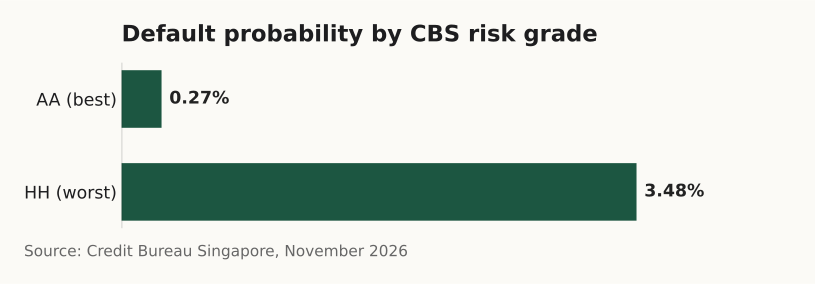
CBS score range and the default probabilities at each end. Source: Credit Bureau Singapore, November 2026.
The Bureau Score “is calculated from an algorithm based on current available credit data and is a fluid number which may change from time to time in tandem with changes in a consumer’s credit information.” Because it is recalculated as new data arrives, it is a snapshot, not a permanent label.
When you have no score
Not everyone has a score. For certain “non-scored” risk grades — HX, HZ, GX, BX or CX — “the score is not applicable” and the report shows “Not Applicable”. The most common one for younger adults is CX, insufficient credit activity: “there is ‘very limited’ information such as credit applications and/or Account Status History as such, unable to derive a Score.” This is why a fresh graduate with no cards and no loans has no score to show — the fix is simply to start using a little credit responsibly so a history can build.
What moves your score
CBS and MoneySense name a consistent set of factors. The biggest lever is your repayment conduct: “Presence of delinquency (late payment) on your loan accounts will reduce your credit score,” and “12 months of account repayment conduct (closed and defaulted accounts are also included) … is used for score calculation.” The other drivers are:
- Utilisation pattern — “the amount of credit owned/ used on accounts by individuals.” Running your cards near their limit signals strain.
- Credit account history — “A consumer with long-established credit history is deemed to be more favourable … Accounts with history of prompt payments will help to boost your credit rating.”
- Enquiry activity — “while self-enquiries will not have an effect on your credit score, increased loan application activities have a direct correlation to credit risk.” Checking your own report is free of penalty; a flurry of applications is not.
- Recent credit — “If you have recently taken multiple new credit facilities within a short period, it may be perceived as you overextending yourself.”
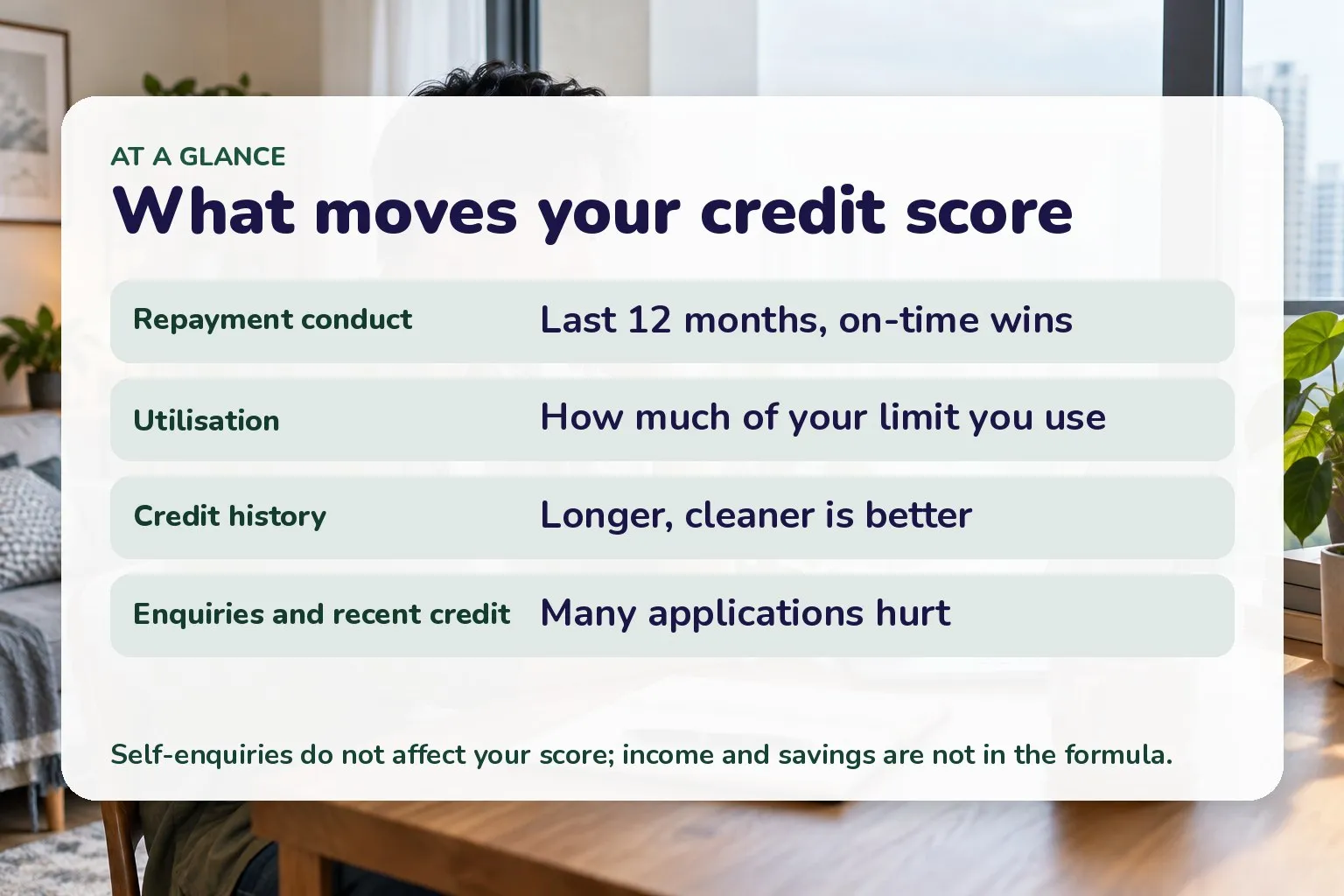
The factors CBS and MoneySense name as moving your score. Source: Credit Bureau Singapore and MoneySense, November 2026.
Note what is not on the list: your income, your savings balance and your salary do not appear in the Bureau Score formula (though a lender will ask for them separately). The score is about credit behaviour, not wealth.
How long information stays on your report
Your report is not a permanent memory of every slip. Enquiry records are “retained in the Credit Report for 2 years from the date of enquiry,” and because only the most recent 12 months of repayment conduct feed the score, old late payments fade from the calculation faster than many people fear. Small amounts are also filtered out: an overdue balance is only shown when “values of $200.00 or more” are involved. The practical upshot is that steady, on-time payments can repair a score within months — but serious events such as defaults and bankruptcy stay visible far longer and carry the most weight.
How to check your credit score
The quickest route is online. You can “purchase a copy of your credit report online at $8.00 (before prevailing GST)” by logging in with your Singpass. One timing tip from CBS: to see the latest month’s records, “retrieval should be done from the 16th of each month,” after lenders have uploaded the previous month’s data.
When the report loads, save a copy — CBS does not email it to you. Read two things first: the score and grade, and the list of accounts and enquiries, so you can spot anything you do not recognise.
If you spot a mistake
Errors happen, and you can challenge them. MoneySense sets out the process: write to the credit bureau, which will “forward your request to the member who contributed the data,” “post a notice in your credit report that the data is being disputed and is under investigation,” tell you the outcome, and “send the revised report to all its members who made enquiries on you in the past 12 months.” Reviewing your report regularly is also the simplest defence against identity theft, since an account you never opened will show up there first.
How to improve your score
MoneySense is blunt that there is no quick fix: “Building back your credit score takes time and steady effort – there are no shortcuts.” The habits it recommends map directly onto the scoring factors:
- Pay in full and on time. “Strive to pay your bills in full and on time, and stay within your spending limits.” This is the single biggest lever, since recent repayment conduct dominates the score. Paying your card in full also spares you the punishing interest covered in our guide to credit card fees and interest.
- Automate payments. “Simplify payments and prevent missed bills by setting up automatic debits using GIRO or standing instructions.” A GIRO arrangement means a forgotten due date can never dent your record.
- Keep the number of accounts sensible. “Limit the number of your credit accounts to help you stay on top of payments and avoid extra charges like annual fees.”
- Do not apply for lots of credit at once. “Avoid taking multiple loans within a short time frame.”
- Pay down what you owe. “Pay down debts as much as possible” to lower your utilisation.
- Rebuild with a secured card if needed. “If you are unable to obtain an unsecured credit card, consider applying for a secured credit card instead” — prompt payment on it rebuilds your account history.
If missed payments have already piled up, act early. MoneySense warns that if you cannot keep up, “your credit score will be affected” and “late payments may lower your chances of getting a loan in the future, or require you to pay a higher interest rate.” It points to free help: “Contact Credit Counselling Singapore … for free counselling and debt advisory services.” Where card balances across banks have grown unmanageable, a debt consolidation plan can refinance them at a lower rate. And once you are back in control, parking your buffer in a high-interest savings account keeps it working for you.
Frequently asked questions
What is a good credit score in Singapore? The best grade is AA, which CBS links to a default probability of 0.27% or less, at the top of the 1000-to-2000 range. The worst scored grade is HH, at 3.48% or more. Lenders still apply their own cut-offs on top of the grade.
Does checking my own credit score lower it? No. CBS and MoneySense confirm that self-enquiries have no effect on your score; only a lender’s enquiry when you apply for credit is recorded.
How much does a credit report cost? It is $8.00 before prevailing GST online with your Singpass login — or free if you request it after a lender has approved or rejected a recent credit application.
Why do I have no credit score? If you have very little credit history, CBS may assign a non-scored grade (such as CX, insufficient credit activity) and be “unable to derive a Score.” Using a little credit responsibly builds a history over time.
How long do late payments affect my score? The score is driven by the most recent 12 months of repayment conduct, so on-time payments can repair it within months — but defaults and bankruptcy records stay visible much longer.
General information on credit scores, not financial advice. The Bureau Score and report details are set by Credit Bureau Singapore and can change; confirm the current figures and your own report at creditbureau.com.sg.
Sources
- Consumer Credit Report (CBS credit score, risk grades, $8 report) — Credit Bureau Singapore (as of November 2026)
- Consumer Credit Report Explanation (Bureau Score, non-scored grades, enquiry retention) — Credit Bureau Singapore (as of November 2026)
- Credit reports and creditworthiness — MoneySense (MAS) (as of November 2026)
- Managing debt: What can you do? — MoneySense (MAS) (as of November 2026)