Debt Consolidation Plan (DCP) in Singapore

A Debt Consolidation Plan moves your unsecured debts from several banks into one loan at one bank, at a much lower rate than a credit card. You qualify if you are a citizen or PR with unsecured debt above 12 times your monthly income.
On this page9 sections · tap to jump
- 01What a Debt Consolidation Plan is
- 02Who can apply
- 03What a DCP covers — and what it leaves out
- 04Interest and repayment, with a worked example
- 05How to apply, step by step
- 06Fees, early repayment and refinancing
- 07DCP versus a Debt Management Programme
- 08When a DCP is not the right move
- 09Frequently asked questions
If credit card balances at three or four banks are quietly compounding at close to 28% a year, a Debt Consolidation Plan (DCP) is the one tool built for exactly that situation. It is not a bank marketing gimmick but an industry-wide scheme coordinated by the Association of Banks in Singapore (ABS) and signposted by MoneySense. This page explains who qualifies, which debts count, what the loan actually costs, how to apply, and when a DCP is the wrong answer — with dated figures from ABS, MoneySense and the banks’ own pages.
What a Debt Consolidation Plan is
A DCP is a refinancing programme, not debt forgiveness. In the ABS definition, it “offers a customer the option to consolidate all his unsecured credit facilities (such as credit cards and some types of unsecured loans) across financial institutions with 1 participating financial institution.” In plain terms: one bank pays off what you owe everywhere else, and you then repay that single bank in fixed monthly instalments. MoneySense describes it as “an industry-initiated debt-refinancing programme” where “the interest rate will be lower” and you commit to “making fixed monthly repayments until you repay all outstanding balances.”
The scheme runs across the whole industry. ABS lists 17 participating financial institutions as of November 2026 — the major banks (DBS, OCBC, UOB), foreign banks (Citibank, HSBC, Standard Chartered, Maybank, CIMB, RHB, Bank of China, ICBC), the card issuers (American Express, Diners Club) and the digital banks (GXS, Trust, MariBank). The list is “subject to revision,” so check the current roster on the ABS page. A key control sits behind it: a central “DC Registry” exists “to ensure that customers only have one active DC account at any point in time.” You cannot stack DCPs.
Who can apply
The scheme-level criteria are set across the industry. Per ABS, to be eligible you must “be a Singapore Citizen or Permanent Resident,” “earn between S$20,000 and below S$120,000 per annum with Net Personal Assets of less than $2 million,” and “have total interest-bearing unsecured debt on all credit cards and unsecured credit facilities with financial institutions in Singapore that exceeds 12 times of your monthly income.” MoneySense states the same income band and the “net personal assets of less than $2 million” test.
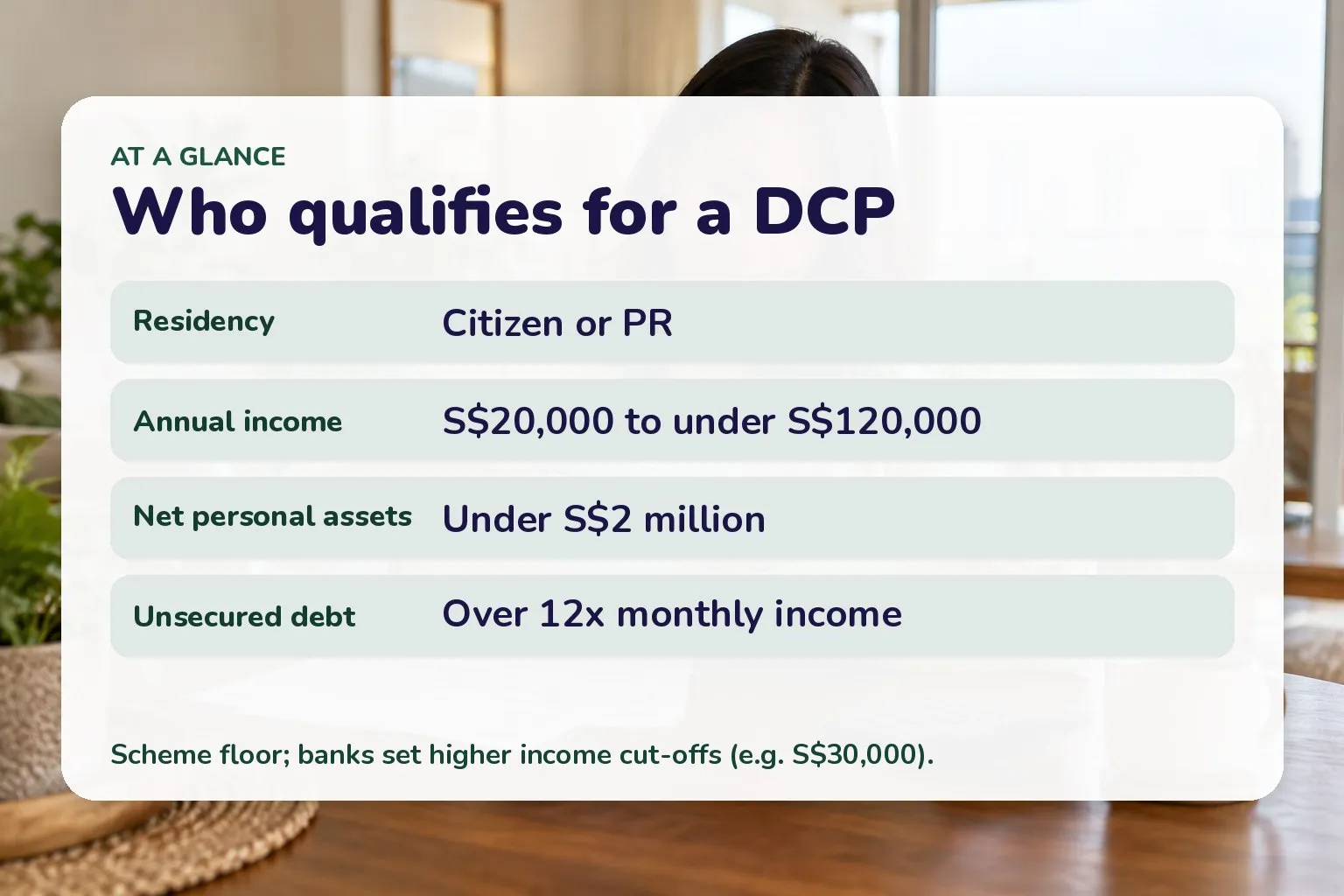
DCP eligibility at a glance. Source: ABS and MoneySense, November 2026.
That last rule is the gateway. A DCP is designed for people who are already over the regulatory borrowing ceiling. MoneySense warns that if your unsecured debt “exceeds 12 times your monthly income for three consecutive months, you will not be able to get additional credit facilities and your existing credit line(s) will be suspended.” A DCP is the structured way out of that corner.
What a DCP covers — and what it leaves out
A DCP sweeps up your unsecured debt: credit cards, and personal/credit-line loans. It deliberately excludes purpose-built borrowing. ABS lists the exclusions as “joint accounts, renovation loans, education loan, medical loans, and/or credit facilities granted for businesses or business purposes.” Those keep running on their own terms.
Consolidation is all-or-nothing. ABS states that a “DCP must be done in full with one Participating FI” — you cannot cherry-pick which cards to move. Once approved, “all your unsecured credit facilities will be closed or suspended,” and crucially you may not use them during the application either: “Further usage of existing unsecured credit facilities will not be allowed once a borrower decides to take up the DCP.”
To avoid leaving you with no card at all, the plan bundles in one replacement. You receive a single revolving credit facility — a credit card — with a limit “fixed at 1x your monthly income,” as MoneySense puts it, “for your daily needs.” This card is part of the product: ABS notes “the revolving credit facility and the DCP are bundled together,” though “you can choose not to use” it. At OCBC, for example, this Debt Consolidation Card carries “no annual fees” but still runs at a credit-card rate of “26.88% per annum” if you revolve a balance on it — so treat it as a payment tool, not fresh borrowing.
Interest and repayment, with a worked example
The appeal is the rate gap. HSBC notes its DCP rates are “far lower than the 24% to 28% annual interest rate charged by most credit cards in Singapore.” As a concrete published example, OCBC’s DCP uses an “applied interest rate” of “4.50% per annum” across tenures from “36 to 96 months,” which works out to an effective interest rate (EIR) of “8.41% per annum” at 36 months down to “8.06% per annum” at 96 months. HSBC lets you “set a loan tenure from 1 year to 10 years.” A longer tenure lowers the monthly payment but increases total interest — pay as much above the minimum as you can afford.
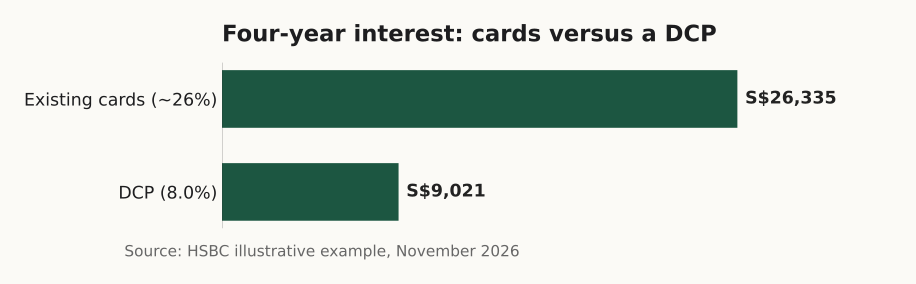
Total interest over four years on S$50,000 of debt, HSBC’s illustration. Source: HSBC, November 2026.
That 5% is a scheme feature, not a sales add-on. ABS sets the first DCP loan at your total outstanding balance “plus an additional ≤5% allowance over and above the total DCP amount,” and it is “mandatory for the first approved DCP loan.” Its job is to cover interest and fees that accrue between approval and the day your old banks actually receive payment; any unused portion is “credited or refunded to you.” It does not apply when you later refinance an existing DCP.
How to apply, step by step
- Pull your numbers together. You apply to just one bank — ABS confirms “you only need to apply to 1 Participating FI.” But you are “encouraged to compare the terms and conditions from different Participating FIs” first, since rates and tenures differ.
- Gather documents. ABS lists a “Copy of NRIC (front and back),” your “Latest Credit Bureau Report,” “Latest Income Documents,” and your “Latest credit card and unsecured credit loan statements.”
- Keep paying until approval. Your old debts stay fully yours while the application is pending, so keep servicing at least the minimums to avoid late marks.
- Approval and disbursement. The DCP bank pays down your balances directly with your other banks and notifies them to suspend those accounts — you do not have to close them yourself. You then make one monthly instalment to the DCP bank; at OCBC the due date is “28 calendar days after the statement is generated.”
Fees, early repayment and refinancing
A DCP has its own fee schedule, set per bank. OCBC, as an example, charges “Late repayment charges S$200,” a “Termination fee 5% outstanding loan amount,” and “S$25 per transaction” for over-the-counter payments. You can repay early, but ABS warns “you may need to pay a prepayment fee at such rate(s) as financial institutions may from time to time prescribe” — check your bank’s figure first.
Refinancing to another bank is allowed but gated: ABS says “you may only do so at least 3 months after the approval of your latest DCP,” and any early-termination penalty from the first bank is yours to bear and should not be rolled into the new loan. Borrowing fresh unsecured credit is also gated by your balance-to-income (BTI) ratio: ABS allows a new facility “with another financial institution … once your overall BTI reduces to or below 8 times your monthly income,” or “with the DCP financial institution once your overall BTI reduces to below 4 times your monthly income.”
On your credit file, ABS records the DCP under the “Debt Consolidation” product code, and the “credit information will stay on your Credit Bureau report for 3 years after DCP closure.” MoneySense adds that “the last 12 months’ payment status history will be displayed in your credit report for three years” after you close the account.
DCP versus a Debt Management Programme
A DCP is a bank loan; a Debt Management Programme (DMP) is a counselling-led arrangement. Credit Counselling Singapore (CCS) describes the DMP as “a formal consumer debt restructuring agreement facilitated by CCS with major consumer banks and credit card issuers in Singapore, represented by The Association of Banks in Singapore (ABS).” Instead of one new loan, CCS negotiates with each creditor: a borrower “may be granted an extended period and/or charged a moderated interest rate,” and then “makes monthly instalments to each creditor directly, until full settlement.”
Which fits depends on your position. A DCP needs you to qualify commercially (income band, assets, debt above 12x income) and leaves you with a bank loan and a working card. A DMP is assessed on payment capacity by a financial counsellor and suits people who cannot meet DCP criteria or need help negotiating. If you are unsure, free counselling through CCS is the neutral first stop, since the DCP is “a commercial product” and approval is “subject to the assessments of individual FIs.”
When a DCP is not the right move
The maths only works if your habits change. As HSBC says, “it won’t make sense to take on a loan to pay off existing debts, only to pile them on again after your loan has been cleared.” A DCP also fits poorly if your problem debt is largely excluded (renovation, education, medical or business loans), if you only want to move one small card balance (it must be all-or-nothing), or if a cheaper option exists — for a single high-rate card, a balance transfer or simply paying above the minimum may clear it faster. And once you are debt-free, redirect the old repayments into a high-interest savings account and build an emergency fund so the next surprise bill does not go back onto a card.
Frequently asked questions
Can I keep one credit card when I go on a DCP? Not your old ones — those are closed or suspended on approval. You instead get one bundled revolving card with a limit of 1x your monthly income for daily spending.
How much can a DCP save me? It depends on your balances, rate and tenure. In HSBC’s published example, moving S$50,000 of high-rate card debt to an 8.0% DCP cut four-year interest by about 66% — from S$26,334.76 to S$9,020.56.
Can I have two DCPs or consolidate only some cards? No. ABS states a central DC Registry limits you to one active DCP, and the plan must consolidate your unsecured debt in full with a single bank.
When can I borrow again after a DCP? Only once your balance-to-income ratio falls to 8x or below with a non-DCP bank, or below 4x with your DCP bank.
Will a DCP show on my credit report? Yes, under a “Debt Consolidation” product code, and it stays on your Credit Bureau report for three years after you close the account.
General information on the Debt Consolidation Plan, not financial advice. Scheme rules are set by ABS/MAS and product terms by each bank, and both change — confirm the current eligibility, rates and fees on the official pages before you apply.
Sources
- FAQs — Debt Consolidation Plan — The Association of Banks in Singapore (ABS) (as of November 2026)
- Managing debt: What can you do? — MoneySense (MAS) (as of November 2026)
- OCBC Debt Consolidation Plan — rates, fees and eligibility — OCBC Bank (as of November 2026)
- 5 things you didn't know about debt consolidation — HSBC Bank (Singapore) (as of November 2026)
- Debt Management Programme — Credit Counselling Singapore (CCS) (as of November 2026)