Credit Card Fees and Interest in Singapore

Pay your credit card bill in full by the due date and you owe no interest or late fees. Carry a balance and interest around 27.8% a year is charged daily; miss the minimum payment and a S$100 late fee plus a higher penalty rate apply.
On this page10 sections · tap to jump
A credit card is close to free if you clear it in full every month — and surprisingly expensive if you do not. The gap between those two outcomes is the set of fees and interest charges printed in the fine print: the interest rate, the late fee, the minimum-payment mechanics, cash-advance charges, the annual fee and the costs of spending overseas. This page explains each one with current, dated figures from MoneySense and the banks’ own pages, so you know exactly what you are signing up for.
When interest applies
The single most important rule is the cheapest one to follow: “If you pay your credit card bill in full and on time, you will not get charged interest.” Pay the full statement balance by the due date and the bank earns nothing from you in interest — the interest-free period (25 days from the statement date at DBS) does its job.
The moment you pay less than the full amount, the picture flips. Interest “is charged on a daily basis for the outstanding amount”, and it compounds: unpaid interest is added to the next bill and itself attracts interest. That is why a card should never be treated as a long-term loan.
The interest rate
Carry a balance and you pay one of the highest ordinary interest rates in consumer finance. The headline purchase rates are close across the big banks: DBS charges a “Prevailing interest rate of 27.8% p.a. chargeable on a daily basis”, and OCBC states “The interest rate for OCBC Credit Cards is 27.78% per annum.” Both apply a minimum interest charge of S$2.50 a month once interest kicks in.
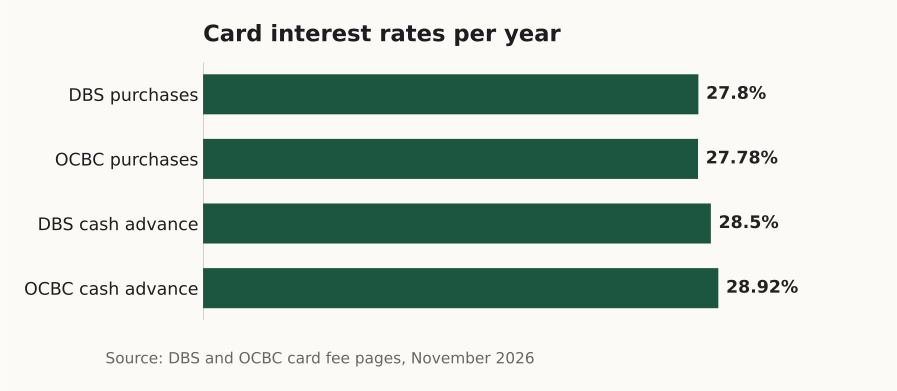
Published card interest rates. Source: DBS and OCBC card fee pages, November 2026.
Because interest runs daily on the outstanding balance until it is fully cleared — and on new purchases too once you are carrying a balance — the effective cost of rolling debt is high and relentless. No rewards rate comes close to offsetting it, which is the theme of our guide to cashback versus miles cards: rewards only pay if you never pay interest.
Late fees and the penalty rate
Miss the minimum payment and two charges stack up. First, a flat late fee: MoneySense notes “The late fee is often a flat $100, regardless of the size of the bill,” and both DBS and OCBC levy “S$100” when the minimum payment is not received by the due date. Second, a penalty interest rate: DBS adds “an additional interest rate of 3% p.a.” to your prevailing rate if you miss the minimum, and OCBC’s rate “will be increased to a higher interest rate of 30.78% per annum.” Keep missing and the pain goes beyond money — fail the minimum “for two consecutive months” and “You will not be able to obtain new unsecured credit facilities” while your lines are suspended.
The minimum-payment trap
The “minimum payment” on your statement is the floor the bank will accept, not a sensible amount to pay. The reason it is a trap is the order of repayment: “The minimum payment always goes towards paying the interest charge first, then to paying the outstanding balance.” Pay only the minimum and most of it services interest, barely denting what you owe.
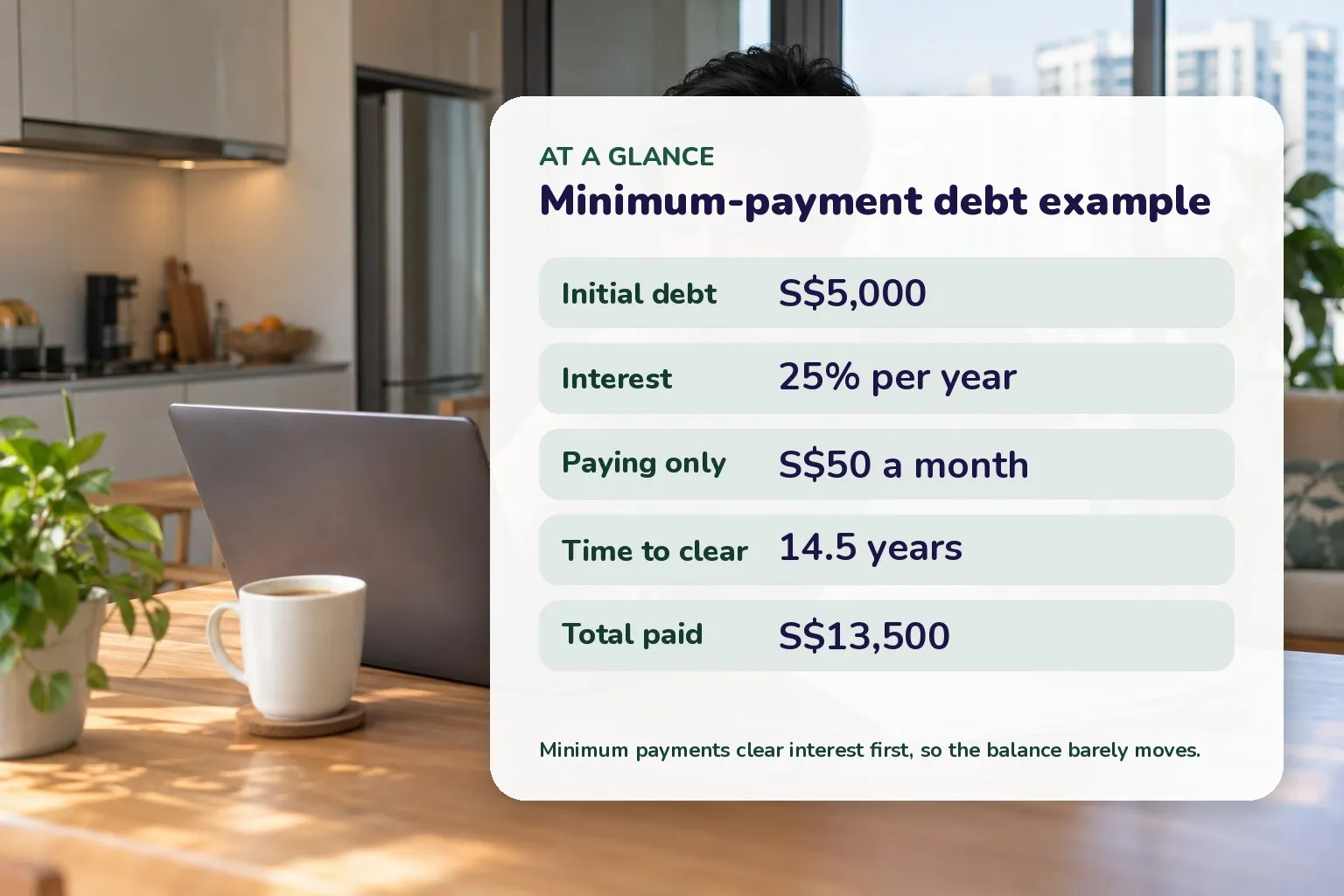
How minimum-only payments snowball. Source: MoneySense (MAS), November 2026.
MoneySense works the example: a “$5,000” debt, “Interest Rate For Overdue Outstanding Debt 25% per annum”, paying the “$50” monthly minimum, takes “175 months or 14.5 years” to clear and costs “$13,500” — almost three times the original sum. The lesson is simple: pay in full if you can, and if you cannot, pay as much above the minimum as possible.
Cash advances: the most expensive cash
Drawing cash on a credit card is the costliest thing you can do with it, because two charges hit at once. There is an upfront fee — DBS charges “8% of the amount withdrawn per transaction or S$15, whichever is greater,” and OCBC “S$15 or 8% of amount withdrawn whichever is greater.” Then interest starts immediately at a higher rate than purchases — “28.5% p.a.” at DBS and “28.92% per annum” at OCBC — with no interest-free grace period. Treat cash advances as an emergency-only option.
Annual fees and waivers
Most cards carry an annual fee, but it is often waivable. A mainstream cashback card like the OCBC 365 charges a principal-card fee of “S$196.20 (including GST), waived for the first two years”, after which a spend of “S$10,000 in one year” earns an automatic waiver. A premium card sits much higher — the DBS Vantage Card’s principal “Annual fee” is “S$599.50” (inclusive of GST). So the annual fee can range from S$196.20 to S$599.50 depending on the tier; always check whether a first-year or spend-based waiver applies before you treat it as a cost.
Foreign-currency and overseas fees
Spending abroad or on overseas websites adds charges on top of the exchange rate. As MoneySense explains, the card network “(Mastercard or Visa) will also charge an international transaction fee to the card issuing bank. This is typically passed on to you.” On top of that the bank adds its own admin fee — DBS states a “prevailing administrative fee is 2.25% of the foreign currency transaction amount for transactions involving VISA International and MasterCard International.” Watch for “pay in SGD” offers at overseas tills and websites (dynamic currency conversion): you may pay a poor merchant exchange rate and still be charged the network’s international transaction fee, as MoneySense warns.
Other charges to watch
Beyond the big items, cards carry smaller fees: a card replacement fee if you lose the card, and the cash-advance withdrawal fee noted above. None of these are large on their own, but they add up — and all of them are avoidable with a little admin. If your goal is simply to earn on everyday spend without fee surprises, compare the no-fee options in our cashback cards guide and, for travellers, the air-miles cards guide.
How to pay nothing in fees
Almost every charge here is avoidable:
- Pay the full statement balance by the due date, every month — that alone removes interest and late fees.
- Automate at least the minimum via GIRO so a missed payment can never trigger the S$100 fee and penalty rate.
- Avoid cash advances unless it is a genuine emergency.
- Get the annual fee waived or cancel a card you do not use.
- Decline “pay in SGD” abroad, and factor the foreign-currency fee into overseas spending.
Used this way, the money you would have lost to interest can instead sit in a high-interest savings account earning for you.
Frequently asked questions
What is the interest rate on a credit card in Singapore? Prevailing purchase rates are about 27.8% a year at DBS and 27.78% at OCBC, charged daily on any balance you carry. Cash advances are higher — 28.5% to 28.92% a year — and start with no grace period.
Do I pay interest if I pay in full? No. Pay the full statement balance by the due date and no interest is charged; the interest-free period covers your purchases.
How much is the late payment fee? Commonly a flat S$100, regardless of the bill size, if the minimum payment is not received by the due date — and your rate can rise (for example by 3% at DBS, or to 30.78% at OCBC).
Why shouldn’t I just pay the minimum? Because it pays interest first. MoneySense shows a S$5,000 debt at 25% paying only S$50 a month takes 14.5 years and costs about S$13,500.
What does overseas spending cost? The exchange rate plus a bank admin fee (2.25% at DBS for Visa/Mastercard) and the card network’s international transaction fee — and possibly more if you accept dynamic currency conversion.
General information on card fees, not financial advice. Rates and fees are set by each bank and change often; confirm the current figures on the bank’s own page before you apply or spend.
Sources
- Understanding Credit Card Interest And Charges — MoneySense (MAS) (as of November 2026)
- DBS/POSB Credit Cards — Rates and Fees — DBS Bank (as of November 2026)
- Fees and Charges for Credit Cards (PDF) — OCBC Bank (as of November 2026)
- OCBC 365 Credit Card (annual fee and waiver) — OCBC Bank (as of November 2026)
- DBS Vantage Card (annual fee) — DBS Bank (as of November 2026)