SRS Account: Tax Relief and Returns

The Supplementary Retirement Scheme (SRS) is a voluntary retirement account that lowers your income tax: each dollar paid in cuts your taxable income, up to $15,300 a year for citizens and PRs or $35,700 for foreigners. At retirement, only 50% of withdrawals are taxed.
The Supplementary Retirement Scheme (SRS) is a voluntary account that lets you save for retirement on top of CPF while cutting your income tax today. Introduced in 2001 and run by the private sector, it does three things: every dollar you contribute lowers your taxable income, your investments grow tax-free inside the account, and when you withdraw at retirement only half of what you take out is taxed. The catch is that it is money you lock away, so the tax saving has to be worth the trade-off.
This guide covers the 2026 contribution caps, exactly how the relief works, how withdrawals are taxed — including the penalties for taking money early — and who the scheme suits. Every figure here is from IRAS or the Ministry of Finance.
What the SRS is
The SRS complements CPF. Where CPF savings are earmarked for basic retirement, housing and healthcare, the SRS is extra, flexible savings you set aside at your own pace and can invest. You open an account with one of the three SRS operator banks — DBS, OCBC or UOB — and you may hold only one account at any time.
Contributing is entirely optional and the amount is up to you, from a single dollar up to your annual cap. You can pay in at any time and as often as you like, and contributions must be made in cash. Your employer may also contribute on your behalf, but anything they put in counts as part of your salary, is taxable, and must be declared in your Form IR8A — you then receive the relief on it.
The annual contribution cap
How much you can put in each year depends on your residency:
| Account holder | Maximum yearly contribution (2026) |
|---|---|
| Singapore Citizens / Permanent Residents | $15,300 |
| Foreigners | $35,700 |
These caps have applied since 1 January 2016. They are not arbitrary: the cap is the SRS contribution rate — 15% for citizens and PRs, 35% for foreigners — multiplied by an absolute income base of $102,000. Foreigners get a higher rate because they do not enjoy the tax relief that CPF contributions give citizens and PRs.
The tax relief on contributions
This is the headline benefit. Your SRS contribution is subtracted from your chargeable income, so it reduces tax from the top of your income down — meaning the saving is roughly your marginal tax rate multiplied by the amount you put in. You do not claim it yourself: the operator reports your contribution to IRAS and the relief appears automatically when you e-File, in the YA following the year of contribution (provided you are a tax resident that year).
Two hard limits shape the benefit:
- The $80,000 personal income tax relief cap. For each Year of Assessment, a cap of $80,000 applies to all your tax reliefs combined — SRS, CPF reliefs, the Working Mother’s Child Relief and so on. SRS relief counts inside that cap, so if your other reliefs already reach $80,000, a contribution buys you no extra tax saving.
- No refunds. Once contributed, the money cannot be refunded, and IRAS explicitly advises you to evaluate whether you would actually benefit before contributing.
Note the timing. To count towards a given year’s relief, your contribution must reach your SRS account by 31 December of that year. Banks often set an earlier internal cut-off before the year-end holidays, so a transfer you make on 31 December itself may not be processed in time — check your operator’s deadline rather than assume.
You also will not get relief if your SRS account is suspended as at 31 December of the contribution year, or if you withdraw that contribution in the same year you made it.
What you can do with the money
Money sitting as cash in an SRS account earns only a token rate of interest, so the scheme is designed for you to invest it. Through your operator you can typically buy shares, bonds, unit trusts, fixed deposits, single-premium insurance and Singapore Government securities — including Singapore Savings Bonds and T-bills, which can be bought with SRS funds. All returns stay tax-free inside the account until you withdraw. Investment choices and charges vary by operator, so compare before you commit.
If SSBs appeal, see how to apply for Singapore Savings Bonds, which can be bought with SRS money.
How withdrawals are taxed
SRS is best understood as tax deferment: you get relief during your working years, then pay tax when you take the money out. How much you pay depends entirely on when and why you withdraw.
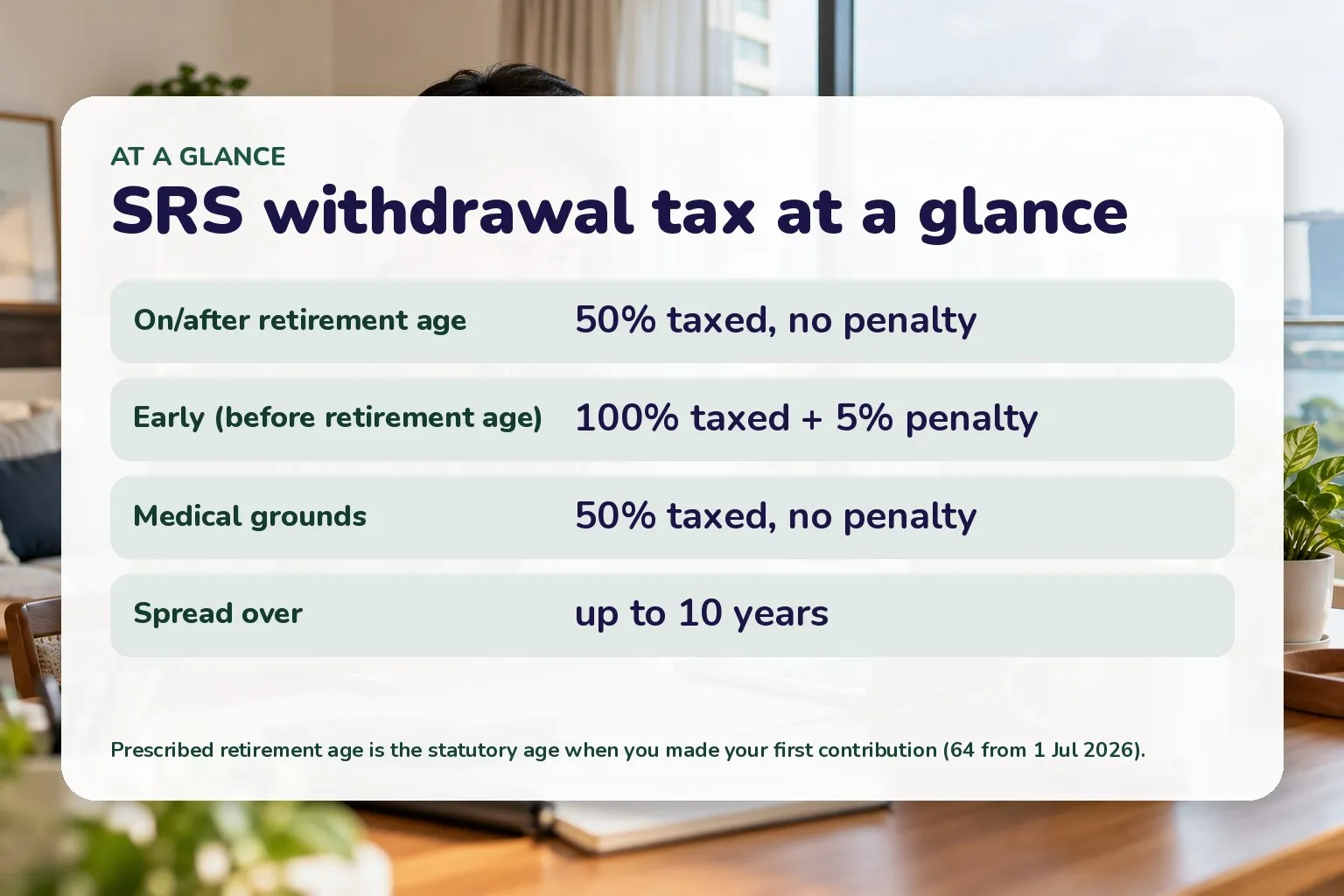
How SRS withdrawals are taxed by situation. Source: IRAS, October 2026.
The key milestone is the statutory retirement age that applied when you made your first contribution — your “prescribed retirement age”. It is locked in: if the statutory age later rises, it does not affect you. For first contributions made from 1 July 2026 the prescribed age is 64 (it was 63 before that).
- On or after your prescribed retirement age: only 50% of each withdrawal is taxable, with no penalty. This is the scheme’s second big benefit.
- You can spread withdrawals over 10 years, starting from your first penalty-free withdrawal. Because only half is taxed and you can split it across years, you can keep each year’s taxable amount — and therefore your tax rate — low.
Withdrawals are taxed in the Year of Assessment following the year you withdraw. You do not declare them — the operator reports to IRAS and the amount is added to your assessment automatically.
Taking money out early
Withdraw before your prescribed retirement age and, in most cases, the consequences are steep: the full 100% of the withdrawal is added to your taxable income and a 5% penalty is deducted on top. The penalty is non-refundable. This is deliberate — the relief was granted to encourage retirement saving, not a flexible savings account.
Special withdrawal situations
Some circumstances are treated more leniently. The table shows how each is taxed and whether the 5% penalty applies.
| Type of withdrawal | Amount taxable | 5% penalty |
|---|---|---|
| On or after prescribed retirement age | 50% | No |
| On medical grounds | 50% | No |
| Full withdrawal due to terminal illness | 50%, less an exempt amount up to $400,000 | No |
| In the event of bankruptcy | 100% | No |
| Lump sum by a foreigner (held ≥ 10 years) | 50% | No |
| Early withdrawal before prescribed retirement age | 100% | Yes |
On death or terminal illness, a tax exemption of up to $400,000 applies, broadly mirroring what you could have drawn out tax-free over a 10-year retirement drawdown; only amounts above that are 50%-taxable.
Foreigners and PRs face an extra step: when they withdraw, the operator deducts withholding tax at the prevailing non-resident rate of 24% at the point of withdrawal. A concessionary 15% rate can apply if the year’s cumulative withdrawals do not exceed $200,000 and the person has no other Singapore income, declared on Form IR37B(1). There is no withholding tax for Singaporean account holders.
Who benefits (and who may not)
SRS rewards people who are paying meaningful income tax now and expect a lower tax rate in retirement — the gap between the two is your real saving. The higher your current marginal rate, the more each dollar of relief is worth.
It is less useful if: your income is low enough that you pay little or no tax (there is little relief to capture); your other reliefs already fill the $80,000 cap; or you may need the money before retirement, where the 100%-plus-5% early-withdrawal treatment can wipe out the upfront benefit.
Compare it with CPF cash top-ups, which also give tax relief but lock the money even more tightly while earning CPF’s floor rates — see CPF top-ups: returns and tax relief and CPF interest rates explained. Many savers use both, within the shared $80,000 relief cap.
FAQ
Can I have SRS accounts at two banks? No. You may hold only one SRS account; opening more than one is an offence.
Do I need to claim the relief in my tax return? No. Your operator reports contributions to IRAS and the relief is applied automatically — you just confirm it when e-Filing.
What if I contribute but it turns out I get no tax benefit? The money is not refundable. That is why IRAS tells you to check whether you would benefit first, especially if your reliefs are near the $80,000 cap.
When can I withdraw without penalty? On or after the statutory retirement age that applied when you made your first contribution (64 for first contributions from 1 July 2026), on medical grounds, or in the other special cases above.
Is the money stuck as cash? No — you invest it through your operator (shares, bonds, unit trusts, SSBs, insurance and more); returns grow tax-free until withdrawal.
Related
- How to apply for Singapore Savings Bonds
- CPF top-ups: returns and tax relief
- CPF interest rates explained
General information on the Supplementary Retirement Scheme, not financial or tax advice. Caps, ages and tax treatment are set by IRAS and MOF and can change; confirm your own position with IRAS and your SRS operator before contributing or withdrawing.
Sources
- SRS contributions and tax relief — Inland Revenue Authority of Singapore (as of October 2026)
- Tax on SRS withdrawals — Inland Revenue Authority of Singapore (as of October 2026)
- Tax Obligations for SRS Withdrawal (withholding tax, foreigners and PRs) — Inland Revenue Authority of Singapore (as of October 2026)
- Supplementary Retirement Scheme (overview) — Ministry of Finance (as of October 2026)
- Annual Declaration Form for SRS (contribution rates 15%/35% and $102,000 income base) — Inland Revenue Authority of Singapore (as of October 2026)