CPF Contribution Rates by Age

From 1 January 2026, an employee aged 55 and below has 37% of monthly wages paid into CPF — 17% from the employer and 20% from the employee. The total rate steps down with age: 34%, 25%, 16.5%, then 12.5% past 70.
CPF contributions come out of every Singapore Citizen’s and Permanent Resident’s pay, but the rate is not fixed — it falls as you get older, and what you pay in is split differently across your accounts at each stage of life. For an employee aged 55 and below, the total contribution from 1 January 2026 is 37% of monthly wages: 17% from the employer and 20% from the employee. This guide sets out the full rate table by age, the wage ceilings that cap it, how the money is allocated to your Ordinary, Special/Retirement and MediSave accounts, the lower rates for new PRs, and the increases coming in 2027. Every figure is from the CPF Board.
The 2026 contribution rates by age
For monthly wages above $750, the shares are:
| Employee’s age | Employer | Employee | Total |
|---|---|---|---|
| 55 and below | 17% | 20% | 37% |
| Above 55 to 60 | 16% | 18% | 34% |
| Above 60 to 65 | 12.5% | 12.5% | 25% |
| Above 65 to 70 | 9% | 7.5% | 16.5% |
| Above 70 | 7.5% | 5% | 12.5% |
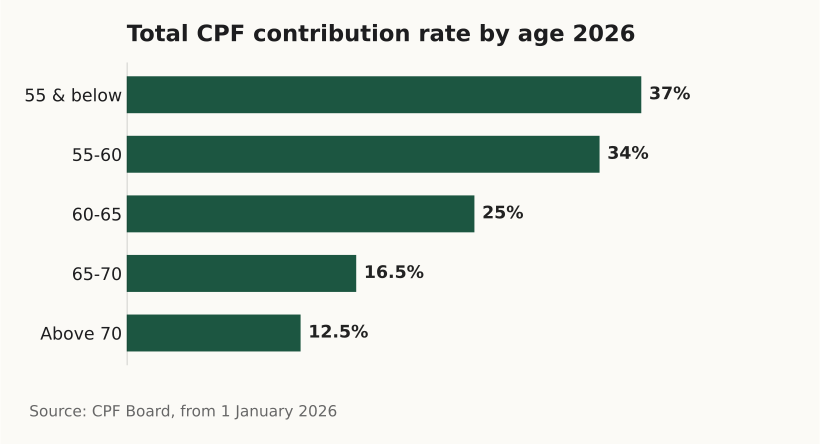
Total CPF contribution rate (employer plus employee) by age, from 1 January 2026. Source: CPF Board.
The employer pays the whole amount to CPF and recovers the employee’s share by deducting it from wages. The total CPF contribution is rounded to the nearest dollar, and the employee’s share is rounded down to the nearest dollar.
Why the rates fall with age
The step-down reflects policy priorities rather than a smaller pay-in being “worse”. Full rates in your working years build your Ordinary Account for housing and your retirement and healthcare savings. From 55, the Government has historically trimmed rates to keep older workers employable by lowering the cost of hiring them — though this is now being partly reversed for seniors (see 2027, below). The rate only drops sharply well past the typical retirement age.
The wage ceilings that cap contributions
The percentages apply only up to two ceilings, so high earners do not pay CPF on their entire salary.
- Ordinary Wage (OW) ceiling: $8,000 a month in 2026. This caps the monthly salary that attracts CPF. It rose from $7,400 in 2025 — the final step of a schedule that lifted it from $6,000 in stages ($6,300 in Sep 2023, $6,800 in 2024, $7,400 in 2025, $8,000 in 2026).
- CPF annual salary ceiling: $102,000, unchanged. This caps the total of Ordinary and Additional Wages (like bonuses) that attract CPF in a year.
- Additional Wage (AW) ceiling = $102,000 − total OW subject to CPF for the year. For someone at or above the OW ceiling all year, that is $102,000 − ($8,000 × 12) = $6,000 of bonus that attracts CPF.
- CPF Annual Limit: $37,740 — the most that can go into your CPF in a year from all contributions, mandatory and voluntary combined.
How contributions are split across your accounts
Your contribution does not land in one pot. It is divided between the Ordinary Account (OA) for housing, the Special Account (SA) or, from 55, the Retirement Account (RA), and the MediSave Account (MA) for healthcare. The CPF Board computes the MediSave share first, then the Special/Retirement share, and the remainder goes to the Ordinary Account.
The ratios shift with age — away from the OA and towards healthcare and retirement:
| Employee’s age | Ordinary Account | Special / Retirement | MediSave |
|---|---|---|---|
| 35 and below | 62.17% | 16.21% (SA) | 21.62% |
| Above 35 to 45 | 56.77% | 18.91% (SA) | 24.32% |
| Above 45 to 50 | 51.36% | 21.62% (SA) | 27.02% |
| Above 50 to 55 | 40.55% | 31.08% (SA) | 28.37% |
| Above 55 to 60 | 35.30% | 33.82% (RA) | 30.88% |
| Above 60 to 65 | 14.00% | 44.00% (RA) | 42.00% |
| Above 65 to 70 | 6.07% | 30.30% (RA) | 63.63% |
| Above 70 | 8.00% | 8.00% (RA) | 84.00% |
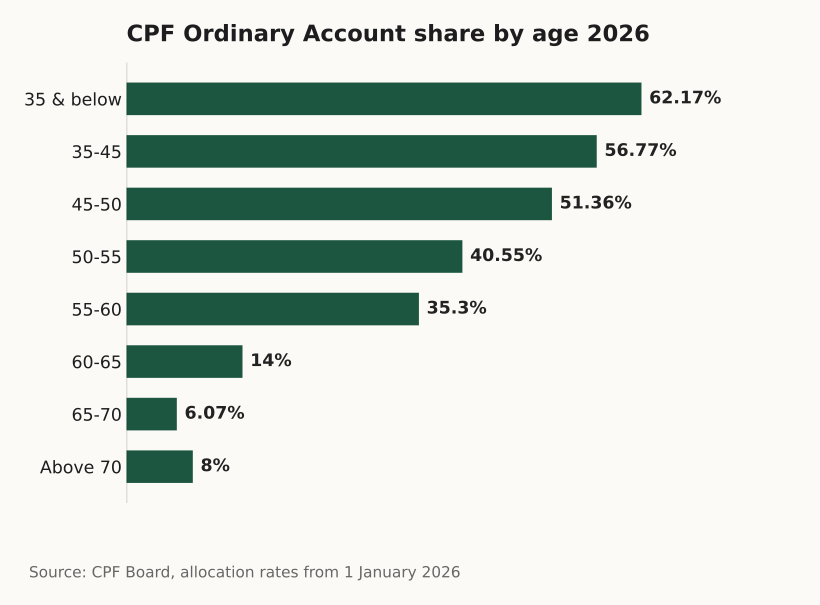
Share of each CPF contribution going to OA, SA/RA and MediSave, by age, 2026. Source: CPF Board.
Two things stand out. First, the MediSave share climbs steadily — from about a fifth under 35 to the vast majority past 70 — because healthcare costs rise with age. Second, from age 55 the Special Account is closed: contributions are then directed to the Retirement Account up to your Full Retirement Sum, and once that is met, the balance goes to your Ordinary Account.
A worked allocation
For a 30-year-old whose total CPF contribution in a month is $100, the CPF Board’s own example allocates it as $62.17 to the OA, $16.21 to the SA and $21.62 to MediSave (MediSave and SA are worked out first; the rest falls to the OA).
Low-wage and phased-in rates
Employees earning modest wages do not jump straight to full rates. For an employee aged 55 and below:
- $50 or less a month: no CPF.
- More than $50 up to $500: the employer pays 17% of total wages; the employee pays nothing.
- More than $500 up to $750: the employer pays 17% plus a phased-in employee share of 0.6 × (wages − $500), easing the employee contribution in gradually.
- Above $750: the full rates in the table above apply.
This keeps take-home pay from dropping sharply as low earners cross each threshold.
Permanent residents: graduated rates
New PRs contribute at lower graduated rates for their first two years to ease the transition, then move to full rates in their third year. For a first-year PR aged 55 and below earning above $750, the total is 9% (4% employer, 5% employee); in the second year it rises to 24%. Employer and employee can jointly apply to pay full rates earlier. The full set of PR tables (by SPR year and age) is in the CPF Board’s rate-table PDF.
What changes in 2027
Senior-worker rates are still rising towards their targets. From 1 January 2027:
| Age band | 2026 total | 2027 total |
|---|---|---|
| Above 55 to 60 | 34% | 35.5% (+1.5) |
| Above 60 to 65 | 25% | 26% (+1) |
For the above 55 to 60 band the employer share rises 0.5 point (to 16.5%) and the employee share 1 point (to 19%); for above 60 to 65 both rise 0.5 point (to 13% each). The entire increase is allocated to the Retirement Account, up to the Full Retirement Sum, to boost seniors’ retirement savings. With this step, the above-60-to-65 band reaches its target rate, and employers receive a one-year CPF Transition Offset to cushion the cost. Rates for those 55 and below, above 65 to 70, and above 70 are unchanged.
FAQ
Who pays CPF — me or my employer? Both. The employer pays the full contribution to CPF and deducts your employee share from your wages.
Do I pay CPF on my whole salary? No. Only Ordinary Wages up to $8,000 a month and total wages up to $102,000 a year attract CPF; anything above is free of CPF.
Why does less go to my Ordinary Account as I age? The allocation deliberately shifts towards MediSave and the Retirement Account, which cover healthcare and retirement income, as those needs grow.
What happens to my Special Account at 55? It closes, and contributions are directed to your Retirement Account up to your Full Retirement Sum, then to your Ordinary Account.
Do permanent residents pay the same rates? Not at first. New PRs pay graduated rates for two years before full rates, unless both sides jointly apply to pay full rates sooner.
Related
- CPF interest rates explained
- CPF retirement sums: BRS, FRS and ERS
- CPF top-ups: returns and tax relief
General information on CPF contribution rates, not financial advice. Rates, ceilings and allocation ratios are set by the CPF Board and change over time; confirm your own figures with the CPF Board before relying on them.
Sources
- How much CPF contributions to pay — Central Provident Fund Board (as of October 2026)
- CPF Contribution Rate Table from 1 January 2026 — Central Provident Fund Board (as of October 2026)
- CPF Allocation Rates from 1 January 2026 — Central Provident Fund Board (as of October 2026)
- What is the Ordinary Wage (OW) ceiling? (schedule to $8,000 in 2026) — Central Provident Fund Board (as of October 2026)
- CPF Contribution Changes from 1 January 2027 (senior-worker rates) — Central Provident Fund Board (as of October 2026)