Savings Account vs Fixed Deposit: Which to Use

Use a savings account for money you may need at any time; use a fixed deposit for a lump sum you can lock away for a set term in exchange for a rate fixed upfront. Keep your emergency fund liquid before locking any cash into a fixed deposit.
On this page10 sections · tap to jump
A savings account and a fixed deposit are both safe homes for cash, but they answer two different questions. A savings account asks “what if I need this money at any time?”; a fixed deposit asks “what rate can I lock in if I promise not to touch it?” MoneySense puts the split plainly: for everyday money management use a savings or current account, while “for medium to long-term savings, a fixed deposit account is more appropriate”. Get the match right and you earn more without trapping cash you need; get it wrong and you either forfeit interest breaking a deposit early, or leave money idle that could have been locked in. Here is how to choose, with the current rate picture and a worked example.
The one difference that decides it
Everything flows from a single contrast. A savings account lets you deposit and withdraw at any time, and its rate “can change at any time”. A fixed deposit has a fixed maturity: you cannot freely deposit or withdraw during the term, and in exchange the rate is set the day you place it and does not move. MoneySense’s own feature table marks it clearly — a savings account has no fixed maturity and allows withdrawal anytime; a fixed deposit has a fixed maturity and does not.
That one difference drives the rest:
- Rate certainty. A fixed deposit locks today’s rate for the term, which is valuable when rates are falling. A savings account floats, which is better when rates are rising.
- Access. A savings account is liquid; a fixed deposit is not until maturity.
- Conditions. Top savings rates often need salary credit and card spend; top fixed-deposit rates often need “fresh funds” and a minimum sum.
When a savings account wins
Use a savings account for any money you might need on short notice, and for your emergency buffer. Because you can withdraw anytime with no penalty, it is the right home for the emergency fund MoneySense suggests building — “3 to 6 times of your monthly expenses”. A savings account also wins when you cannot predict your timing: there is no maturity date to plan around and no cost to dipping in.
Crucially, a good savings account is no longer the low-rate option it once was. A no-conditions digital bank such as GXS pays 1.2% p.a. on its Saving Pockets (a limited-time promotional rate; 0.88% on the Main Account) with no lock-in and no fees, interest credited daily. That is below the best fixed-deposit promotions, but the money stays fully withdrawable — which is what liquid cash needs.
When a fixed deposit wins
Use a fixed deposit for a lump sum you have earmarked for a known date and are sure you can leave untouched — a tax bill due next year, a renovation deposit, money parked between other plans. You give up access, and in return you get a rate fixed for the whole term, immune to cuts if market rates fall.
Two conditions usually attach. First, fresh funds: promotional rates typically apply only to money not already with that institution. Hong Leong Finance, for example, states you must “place deposits in fresh funds to qualify”. Second, a minimum placement, commonly around S$20,000. As of its 23 October 2026 rates, Hong Leong Finance’s 8-month promotion paid 2.08% p.a. on S$20,000 of fresh funds; its 12-month rate was 1.80% (1.90% for S$100,000 and above).
Which pays more right now
Neither type always pays more — it depends on conditions and the rate cycle. As of late 2026 the two sit in a similar band: the sharpest mainstream fixed deposit (Hong Leong Finance, 2.08% for 8 months) pays clearly more than a no-conditions savings rate (GXS Saving Pockets, 1.2%), and a bonus savings account can beat both if you clear its hoops. The honest comparison is not headline versus headline but the rate you will actually earn, after conditions, on money you can actually commit. For the current full tables, check the live fixed deposit rates page, which also tracks how an FD stacks up against a T-bill.
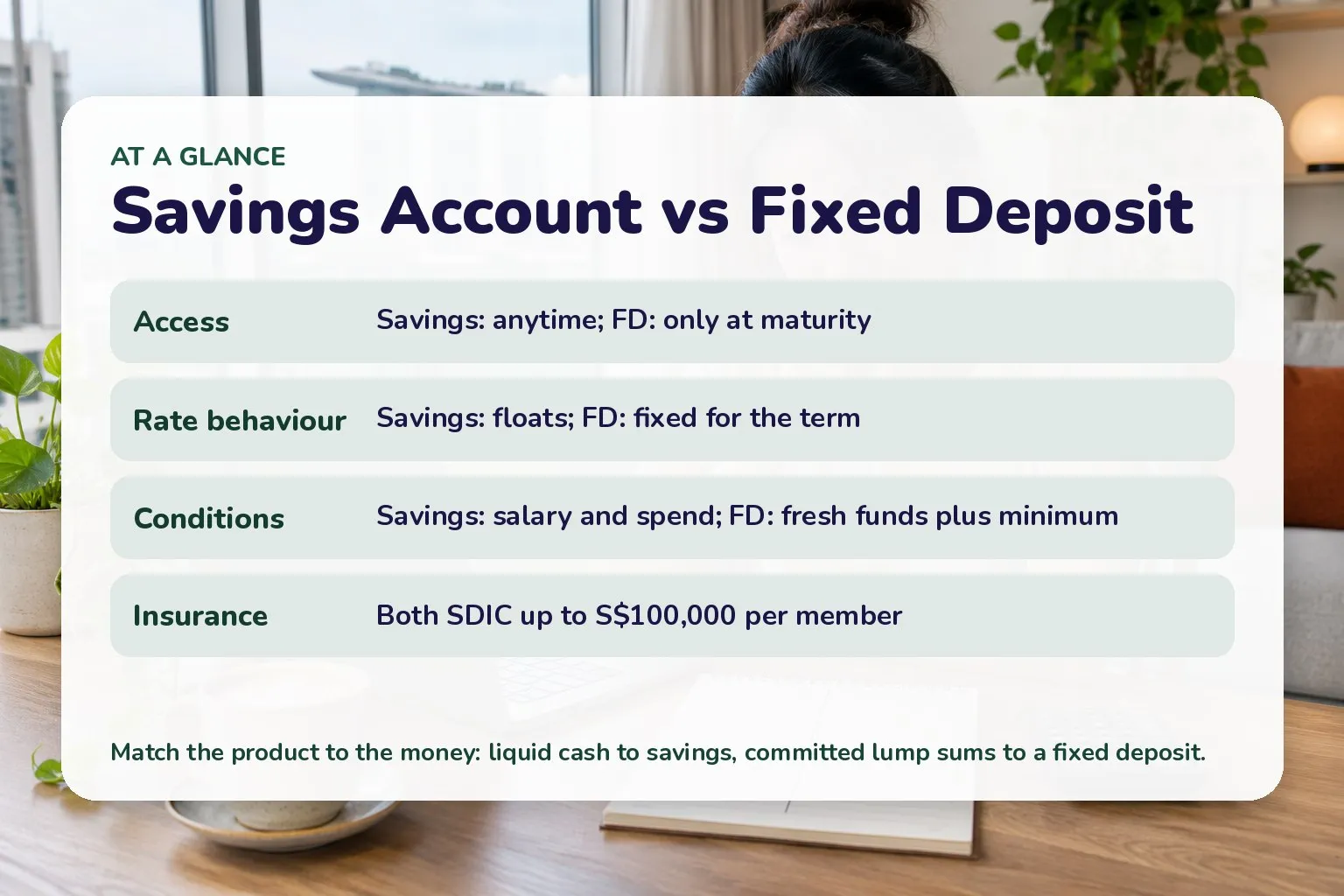
Savings account vs fixed deposit on the four features that decide the choice.
The cost of breaking a fixed deposit early
This is the trap that catches savers. If you withdraw a fixed deposit before maturity, MoneySense warns “you may receive no interest or suffer partial loss of interest on the deposit”, and “in some cases, you may also need to pay a fee which could potentially result in you receiving less than the initial deposit placed”. In practice the cost is often not “a little less interest” but no interest at all for the whole term — turning a 2% deposit into a 0% one.
Because of this, a fixed deposit suits only money that matures before you need it. If you are unsure of the timing, a better route is to keep the cash liquid or use something you can redeem when you choose, such as Singapore Savings Bonds, which can be redeemed monthly — see how to apply for Singapore Savings Bonds.
Is my money safe in either
Both are among the safest homes for Singapore dollars. Eligible Singapore-dollar deposits — savings, current and fixed — at a Scheme member are insured by the Singapore Deposit Insurance Corporation (SDIC) up to S$100,000 per depositor per member, with your accounts at that member aggregated towards the one limit.
How much to keep liquid first
Before locking anything away, set aside your emergency fund — MoneySense suggests “3 to 6 times of your monthly expenses” — and keep it in a liquid savings account. Only cash beyond that buffer, with a known future use, belongs in a fixed deposit. Sequencing it this way means you never have to break a deposit for an emergency and eat the interest loss.
A worked example
Say you have S$20,000 you will not touch for eight months.
- Fixed deposit: at 2.08% p.a. for 8 months, the gross interest is roughly S$20,000 x 2.08% x 8/12 = about S$277, paid at maturity — provided you leave it the full term.
- No-conditions savings account: at 1.2% p.a. for the same 8 months, roughly S$20,000 x 1.2% x 8/12 = about S$160, and you can withdraw any time without losing it.
Here the fixed deposit earns about S$117 more, but only if you leave the money untouched for the full 8 months; the savings account pays less and keeps access. So lock up money you are sure you will not need, and keep your emergency cash liquid. The figures are illustrative; both rates can change, so confirm current offers before you act.
A simple way to decide
- Is this my emergency fund or might I need it soon? Savings account — keep it liquid.
- Do I have a lump sum with a known future date I can commit fully? Fixed deposit, matched to that date.
- Which actually pays more for me? Compare the savings rate I will truly earn (after conditions) against the fixed-deposit rate — for money I may need soon, a no-hoops digital account keeps access even when it pays less.
- Do I think rates will fall? Lock in with a fixed deposit. Rise? Favour a floating savings account.
Frequently asked questions
Is a fixed deposit better than a savings account? Neither is universally better. A fixed deposit locks a rate for money you can commit; a savings account stays liquid, and at current rates a no-conditions digital account pays less than the best fixed-deposit promotions. Match the product to the money.
Can I withdraw a fixed deposit early? Yes, but you typically forfeit most or all of the interest and may pay a fee, sometimes receiving back less than you placed. Only lock away money you are sure you can leave.
Are both insured the same way? Yes — eligible Singapore-dollar deposits are covered up to S$100,000 per depositor per Scheme member by SDIC, including deposits with licensed finance companies.
Do I have to credit my salary for a fixed deposit? No — that is a savings-account bonus condition. Fixed deposits instead usually need “fresh funds” and a minimum sum, with no monthly hoops.
What if I’m not sure when I’ll need the money? Keep it liquid in a savings account, or use something you can redeem when you choose such as a Singapore Savings Bond, rather than locking it in a fixed deposit.
Related
- Fixed deposit rates in Singapore
- High-interest savings accounts compared
- How SDIC deposit insurance works
General information on deposits, not financial advice. Rates, minimums and conditions change frequently; confirm the current figures on each institution’s official page before you place money.
Sources
- Understanding bank accounts (savings, current and fixed deposit) — MoneySense (MAS) (as of November 2026)
- Managing your money (budgeting and emergency funds) — MoneySense (MAS) (as of November 2026)
- Deposit Insurance Scheme coverage — Singapore Deposit Insurance Corporation (as of November 2026)
- Hong Leong Finance Fixed Deposit promotion (8-month and 6/9/12-month rates) — Hong Leong Finance (as of 23 October 2026)
- GXS Savings Account (no-conditions daily interest) — GXS Bank (as of November 2026)
- Domestic Interest Rates (deposit rate context) — Monetary Authority of Singapore (as of November 2026)