How to Get Credit Card Fee Waivers in Singapore

Most credit card annual fees in Singapore can be waived. Request it through your bank's app, chatbot or hotline once the fee is charged, or spend enough in the year to trigger an automatic waiver — DBS, OCBC and UOB each publish their own threshold.
On this page9 sections · tap to jump
The annual fee on a Singapore credit card is, as MoneySense puts it, simply “Charged every year as a subscription” — and for most mainstream cards that subscription is optional. Banks will waive it if you ask through the right channel, or if you spend enough during the year to trigger an automatic waiver. This guide shows exactly how to do that at the three biggest issuers — DBS, OCBC and UOB — what each one requires, what changed in 2026, and the few cards where the fee genuinely cannot be removed.
What the annual fee costs
Before you waive it, know what is at stake. The standard principal-card annual fee at DBS, OCBC and UOB clusters around S$196.20 including GST, with a supplementary card at S$98.10. Some cards sit lower — the DBS Woman’s Mastercard is S$163.50 — and premium cards run far higher. At DBS the Vantage Card fee is S$599.50; at UOB the PRVI Miles and Visa Signature cards are S$261.60 and S$218.00, and the metal cards reach into four figures.
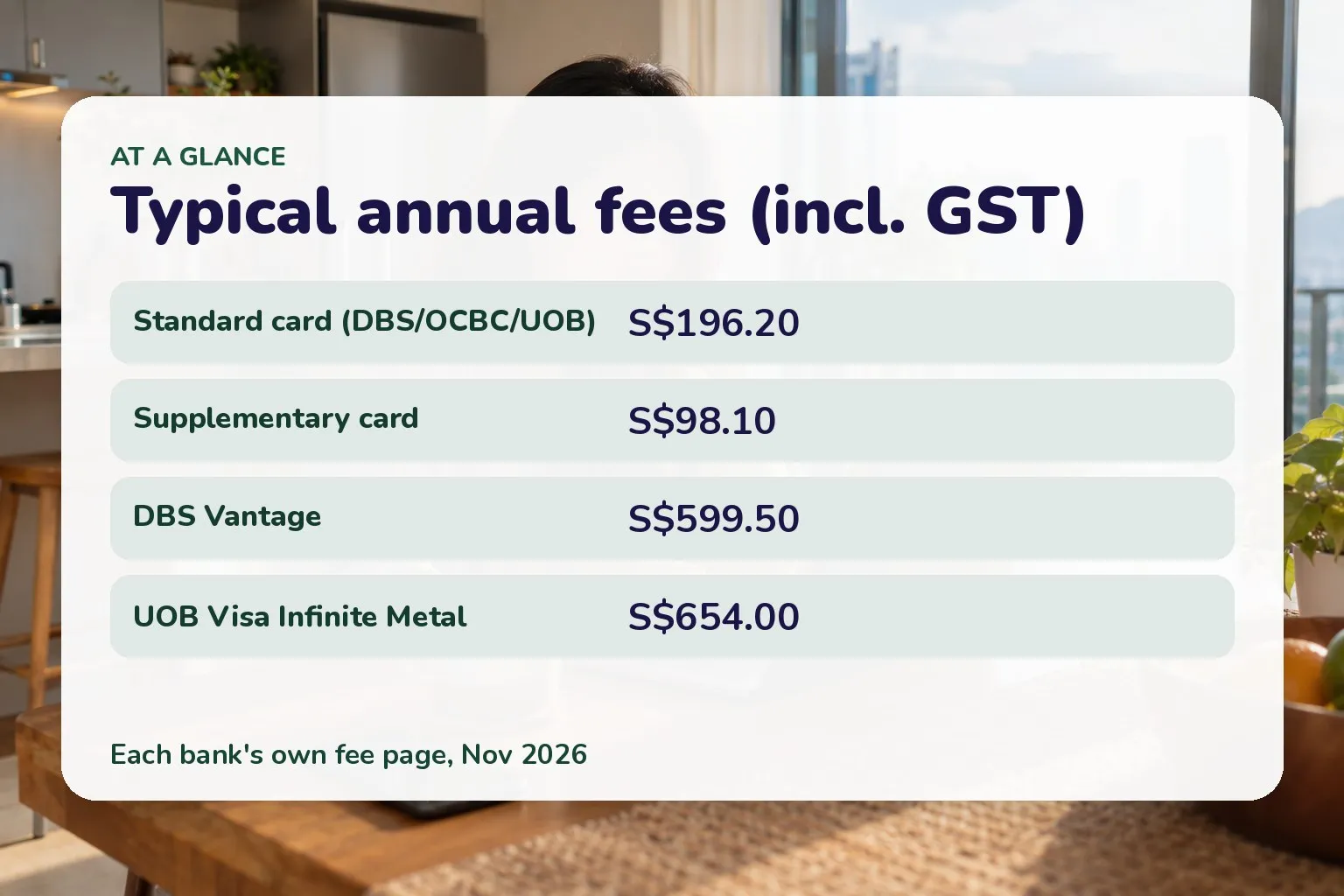
Principal-card annual fees at the three biggest issuers. Source: DBS, OCBC and UOB card fee pages, November 2026.
The fee is billed before you can earn anything back from it. DBS states plainly that the “Annual Fee is charged up-front yearly on your card(s) approval date”, so it lands on your statement first and you request the reversal after. That is why knowing the waiver process matters: the money is already charged, and getting it back is a deliberate step.
How a fee waiver actually works
A waiver is a reversal of a fee that has already posted. You submit a request, the bank checks your eligibility, and if approved the charge is credited back. The big shift in recent years is that this is now a self-service process — you no longer talk your way into it with a customer service officer at DBS or UOB.
DBS accepts requests only through automation: “Fee waiver requests are only accepted via the automated system.” You use the DBS digibot, which is “available 24/7”, or the automated phone line. UOB is the same — “Credit/Debit Card fee waiver requests are only accepted via our automated self-serve channels, we will no longer accept fee waiver requests via a customer service officer” — a policy in force “From 1st February 2025”. Either way you get a decision fast: DBS says “An email/SMS will be sent to you as per your registered bank record on the status of your waiver request within 3 working days.”
Bank by bank: where to request
Each issuer publishes its own channels. These are the official routes as at November 2026.
- DBS / POSB. Open the DBS digibot (bottom-right chat on the website or in the app), type “Fee Waiver”, authenticate, choose Credit Cards Fee Waiver, pick the fee type and the card, and confirm. Or call the automated line: “Dial 1800 111 1111 (from Singapore) or (+65) 6327 2265 (from Overseas)” and press 1 for a fee waiver request.
- UOB. Use the UOB TMRW app (Accounts → select card → Services → “Waive fees”), the UOB Digital Assistant, or Phone Banking. There is no officer route.
- OCBC. OCBC leans on an automatic spend-based waiver (below) rather than a one-tap request button; if the fee posts and you believe you qualify, contact the bank through its app or hotline to have it reviewed.
For every bank, the request must be timely. UOB only looks at fees that are recent: “fee waiver requests are only considered for Annual / Membership Fee charges in your current unbilled transactions or within the past 3 statement months.” Leave it longer and the fee sticks.
Spending your way to an automatic waiver
The cleaner route is to never pay the fee in the first place by meeting a spend target, after which the bank waives it without you asking. The thresholds are card-specific and published.
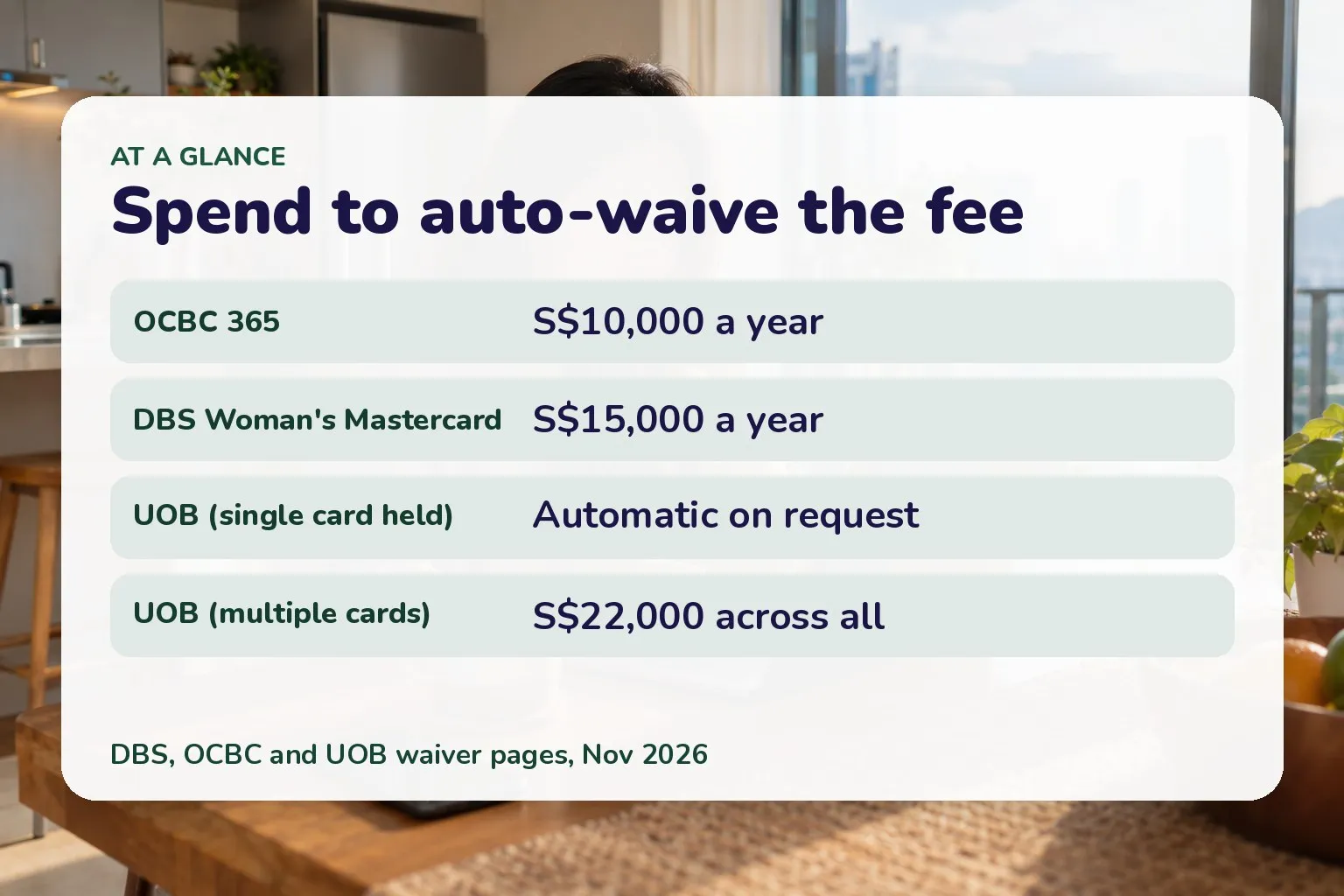
Published annual spend that triggers an automatic waiver. Source: DBS, OCBC and UOB, November 2026.
OCBC is the most transparent: on the 365 card the fee is “S$196.20 (including GST), waived for the first two years”, and after that the “Minimum spending required to have your Annual Service Fee automatically waived” is “S$10,000 in one year, starting from the month in which your OCBC 365 Credit Card was issued.” DBS historically ran similar targets — S$15,000 on the Woman’s Mastercard, S$25,000 on Altitude cards, S$60,000 on the Vantage.
UOB spells out the arithmetic for people who hold several of its cards. If you only hold one UOB credit card, the waiver is automatic on request. Otherwise you must spend “S$5,500 on credit card charged w/ Annual Fee, or S$22,000 across all UOB credit cards, or S$3,000 in overseas spend across all UOB credit cards”, and “This spend must be within the first 11 months from your card anniversary date.”
Cards that cannot be waived
Not every fee is negotiable. UOB marks its top metal and invitation-only cards as non-waivable: the “Visa Infinite Metal Card” at “S$654.00” and the “Reserve” at “S$3,924.00” both show “Cannot be waived” in UOB’s own fee table, and the fee-waiver page excludes “fee-paying premium cards such as Visa Infinite Metal Card and Reserve Card.” These cards bundle lounge access, concierge and travel perks whose value is meant to justify the fee, so treat that fee as the real price of holding the card.
At the other end, some cards carry no annual fee at all. UOB notes that the “UOB EVOL card and Singtel-UOB card do not have an Annual Fee effective 1st July 2026”, and the DBS Live Fresh Student Card is free for its first five years. If a fee-free card covers your spending, that sidesteps the whole exercise.
Late fees and finance charges
Waivers are not only for the annual fee. If you slip on a payment, you can also ask the bank to reverse a late fee — which MoneySense notes “is often a flat $100, regardless of the size of the bill” — or a finance (interest) charge. But goodwill here is rationed. UOB grants “one (1) finance charge or late charge waiver across all eligible account(s) with the Bank within a period of 12 rolling months”, and will not consider further requests or appeals once you have used it. So a one-off genuine slip is usually forgiven; a pattern of late payment is not. The durable fix is a GIRO instruction for at least the minimum payment, which stops the S$100 late fee from ever triggering. If interest has already built up, understand how it compounds first — see how credit card fees and interest work.
If your request is rejected
A refusal is usually about eligibility, not a mistake. UOB states that “Your Annual Fee Waiver request has been declined if you did not meet the eligibility criteria during the applicable annual fee period” — typically because you have not spent enough, you hold a non-waivable card, or you already used your one goodwill waiver. If you were turned down:
- Check you used the right channel. A request outside the automated system, or for a fee older than the last three statements at UOB, is not processed.
- Try the other channel. If the chatbot declined, the automated phone line (or app) may reconsider, and a short appeal can be lodged by phone.
- Meet the spend target. If the card has a published threshold, charging the balance of that spend before the assessment window closes converts the fee to an automatic waiver next cycle.
- Weigh cancelling. If none of that works and you do not use the card, cancelling is the rational end point.
When cancelling makes more sense
A waiver keeps a card you actually use; it is not worth contorting yourself to keep a card you do not. If you have stopped using a card, the annual fee buys you nothing, and repeated waiver requests on a dormant card are exactly what banks decline. In that case, clear any outstanding balance and close the card before the next fee bills. Freeing yourself of unused cards also keeps your credit profile tidy — relevant if you are managing your credit score in Singapore. Money you are not losing to fees can instead sit in a high-interest savings account working for you.
Frequently asked questions
Can I really get my credit card annual fee waived? For most mainstream cards, yes — either by requesting it through your bank’s app, chatbot or automated hotline after it is charged, or by meeting a published annual spend target that waives it automatically.
How long does a waiver decision take? At DBS, an SMS or email on the outcome arrives within about three working days; UOB and OCBC are broadly similar.
Will I lose my miles if I waive the fee? On DBS Altitude and Vantage cards, yes — the bonus points credited when the fee was charged are reversed when the fee is waived, so make sure the points are still in your account.
Which cards cannot be waived? Premium metal and invitation cards such as the UOB Visa Infinite Metal Card (S$654.00) and UOB Reserve (S$3,924.00) are marked “Cannot be waived”.
Is it better to cancel a card than keep requesting a waiver? If you no longer use the card, yes. Clear the balance and close it before the next annual fee is billed rather than paying for a card that earns you nothing.
General information on credit card fees, not financial advice. Fees, thresholds and waiver channels are set by each bank and change often; confirm the current terms on your bank’s own card page before you rely on them.
Sources
- Waive Credit Card / Cashline Fees & Charges — DBS Bank (as of November 2026)
- DBS Credit Card Annual Fee — DBS Bank (as of November 2026)
- UOB Card Fee Waiver — UOB (as of November 2026)
- UOB Credit Card Annual Fee — UOB (as of November 2026)
- OCBC 365 Credit Card (annual fee and automatic waiver) — OCBC Bank (as of November 2026)
- Understanding Credit Card Interest And Charges — MoneySense (MAS) (as of November 2026)