Money Market Funds in Singapore: A Plain Guide

A money market fund is a low-risk unit trust that parks your cash in short-term instruments like T-bills and bank deposits, aiming for a return close to short-term deposit rates with daily access. It is not capital-guaranteed and is not covered by SDIC deposit insurance.
On this page8 sections · tap to jump
A money market fund (MMF) is a simple way to earn a little more than a savings account on cash you might need soon, without locking it up. UOB Asset Management describes the category well: “Money market funds are popular cash management tools. They are an alternative to short-term deposits that provides capital preservation and is redeemable when you have a need.” In Singapore these funds hold short-dated instruments such as Treasury bills and bank deposits, aim for a return close to short-term deposit rates, and let you redeem on any business day. The important catch — the reason this sits under investing, not banking — is that an MMF is a unit trust, so it is neither capital-guaranteed nor covered by deposit insurance.
What a money market fund is
Structurally, an MMF is a collective investment scheme — MoneySense notes that “local and foreign funds offered to retail investors are regulated as collective investment schemes.” Your money is pooled with other investors’ and used to buy a diversified basket of very short-term, high-quality debt. You own units; the price of each unit is the fund’s net asset value (NAV) per unit, and “The NAV is usually computed daily to reflect changes in the prices of the investments held by the fund.”
The goal is deliberately modest. A money market fund is not trying to grow your wealth; it is trying to hold its value and stay liquid while paying a bit of yield. UOBAM frames its fund’s aim as providing “a return which is comparable to that of Singapore dollar short-term deposits”, and Fullerton’s SGD Cash Fund “seeks to provide investors with liquidity while achieving a return that is comparable to the SGD Bank Saving Deposits rate.” Think of it as a parking space for cash, not a destination for long-term savings.
What is inside a money market fund
The holdings are short-term and conservative. A Singapore-dollar MMF typically mixes government bills, bank fixed deposits and high-grade short-dated debt. Fullerton’s SGD Cash Fund, for example, reported an asset split of roughly “Deposit 58.9%” and “Treasury Bills 41.4%” as of 31 August 2026 — in other words, mostly bank placements and MAS/Singapore T-bills. UOBAM keeps its fund’s average maturity short: “Investments in the Fund have an average maturity of not more than 6 months.”
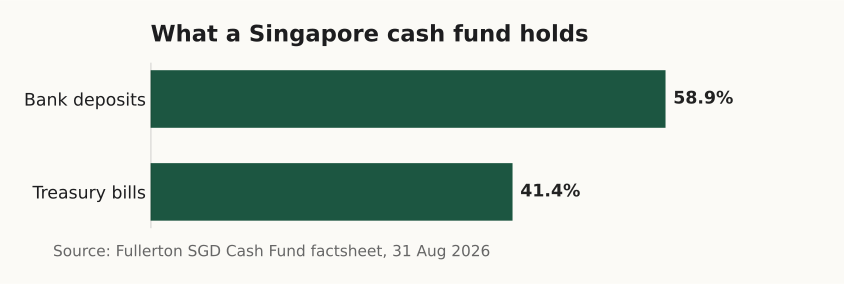
Asset split of a large SGD cash fund. Source: Fullerton SGD Cash Fund factsheet, 31 August 2026.
Because the instruments are short-dated and high-quality, the funds carry low interest-rate sensitivity and low credit risk — but not zero. MoneySense’s reminder on bond-type funds applies: “debt securities prices generally fall when interest rates rise”, which is why a fund’s unit price can dip, even if only slightly, when rates move.
What returns to expect
Set expectations at “a little better than a savings account”, not “a windfall”. Recent SGD money market fund yields have clustered around 1.5% a year. Fullerton’s SGD Cash Fund showed a gross yield of “1.5%” on a five-day rolling basis as of 31 August 2026, and UOBAM’s United SGD Money Market Fund reported that “As of August 2026, the Fund’s weighted average yield to maturity is 1.56 per cent.” Those are gross figures before fees, and they are not promises — the monthly return on UOBAM’s fund was “+0.08 per cent” in August 2026 against a benchmark (3-month compounded SORA) of “+0.10 per cent”.
Are money market funds safe?
They are among the lowest-risk funds you can buy, but they are investments, and two differences from a bank account matter.
First, no deposit insurance. The Deposit Insurance Scheme, run by SDIC, protects your SGD bank deposits “for up to $100,000 per depositor per Scheme member” — but it explicitly excludes “Investment products like shares, unit trusts.” A money market fund is a unit trust, so that S$100,000 safety net does not apply to it. (For what the scheme does cover, see how SDIC deposit insurance works.)
Second, it is not a deposit. Fullerton states the point as starkly as a fund manager can: “Any investments in the Fund must not at any time be thought of as similar to a deposit in a bank.” Your capital rides on the value of the underlying instruments. In practice SGD cash funds have been very stable, but “very stable” is not the legal certainty a fixed deposit gives you.
Fees and how they eat into returns
Fees on SGD cash funds are low, but they bite because the yield itself is small. Fullerton has capped its management fee at 0.16% a year since February 2024; LionGlobal’s SGD Money Market Fund lists share classes from “Currently 0.10% p.a.” upward, and UOBAM’s fund charges no sales fee at all. Some funds also charge a one-off sales (preliminary) charge, though several waive it, and UOBAM’s fund advertises that “no subscription or realisation fees are charged on the investment and redemption amounts.”
The reason to watch fees is that they are unconditional. As MoneySense warns, “Fees are usually payable regardless of how well or poorly the fund performs.” On a fund yielding 1.5%, even a 0.16% fee is already more than a tenth of your gross return — so comparing the all-in cost across platforms is worth a few minutes.
How to buy and how quickly you get your cash
You buy MMFs the way you buy any fund: through a bank or an online fund platform. MoneySense confirms the funding options — “You can invest in funds using cash, or via the Supplementary Retirement Scheme (SRS) … or the Central Provident Fund Investment Scheme (CPFIS)” — so idle SRS money can sit in a cash fund too (see our SRS account guide). Only funds on MAS’s authorised/recognised list may be sold to retail investors.
Liquidity is the selling point. These funds deal daily, and redemptions are quick: Fullerton promises “Next business day settlement during redemption”, so cash is typically back with you one business day after you sell. You also get a short cooling-off window on a new purchase — MoneySense says “You can change your mind about your fund purchase within 7 calendar days”, though that right does not apply to top-ups of a fund you already hold.
Money market fund vs the alternatives
An MMF is one of several places to keep low-risk SGD. The right pick depends on whether you value flexibility or a locked, known return.
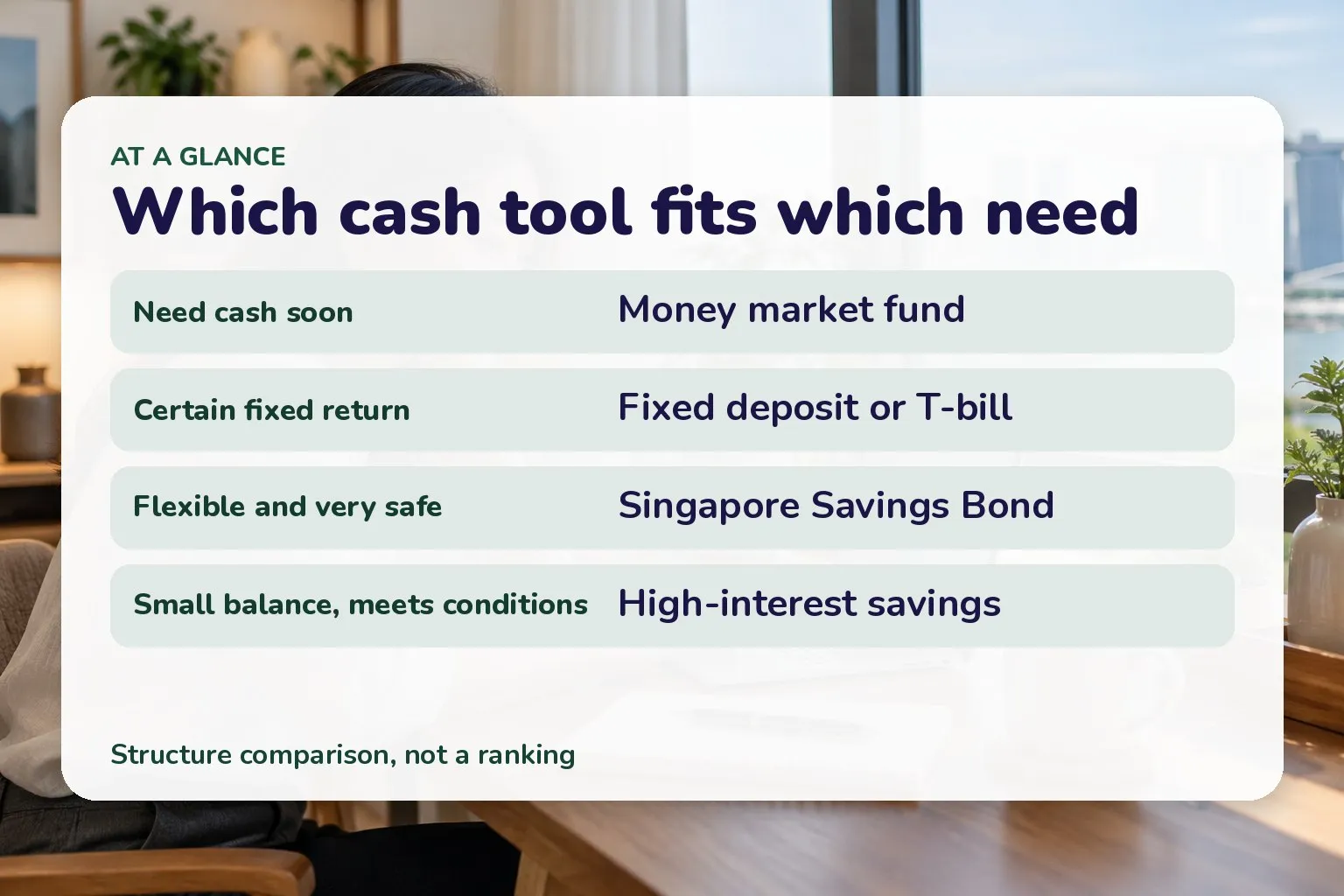
A quick per-need guide; compare current rates before deciding.
| Option | Return basis | Access to cash | SDIC-insured? | Best for |
|---|---|---|---|---|
| Money market fund | Variable, ~short-term deposit rates | Any business day, ~1 day to settle | No | Parking cash you may need soon |
| Fixed deposit | Fixed, known upfront | Locked for the tenure | Yes (up to S$100k) | A certain return you won’t touch |
| T-bill | Fixed at auction (discount) | Locked ~6–12 months | No (but SG government) | A known short-term yield |
| Singapore Savings Bond | Step-up, government-backed | Redeem any month, no penalty | No (but SG government) | Flexible, very safe medium-term |
| High-interest savings account | Variable, condition-based | Instant | Yes (up to S$100k) | Everyday cash that meets the conditions |
The per-need verdict: for cash you might need at short notice but want to earn a little on, a money market fund is the natural fit thanks to daily dealing and no lock-in. If you can commit the money and want certainty, a fixed deposit or a T-bill gives a rate you know in advance. For a flexible, government-backed option you can exit any month, a Singapore Savings Bond wins. And for smaller balances where you can meet the salary/spend conditions, a high-interest savings account can beat all of them while keeping SDIC cover. Compare current rates on each before deciding — the gap narrows and widens as interest rates move.
Frequently asked questions
Is a money market fund safe? It is low-risk, not risk-free. The holdings are short-term and high-quality, but the fund is not capital-guaranteed and is not covered by SDIC deposit insurance, so it is not the same as a bank deposit.
How much can I earn? Recent SGD fund yields have been around 1.5% a year gross, but the figure is variable and moves with interest rates. It is never fixed or promised.
Can I lose money? In theory yes — MoneySense states funds “are not principal or capital-guaranteed.” In practice SGD cash funds have been very stable, but the unit price can still move.
How fast can I get my money out? Most SGD cash funds deal every business day and settle redemptions the next business day, so you are rarely more than a day or two from cash — far quicker than breaking a fixed deposit.
Can I use SRS or CPF money? Yes. Funds can be bought with cash, SRS or CPFIS money, subject to each scheme’s rules and the fund being eligible.
What fees will I pay? Typically a low management fee — Fullerton’s, for instance, is capped at 0.16% a year — sometimes with a sales charge (often waived). Fees are charged regardless of performance, so compare the all-in cost.
General information on money market funds, not financial or investment advice. Fund yields, fees and holdings are set by each manager and change; read the fund’s prospectus and product highlights sheet, and check your own tax position with IRAS, before investing.
Sources
- Understanding unit trusts — MoneySense (MAS) (as of November 2026)
- Understanding deposit insurance — MoneySense (MAS) (as of November 2026)
- United SGD Money Market Fund (what a money market fund is) — UOB Asset Management (as of November 2026)
- United SGD Money Market Fund — monthly commentary (August 2026) — UOB Asset Management (as of August 2026)
- Fullerton SGD Cash Fund (featured fund) — Fullerton Fund Management (as of November 2026)
- Fullerton SGD Cash Fund — Class A factsheet (August 2026) — Fullerton Fund Management (as of August 2026)
- LionGlobal SGD Money Market Fund — factsheet — Lion Global Investors (as of November 2026)