CPF Allocation Rates: OA, SA and MA Split

Your CPF contribution is divided across three accounts by age. A worker 35 and below has about 62% go to the Ordinary Account, 16% to the Special Account and 22% to MediSave; the Ordinary share shrinks and the MediSave share grows as you get older.
On this page10 sections · tap to jump
- 01Allocation is not the same as the contribution rate
- 02The 2026 allocation rates by age
- 03How CPF works out the split
- 04Worked dollar splits by age
- 05Why the split shifts with age
- 06What changes at 55
- 07When an account is already full
- 08Permanent residents
- 09What changes in 2027
- 10Frequently asked questions
Every CPF contribution you make is split three ways — into your Ordinary Account (OA), your Special Account (SA) (or Retirement Account (RA) from age 55), and your MediSave Account (MA). The share going to each is set by official CPF allocation rates that depend on your age. For a worker aged 35 and below, roughly 62% goes to the OA, 16% to the SA and 22% to MediSave; as you age, less flows to the OA and more to retirement and healthcare. This guide shows the full 2026 allocation table, the order CPF uses to work out the split, dollar-by-dollar examples, and what changes at 55. Every figure is from the CPF Board.
Allocation is not the same as the contribution rate
Two different things decide where your CPF money ends up. The contribution rate fixes the size of the monthly pay-in. The allocation rate then slices that pay-in across your accounts. The CPF Board applies allocation rates to Singapore Citizens and Permanent Residents (from their third year), earning more than $750 a month, in the private sector or on non-pensionable terms.
Each account does a different job: the OA can be used for housing, insurance, investment and education; the SA/RA builds your retirement income; and MediSave pays for healthcare and approved medical insurance. Because the three accounts also earn different interest rates, the split quietly affects how much of your money earns the higher CPF rate — see CPF interest rates explained.
The 2026 allocation rates by age
Allocation rates are expressed as a ratio of each contribution. For 2026 they are:
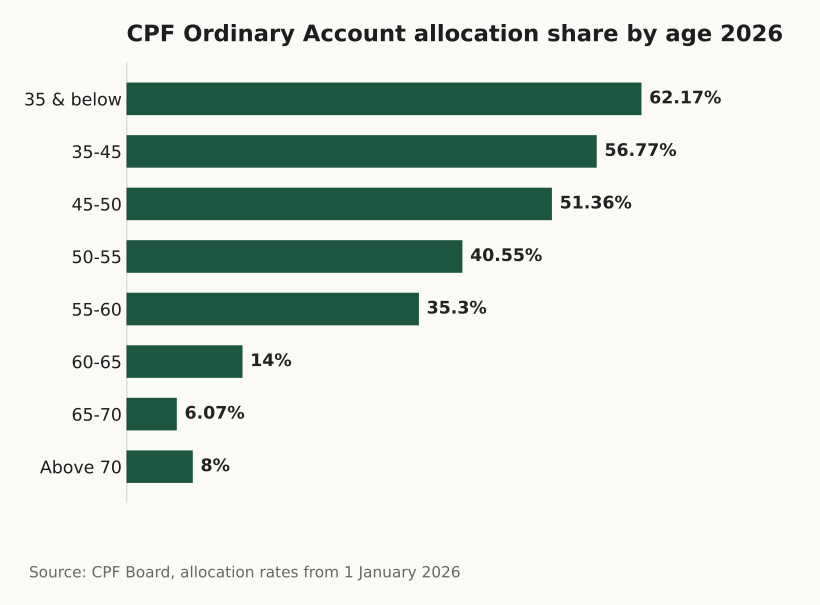
Share of each CPF contribution going to the Ordinary Account by age, 2026; the rest goes to Special/Retirement and MediSave. Source: CPF Board.
| Employee’s age | Ordinary Account | Special / Retirement | MediSave |
|---|---|---|---|
| 35 and below | 62.17% | 16.21% (SA) | 21.62% |
| Above 35 to 45 | 56.77% | 18.91% (SA) | 24.32% |
| Above 45 to 50 | 51.36% | 21.62% (SA) | 27.02% |
| Above 50 to 55 | 40.55% | 31.08% (SA) | 28.37% |
| Above 55 to 60 | 35.30% | 33.82% (RA) | 30.88% |
| Above 60 to 65 | 14.00% | 44.00% (RA) | 42.00% |
| Above 65 to 70 | 6.07% | 30.30% (RA) | 63.63% |
| Above 70 | 8.00% | 8.00% (RA) | 84.00% |
Two patterns stand out. The OA share collapses with age — from more than three-fifths of a young worker’s contribution to single digits once past 65 — because housing needs fade. And the MediSave share climbs steadily, reaching the vast majority of the contribution past 70, because healthcare costs rise in old age.
How CPF works out the split
The order matters, because it decides what lands in the OA. The CPF Board computes the MediSave share first, then the Special or Retirement share, and the remainder goes to the Ordinary Account. In other words, the OA is the residual: it gets whatever is left after healthcare and retirement have taken their slices.
Worked dollar splits by age
Turning the ratios into real money shows how the same salary is divided differently over a career. Take a monthly CPF contribution of 37% of a $5,000 wage — about $1,850 — for an employee aged 55 and below.
- A 30-year-old (35 and below band): roughly $1,150 to the OA, $300 to the SA and $400 to MediSave. Most of it is available for a home.
- A 52-year-old (above 50 to 55 band): roughly $750 to the OA, $575 to the SA and $525 to MediSave. The OA slice has fallen by about a third while retirement and healthcare savings have grown.
(Both illustrative, using 2026 allocation rates and the 37% rate; your contribution depends on your actual wage and age.)
Why the split shifts with age
The design follows life stages. Early on, a large OA share helps you buy and pay for a home. From your late 40s, more is steered into the SA so your retirement pot compounds for longer, and the MediSave share keeps rising to pre-fund healthcare you are statistically more likely to need later. By the time contributions are small in your 70s, almost all of each dollar is routed to MediSave, where it is most useful.
What changes at 55
At 55 the Special Account is closed and a Retirement Account is created. From then on, the portion that would have gone to the SA is fully allocated to the RA, up to your Full Retirement Sum (FRS). Once you have already set aside the FRS in your RA, those contributions are channelled to your Ordinary Account instead.
So from 55 the three-way split still exists, but the middle slice feeds your RA rather than an SA, and a well-funded retiree can see more landing back in the OA. For how the FRS, Basic and Enhanced Retirement Sums work, see CPF retirement sums: BRS, FRS and ERS.
When an account is already full
MediSave has a ceiling: the Basic Healthcare Sum (BHS), which is S$79,000 in 2026 for members below 65 and for those turning 65 this year. It is the most you can hold in MediSave. If your MediSave contribution for the month would push you past the BHS, the excess is automatically transferred to your other CPF accounts rather than lost. A similar overflow applies once your RA reaches the FRS, as above. For what the MediSave balance can actually be spent on, see what you can use MediSave for.
Permanent residents
New PRs are on graduated contribution rates for their first two years, and their allocation follows separate PR tables for those years before moving to the rates above in year three. The principle is the same — MediSave first, then SA/RA, then the OA — but the exact ratios differ in the graduated years. Check the CPF Board’s allocation-rate tables for your SPR year and age band.
What changes in 2027
Allocation rates are not frozen. In step with the senior-worker contribution-rate increases from 1 January 2027, the allocation for the above-55-to-60 and above-60-to-65 bands shifts further towards the Retirement Account, so more of a senior worker’s contribution goes to retirement savings (the MediSave share of the split dips slightly). The CPF Board publishes a separate 2027 allocation table; check it for the exact ratios for your band before relying on them.
Frequently asked questions
What is the difference between contribution and allocation rates? The contribution rate sets how much goes into CPF (for example 37% of wages at 55 and below). The allocation rates then divide that amount between the OA, SA/RA and MediSave.
Which account is worked out last? The Ordinary Account. CPF computes the MediSave share, then the SA/RA share, and the OA gets the remainder.
Do the ratios change every year? Not usually, but they are revised when contribution rates change — as they are for senior workers from 1 January 2027.
What happens to the SA share after 55? It is redirected to your Retirement Account up to the Full Retirement Sum; beyond that it goes to your Ordinary Account.
Where can I see my own allocation? Log in to your CPF account to see how each contribution was split, or use the allocation-rate tables on the CPF website for your age band.
Related
- CPF contribution rates by age
- CPF interest rates explained
- CPF retirement sums: BRS, FRS and ERS
- What you can use MediSave for
General information on CPF allocation rates, not financial advice. Allocation ratios and the Basic Healthcare Sum are set by the CPF Board and change over time; confirm your own figures with the CPF Board before relying on them.
Sources
- Saving as an employee (contribution and allocation rates) — Central Provident Fund Board (as of November 2026)
- CPF Allocation Rates from 1 January 2026 (PDF) — Central Provident Fund Board (as of November 2026)
- CPF overview (contribution rates by age) — Central Provident Fund Board (as of November 2026)
- CPF Allocation Rates from 1 January 2027 (PDF) — Central Provident Fund Board (as of November 2026)
- CPF interest rates and Basic Healthcare Sum for 2026 — Central Provident Fund Board (as of November 2026)