SGS Bonds vs T-Bills vs SSB: Which to Pick

All three are backed by the Singapore Government. For cash you may need within a year and want penalty-free access, pick an SSB; to lock the best short yield, a 6-month T-bill (1.95%, 22 Oct 2026); for a fixed multi-year coupon, an SGS bond.
The Singapore Government offers individuals three safe places to park Singapore dollars: Singapore Government Securities (SGS) bonds, Treasury bills (T-bills) and Singapore Savings Bonds (SSBs). They are often lumped together, but they behave differently on the things that actually matter — how long your money is tied up, whether you can get it back early, and how much you earn. Here is how to choose, with the latest official rates.
Quick verdict
There is no single winner, because the three answer different questions. The overall pick for most savers who want safety with easy access is the SSB; the one paying the most right now for a short, fixed commitment is the 6-month T-bill; and the one for locking a coupon over several years is the SGS bond.
- Money you may need within a year, want zero penalty to exit → Singapore Savings Bond. You can redeem in any month at full face value. The current issue (GX26110X) returns 1.67% in year one, rising to a 2.45% p.a. average over 10 years.
- A lump sum you can leave untouched for 6–12 months, chasing the best rate → T-bill. The latest 6-month cut-off was 1.95% p.a. (22 Oct 2026) and the 1-year was 1.92% p.a. (15 Oct 2026) — currently the highest of the three at the short end.
- Income over several years, or to fix a rate for the long term → SGS bond. Recent auctions cleared at about 2.09% for 5 years (28 Oct 2026) and 2.30% for 10 years (27 Aug 2026), paid as a coupon every six months.
Runner-up for the “safe and flexible” job: a 6-month T-bill — it often out-yields the SSB’s first year, but you give up the monthly exit.
The three at a glance
All three are issued by the Singapore Government, so credit risk is negligible on each. The design is what differs:
- An SGS bond is a long-term, tradable bond. It pays a fixed coupon every six months and runs for 2, 5, 10, 15, 20, 30 or 50 years. You cannot redeem it early with the Government, but you can sell it on the secondary market — where the price floats.
- A T-bill is a short-term, zero-coupon security. You buy it at a discount to its S$100 face value and are repaid the full face value at maturity; the gap is your return. Tenors are 6 months and 1 year. Like an SGS bond, there is no early redemption with the Government — only a secondary-market sale.
- An SSB is a bond designed for individual savers. Interest steps up the longer you hold, you can redeem in any month with no penalty, and you always get your capital back in full because you redeem directly with the Government, not on a market.
Current yields compared
The chart lines up the most recent published rates for each at comparable points. Short-term, T-bills lead; stretch the horizon and SGS bonds pull ahead, while the SSB sits in between with the bonus of monthly liquidity.
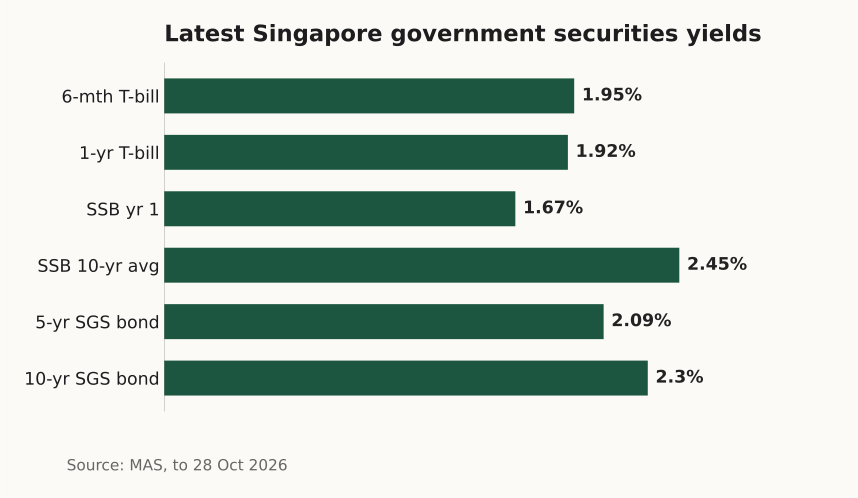
Latest published cut-off yields and SSB average returns. Source: MAS, to 28 Oct 2026.
Side by side
| Feature | SGS bond | T-bill | Singapore Savings Bond |
|---|---|---|---|
| Term | 2 to 50 years | 6 months or 1 year | Up to 10 years |
| How you earn | Fixed coupon every 6 months | Bought at a discount, repaid at face value | Step-up interest, paid every 6 months |
| Latest rate | ~2.09% (5-yr, 28 Oct 2026); ~2.30% (10-yr) | 1.95% (6-mth); 1.92% (1-yr) | 1.67% yr 1; 2.45% p.a. over 10 yrs |
| Get money back early | Sell on secondary market (price floats) | Sell on secondary market (price floats) | Redeem any month at face value, no penalty |
| Minimum | S$1,000, then S$1,000 steps | S$1,000 | S$500, then S$500 steps |
| Maximum | Up to the auction allotment | Up to the auction allotment | S$200,000 per person, all issues |
| Funding | Cash, SRS, CPFIS | Cash, SRS, CPFIS-OA | Cash or SRS only (no CPF) |
| Tax | Interest tax-exempt for individuals | Return tax-exempt for individuals | Interest tax-exempt for individuals |
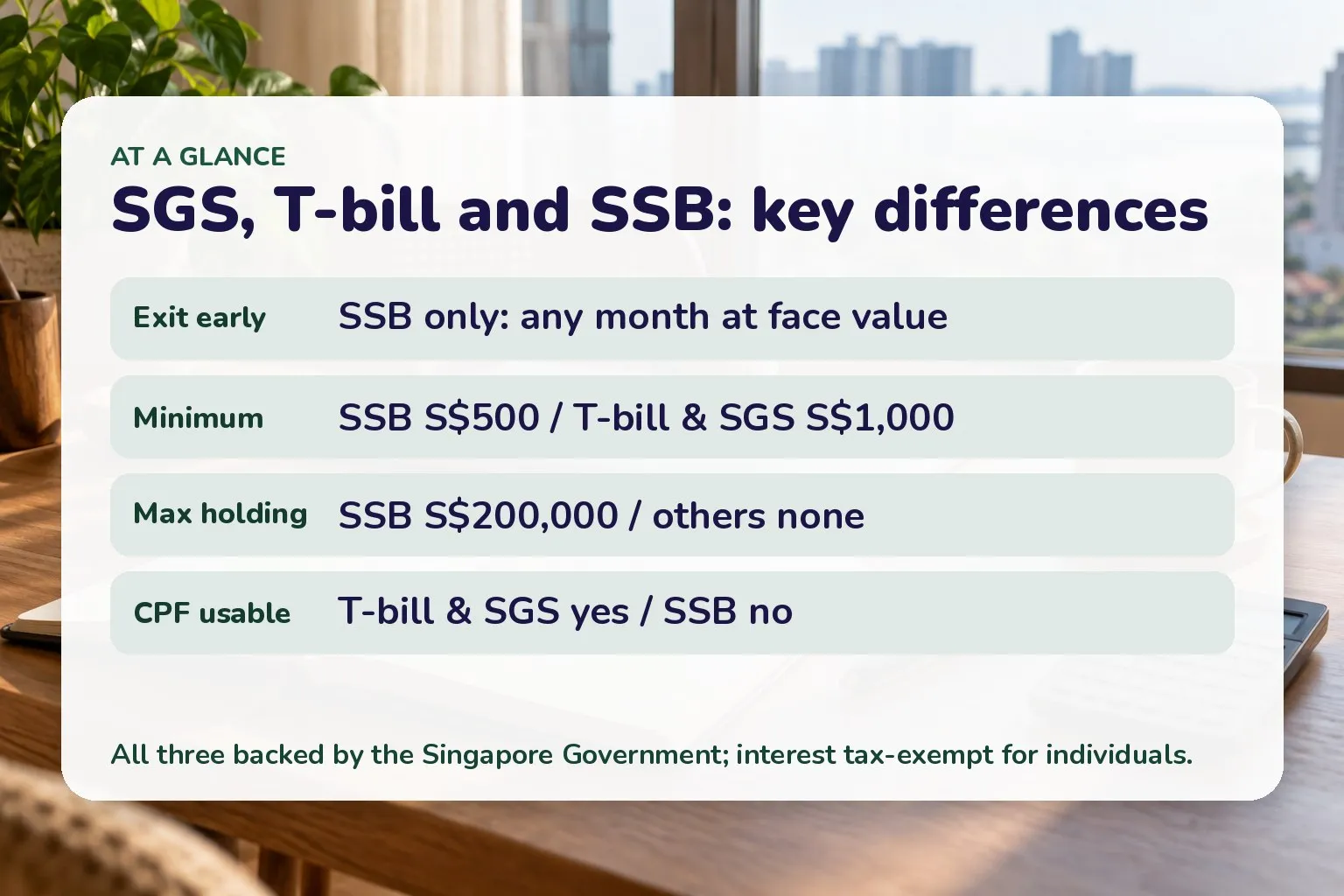
Key differences at a glance. Source: MAS, Oct 2026.
How the return is set
The three set your return in different ways, and this is the heart of the choice:
- T-bill — auctioned. You place a non-competitive bid (accept whatever yield the auction settles at) or a competitive bid (name the highest yield you will accept). You only know your exact return after the auction closes.
- SGS bond — also auctioned, but it carries a stated coupon; the auction sets the price you pay, and therefore your effective yield. Once you hold it, the coupon is fixed for the life of the bond.
- SSB — not auctioned against you. Each monthly issue publishes a full 10-year schedule of step-up rates in advance, derived from the previous month’s average SGS yields.
Getting your money back early
This is where the SSB stands alone, and it is usually the deciding factor.
- SSB: redeem in any month, including the month of issue, with no penalty and no minimum holding period. You get principal plus accrued interest by the second business day of the next month. There is no price risk — you always exit at face value.
- SGS bond and T-bill: there is no early redemption with the Government. To exit before maturity you sell on the secondary market (SGX through a broker, or at DBS, OCBC and UOB branches). MAS warns plainly that “the price of SGS bonds may rise or fall before maturity” — so you could get back more or less than you paid.
Minimums, caps and funding
The practical limits often decide the matter before yield does:
- Minimum: S$500 for an SSB (then S$500 steps), S$1,000 for both T-bills and SGS bonds.
- Maximum: an SSB is capped at S$200,000 per person across every issue you hold — there is no way around it by using several banks. T-bills and SGS bonds have no personal ceiling (you are limited only by the auction allotment).
- Funding: SSBs take only cash or SRS — CPF money cannot buy them. T-bills and SGS bonds also accept CPFIS funds through an agent bank (DBS, OCBC or UOB), though note the agent banks stopped accepting CPF Special Account applications for SGS from January 2025.
A worked example (illustrative)
Suppose you have S$20,000 you will not need for a year. The figures below use the latest published rates and are illustrative, not a forecast:
- 1-year T-bill at 1.92%: roughly S$384 of return over the year, fixed once your bid is filled.
- SSB, held one year at the current issue’s year-1 rate of 1.67%: roughly S$334, but you keep the right to redeem any month.
- 5-year SGS bond at 2.09%: about S$418 a year in coupons — higher, but your S$20,000 is committed for five years unless you sell on the market.
For a one-year horizon the T-bill wins on headline return; the SSB costs about S$50 of that in exchange for monthly access; the SGS bond pays most but locks you in far longer.
Who should not pick the SSB
The SSB is the safe default, but it is the wrong tool if:
- You have more than S$200,000 to place safely — the cap forces the rest into T-bills, SGS bonds or deposits anyway.
- You want to maximise a short-term rate and can commit the money — a T-bill currently pays more for 6–12 months.
- You want a predictable long-dated income stream — an SGS bond’s fixed semi-annual coupon over 5–50 years does that; the SSB maxes out at 10 years and its early coupons are deliberately low.
- You can only invest with CPF — the SSB does not accept it.
How to buy each
- T-bills and SGS bonds: apply at an auction via DBS/POSB, OCBC or UOB (ATM or internet banking) with cash or SRS, or through your CPFIS agent bank for CPF funds; holdings sit in your CDP or SRS account. See how to buy Singapore T-bills.
- SSBs: apply through the three banks’ ATMs or internet/mobile banking, or via your SRS operator, within the monthly application window. See Singapore Savings Bonds explained and the SSB ladder strategy.
FAQ
Which is safest? All three are backed by the Singapore Government. The SSB adds one extra protection: no market-price risk, because you redeem at face value rather than selling.
Which pays the most? It depends on the term. Right now a 6-month T-bill (1.95%) leads at the short end; a longer SGS bond pays more if you can lock the money up for years.
Can I lose money? Not if you hold a T-bill or SGS bond to maturity, or redeem an SSB (always at face value). You can only take a loss by selling an SGS bond or T-bill early for less than you paid.
Can I use CPF? For T-bills and SGS bonds, yes, through a CPFIS agent bank. For SSBs, no — cash or SRS only.
Bottom line
Match the product to the job. Need the money accessible and safe? The SSB wins on flexibility. Chasing the best rate on cash you can park for 6–12 months? A T-bill currently pays more. Want a fixed coupon over many years? An SGS bond. For a fuller treatment of the short-term trade-off, see T-bill vs fixed deposit.
General information on how these securities work, not financial advice. Rates are dated and change at every auction or monthly issue; check the current issue on the MAS website before applying.
Sources
- SGS Bonds: Information for Individuals — Monetary Authority of Singapore (as of 30 October 2026)
- Treasury Bills and SGS bond auction results (listbondsandbills API) — Monetary Authority of Singapore (as of 30 October 2026)
- Singapore Savings Bonds (overview) — Monetary Authority of Singapore (as of 30 October 2026)
- Savings Bonds issue and interest data (listsavingbonds API) — issue GX26110X — Monetary Authority of Singapore (as of 30 October 2026)
- Compare SGS products (tenors available) — Monetary Authority of Singapore (as of 30 October 2026)
- Investing in Savings Bonds (eligibility and limits) — Monetary Authority of Singapore (as of 30 October 2026)