T-Bill Reopening vs New Issue Explained

T-bills are never reopened — MAS issues a brand-new T-bill at every auction, each with its own issue code. Reopening, where MAS sells more of an existing bond with the same coupon and maturity, applies only to longer-dated SGS bonds.
On this page9 sections · tap to jump
If you have searched for a “T-bill reopening”, the honest answer is that there is no such thing. In Singapore, MAS issues a brand-new Treasury bill at every auction — each gets its own issue code and ISIN and is a fresh security. Reopening is a different mechanism that applies only to longer-dated SGS bonds. This page explains what reopening actually means, why T-bills are always new, and how to read the New / Re-open label on the MAS calendar so the terms stop being confusing.
Do T-bills get reopened?
No. MAS is explicit that “Only SGS bonds can be reopened, but not CMTBs, T-bills or Singapore Savings Bonds.” The issuance record backs that up: every one of the 612 T-bill auctions logged in the MAS issuance calendar since November 2021 is a New issue, while 124 of the 156 SGS bond lines in the same list are reopenings. So when a new 6-month or 1-year T-bill comes up for auction, it is always a brand-new bill, never an addition to an older one.
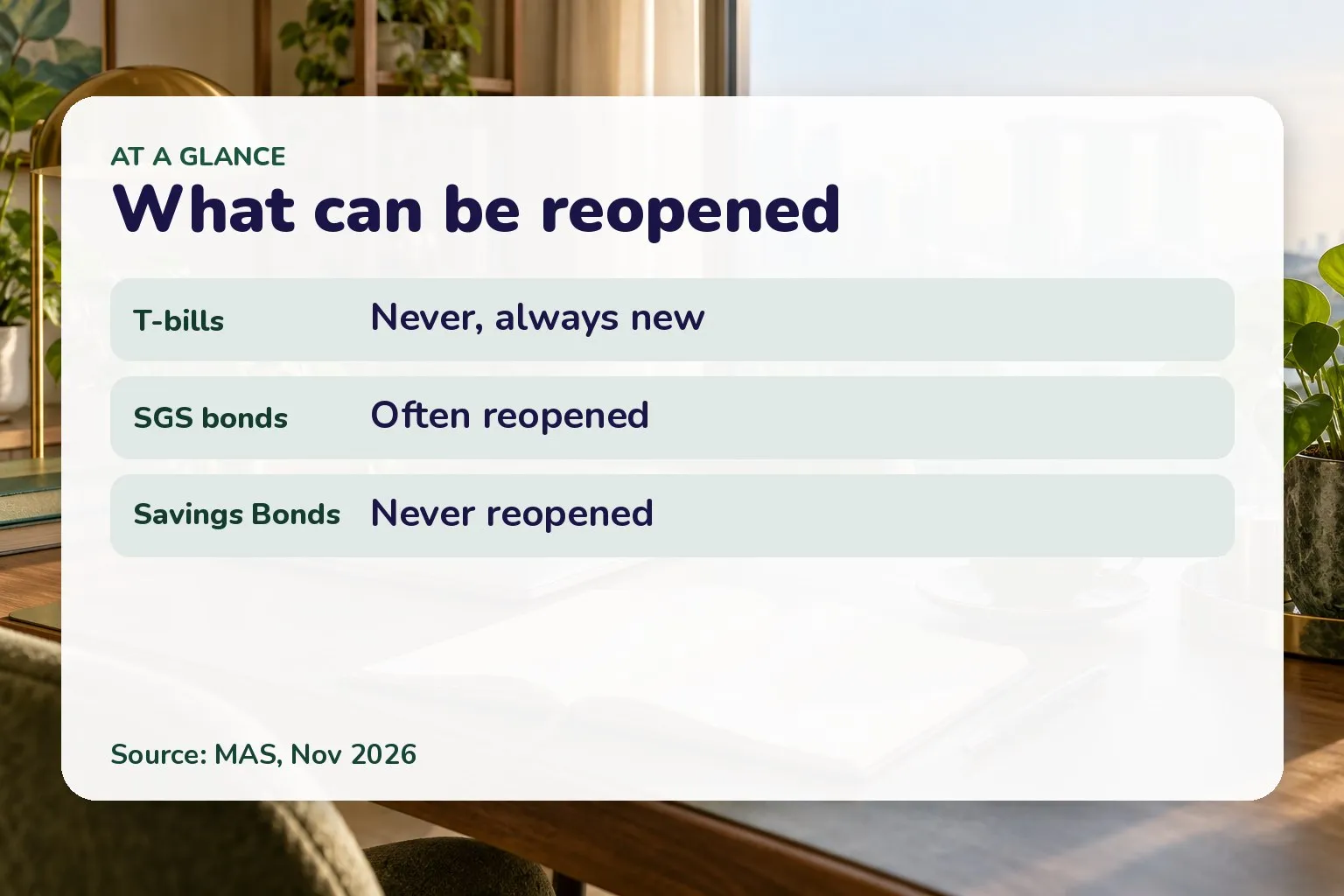
Only SGS bonds are reopened; T-bills and SSBs are not. Source: MAS.
What a reopening means
A reopening is when “MAS may reopen an existing Singapore Government Securities (SGS) bond by issuing additional amounts of the bond.” Instead of launching a new bond with a new code, MAS sells more of a bond that already exists, which “increases the total amount outstanding of that bond”. The point is to keep a few benchmark bond lines large and liquid rather than fragmenting the market into many small issues.
A reopened bond carries “the same maturity date and coupon rate as the existing bond”. Its issue date differs from the original, so “the remaining term to maturity of the reopened bond will thus be different from the original tenor of the bond” — a bond first sold as a 10-year can be reopened years later as, in effect, a shorter bond that matures on the same date.
Reopened bond vs new issue: the differences
The split that matters to an individual investor is how the coupon and your effective return are decided.
| New issue | Reopened issue | |
|---|---|---|
| Issue code | Brand new code and ISIN | Same code as the original bond |
| Coupon | Set at this auction | Inherited from the original bond |
| Maturity date | Set at this auction | Same as the original bond |
| Remaining term | Full stated tenor | Shorter than the original tenor |
| What sets your return | The cut-off yield (and, for a bond, the new coupon) | The cut-off yield versus the fixed coupon, through the price |
| Applies to | T-bills and SGS bonds | SGS bonds only |
How the coupon and price are set
For a new SGS bond, the coupon is created at the auction: “The coupon rate for a newly issued SGS bond is the cut-off yield of successful competitive bids rounded down to the nearest 0.125%”, and “The minimum coupon rate for SGS bonds will be 0.125%.” For a reopened bond there is nothing to set — “The coupon rate for a reopened bond is the same as the existing bond”, and as a holder “you will receive the original coupon rate”.
Because a reopened bond’s coupon is already fixed, your actual return comes from the price you pay, which “depends on the cut-off yield at the auction”. MAS’s rule is simple: “If the cut-off yield is higher than the coupon rate, the purchase price is lower than the face (par) value” — and the reverse pushes the price above par.
Why T-bills are always new
T-bills are built differently from bonds, which is why reopening does not fit them. A T-bill has “No coupon. Issued at a discount to the face value”, and its tenor is just “6 months or 1 year”. There is no coupon to inherit and no multi-year benchmark line to keep liquid — each bill is a short, self-contained discount instrument that matures within a year. SGS bonds, by contrast, “mature in 2, 5, 10, 15, 20, 30 or 50 years”, so keeping a handful of large, reopened benchmark lines is worth doing. The practical upshot: comparing two T-bill auctions is always comparing two independent new issues.
Reading the New vs Re-open label
On the MAS auctions and issuance calendar, every line shows a status. The one that answers this question is the New / Re-open tag:
- Open the issuance calendar on the MAS website and find the auction you care about.
- Check the issue code. A reopened SGS bond reuses the original bond’s code; a new issue has a code you have not seen before.
- Read the New / Re-open field. T-bill lines (codes starting BS for 6-month, BY for 1-year) always read New. SGS bond lines frequently read Re-open.
- For a reopened bond, note the coupon shown — that is the original coupon you will receive, regardless of the cut-off yield.
What it means for your bid
For a T-bill, none of this changes anything: you still submit a bid in yield terms, the minimum is “S$1,000, and in multiples of S$1,000”, and you can “submit up to S$1 million in non-competitive bids at each T-bill auction”. Successful bidders are all allotted at one rate — “You will get the bond at the cut-off yield”, which is “the highest accepted yield of successful competitive bids.” Non-competitive demand is capped, since “A maximum of 40% of the issuance size will be allotted to non-competitive applications”. You can estimate the cash outcome with our T-bill yield calculator.
For a reopened SGS bond the extra step is understanding the price: bid the yield you want, not the coupon, and expect the price to sit below or above par depending on how your cut-off yield compares to the fixed coupon.
A current example
The two most recent retail T-bills show the “always new” pattern. The 6-month T-bill BS26121N, auctioned 22 Oct 2026, is a New issue with a cut-off yield of 1.95% and a cut-off price of 99.028. The 1-year T-bill BY26103X, auctioned 15 Oct 2026, is also New, with a cut-off yield of 1.92%. Neither reused an older code. On the bond side, the 5-year N526100H issued 2 Nov 2026 was a New issue that set its own 2.00% coupon at a 2.09% cut-off (price 99.575), while NY25200N above was a reopening of an existing 15-year line. For how these stack up against other safe options, see SGS bonds vs T-bills vs SSB and T-bill vs fixed deposit.
Frequently asked questions
Is a Singapore Savings Bond ever reopened? No. MAS lists SSBs alongside T-bills and CMTBs as securities that cannot be reopened; a new Savings Bond is issued every month instead.
Does a reopened bond pay less because its coupon is low? Not necessarily. You receive the original coupon, but a below-par purchase price lifts your effective yield to the auction cut-off. Judge the deal on the cut-off yield.
How do I know if an auction is a reopening before I bid? The MAS issuance calendar tags each auction New or Re-open and shows the issue code and, for bonds, the coupon. Reopenings reuse an existing bond’s code.
Why does MAS reopen bonds at all? To concentrate liquidity in a few benchmark bond lines rather than many small issues, which keeps the secondary market more active for those bonds.
General information on how SGS auctions and reopenings work, not financial advice. Auction yields change at every auction; confirm the current issue and its New / Re-open status on the MAS website before you apply.
Sources
- What Are Reopened Bonds — Monetary Authority of Singapore (as of 3 November 2026)
- How SGS Auctions Are Conducted — Monetary Authority of Singapore (as of 3 November 2026)
- T-bills: Information for Individuals — Monetary Authority of Singapore (as of 3 November 2026)
- Understanding Singapore's Bond Market — Monetary Authority of Singapore (as of 3 November 2026)
- Treasury Bills and SGS bond auction results (listbondsandbills API) — Monetary Authority of Singapore (as of 3 November 2026)
- SGS auctions and issuance calendar (issuancecalendar API) — Monetary Authority of Singapore (as of 3 November 2026)