What Happens When Your T-Bill Matures

When a Singapore T-bill matures you are repaid its full face value (S$100 per unit) — your original capital plus the interest earned as the discount. MAS credits it automatically to your cash, SRS or CPF account on the maturity date, with no fee and nothing to do.
On this page9 sections · tap to jump
- 01What you receive when a T-bill matures
- 02Where the maturity money lands
- 03Do you need to do anything? (no action, no fee)
- 04Timing: when the cash arrives
- 05Can you get out before maturity?
- 06Reinvesting into the next auction
- 07A worked example (illustrative)
- 08How it compares to a fixed deposit
- 09Frequently asked questions
A Singapore Treasury bill (T-bill) has a fixed, short life — 6 months or 1 year — and the day it reaches the end is the day you get your money back. Unlike a fixed deposit, there is no renewal notice and no action to confirm: the Government simply repays you. This guide explains exactly what you receive, when and where it lands, and what to do next, as the sequel to how to buy Singapore T-bills.
What you receive when a T-bill matures
You receive the full face (par) value of the T-bill — S$100 for every S$100 of face value you hold. That is the whole point of a T-bill: you bought it at a discount to face value, earned no coupon along the way, and are now repaid in full. As MAS puts it, T-bills are “issued at a discount to their face value. Investors receive the full face value at maturity.”
Your interest is the gap between the two. MAS states plainly that “the interest is paid at maturity and is the difference between the purchase price and the face value.” So if you paid S$990 for S$1,000 of face value, you are repaid S$1,000, and the S$10 difference was your return — received as a lump sum, not as separate coupon payments.
Where the maturity money lands
The repayment goes straight to the account tied to how you paid, with no need to nominate it again at maturity. MAS lists where the principal is credited:
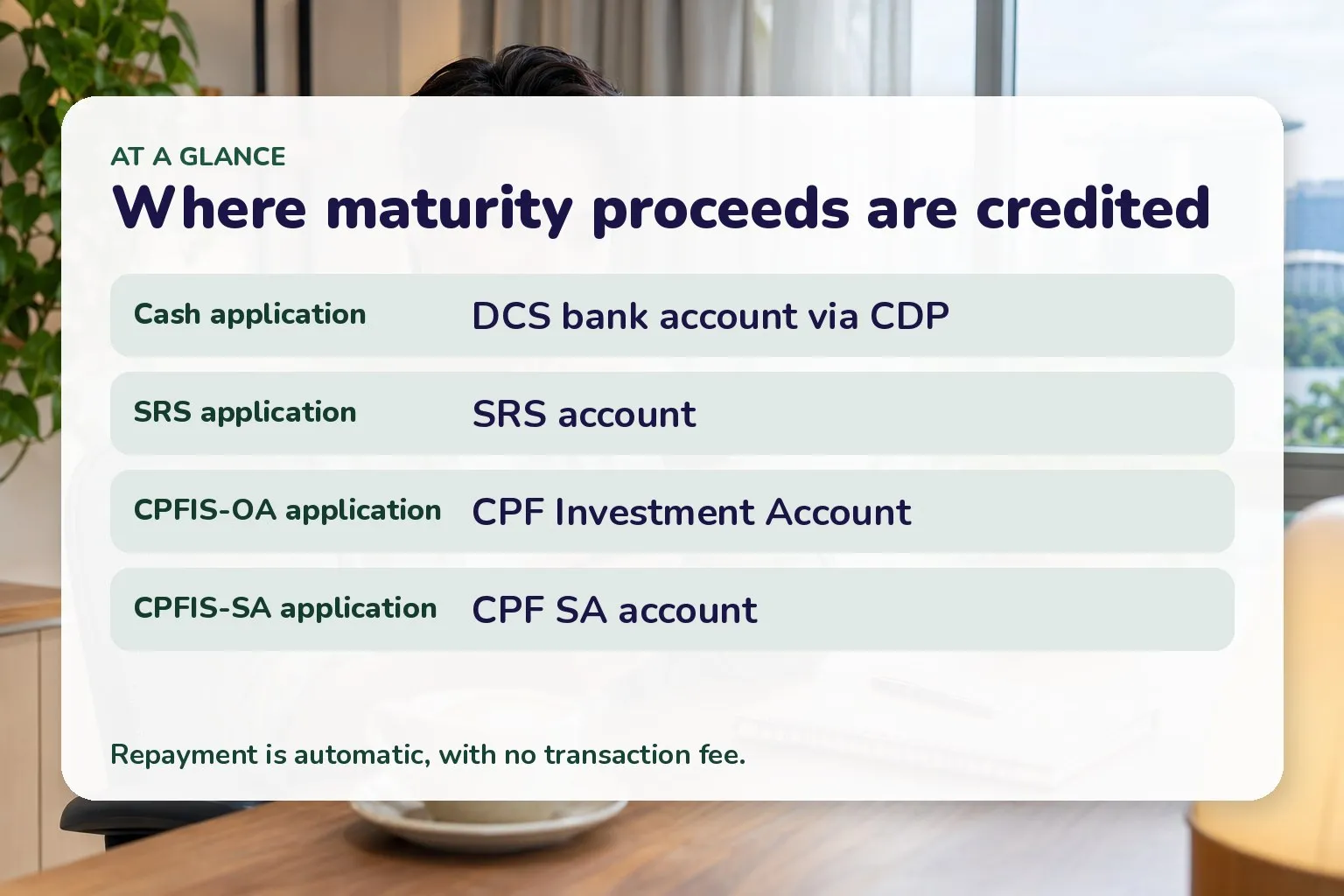
Where your T-bill principal is returned at maturity. Source: MAS, Nov 2026.
- Cash applications: your designated Direct Crediting Service (DCS) bank account linked to your individual CDP account.
- SRS applications: your SRS account.
- CPFIS-OA applications: your CPF Investment Account.
- CPFIS-SA applications: your CPF SA account.
For a cash holding, you can change the bank account that receives the proceeds. MAS confirms you “can change your nominated bank account for Direct Crediting Service … via the CDP Internet Service or by contacting CDP Call Centre at 6535 7511.” It is worth checking this detail is current well before the maturity date, so the money does not get stranded in a closed account.
Do you need to do anything? (no action, no fee)
Nothing. Repayment is fully automatic and free. MAS is explicit: SGS bonds and T-bills “are redeemed at face (par) value when they mature. The face value of the SGS and the last interest payment will be automatically credited to your bank account. You do not need to take any action, and there is no transaction fee.”
Timing: when the cash arrives
The principal is credited on the maturity date shown on your purchase confirmation and CDP statement. One timing caveat applies: MAS notes that “if the maturity date falls on a day when MAS’ electronic payment system is not in operation, the transaction will occur on the next business day” — so a maturity that lands on a weekend or public holiday pays out the next working day.
To confirm a holding before it matures, check the right statement: cash holdings show on your CDP statement (via CDP Internet), SRS holdings on your SRS operator’s statement, and CPF holdings on the CPFIS or CPF statement. On the CDP statement, remember that every 10 units represents S$1,000 in face value — so 100 units is a S$10,000 T-bill.
Can you get out before maturity?
Not with the Government. A T-bill has no early redemption — you cannot hand it back to MAS for cash before the maturity date. If you need the money sooner, the only route is to sell it on the secondary market. MAS says you “can sell your T-bills in the secondary market through DBS, OCBC or UOB by visiting their branches,” indicating whether you used cash, SRS or CPFIS funds.
Reinvesting into the next auction
A T-bill does not roll over by itself. Once it matures the cash is simply returned to your account, so if you want to keep earning you apply again at the next auction — exactly as you did the first time. MAS runs 6-month T-bill auctions on a regular calendar, announced on the SGS website 5 business days before the auction, which typically takes place about 3 business days before the new issue date.
That gap matters. Because the proceeds land on your old bill’s maturity date but the new bill settles a few days after the next auction, your money is briefly uninvested between the two. Savers who want to stay continuously invested often run a T-bill ladder — holding bills that mature in alternating cycles so there is always one maturing to fund the next bid. To size a new bid against the latest yield, use the T-bill yield calculator, and to choose how to bid, see competitive vs non-competitive T-bill bids.
A worked example (illustrative)
Suppose you bought S$10,000 of face value in the 6-month T-bill auctioned on 4 November 2026, which cleared at a cut-off yield of 1.86% and a cut-off price of about S$99.073 per S$100 (figures from MAS; illustrative only):
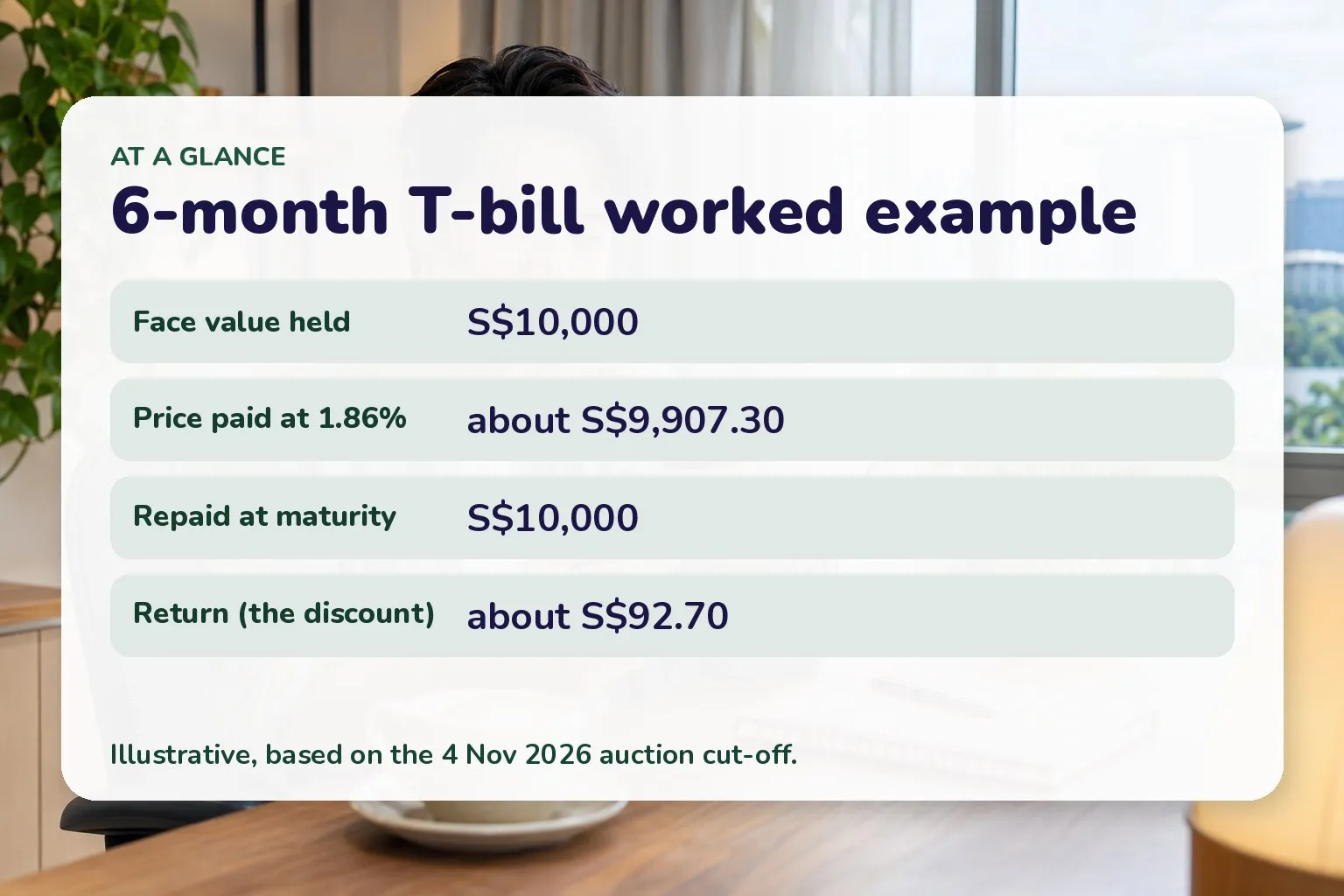
Illustrative only; each auction clears at a different yield. Source: MAS auction data, 4 Nov 2026.
- At purchase you paid roughly S$9,907.30 for S$10,000 of face value.
- You received no coupons during the six months.
- At maturity on 11 May 2027 you are repaid the full S$10,000 face value.
- Your return is the difference: about S$92.70, credited together with the principal.
The exact numbers depend on the auction you bought at; every auction clears at a different yield, so treat this only as an illustration of the mechanics, not a forecast.
How it compares to a fixed deposit
The maturity behaviour is where a T-bill differs most from a bank fixed deposit. A fixed deposit often auto-renews at the prevailing rate unless you tell the bank otherwise; a T-bill never does — it always returns your cash and waits for you to act. A fixed deposit usually lets you break early by forfeiting some interest; a T-bill offers no early break at all — your only way out is a market sale. For the full return-and-liquidity comparison, see T-bill vs fixed deposit.
Frequently asked questions
Is the interest I earn at maturity taxed? No. MAS states “for individuals, interest income earned on SGS is tax exempt,” and “there is no capital gains tax in Singapore,” so your T-bill return is received in full.
Do I get a separate interest payment as well as the face value? No. A T-bill pays no coupon; the only payment is the face value at maturity, and your interest is already baked into the discount you paid at purchase.
Will my bank or CDP charge a fee when the T-bill matures? No. MAS confirms the face value is credited automatically with “no transaction fee.” (Fees may apply only if you later choose to sell on the secondary market through a bank branch.)
What if I used CPF funds — where does the money go? CPFIS-OA proceeds return to your CPF Investment Account and CPFIS-SA proceeds to your CPF SA account, not to your bank account.
Can I roll my matured T-bill straight into the next one? Not automatically through MAS. You reapply at the next auction; plan for a short gap of a few days when your cash is not invested, or ladder your bills to cover it.
Related
- How to buy Singapore T-bills
- How to buy SGS bonds in Singapore
- Competitive vs non-competitive T-bill bids
- T-bill yield calculator
General information on how T-bill maturity works, not financial advice. Auction yields change every issue; confirm current figures and timings with MAS before you reinvest.
Sources
- T-bills: Information for Individuals — Monetary Authority of Singapore (as of 5 November 2026)
- T-bills FAQs (maturity, redemption, how funds are credited) — Monetary Authority of Singapore (as of 5 November 2026)
- Receiving Coupon and Principal Payments for SGS Bonds and T-bills — Monetary Authority of Singapore (as of 5 November 2026)
- Products for Individuals (SGS bonds, T-bills, Savings Bonds) — Monetary Authority of Singapore (as of 5 November 2026)
- Treasury Bills auction results (listbondsandbills API, BS26122V) — Monetary Authority of Singapore (as of 5 November 2026)