Competitive vs Non-Competitive T-Bill Bids

In a Singapore T-bill auction a non-competitive bid takes only an amount and is allotted first, up to 40% of the issue; a competitive bid sets a minimum yield. Everyone successful gets the same cut-off yield, so for most retail savers a non-competitive bid is the simplest choice.
When you apply for a Singapore T-bill you must pick one of two bid types: competitive or non-competitive. The choice does not change the interest rate you ultimately receive — a T-bill auction is uniform-price, so every successful applicant gets the same cut-off yield — but it does change whether, and how much of, your money is allotted. This guide is the decision-focused companion to how to buy Singapore T-bills; to estimate your return at a given yield, use the T-bill yield calculator.
Quick verdict
Competitive vs non-competitive: the core difference
The two differ only in what you specify and how you are ranked:
| Feature | Non-competitive bid | Competitive bid |
|---|---|---|
| What you enter | Amount only, no yield | A minimum yield (up to 2 decimal places) |
| Allotment order | Allotted first, up to 40% of the issue | After non-competitive, lowest yield first |
| Yield received | The cut-off yield | The cut-off yield |
| Risk | Pro-rated if non-competitive demand tops 40% | Nothing if your yield is above the cut-off |
| Per-auction cap (individual) | S$1 million | Within the overall 15% of issue cap |
In a non-competitive application “you only specify the amount you want to invest and not the yield” — the option for those who want the bill regardless of return. In a competitive application you state “the minimum yield you are willing to accept in percentage terms” and submit in yield, not price. A lower yield is a more competitive bid.
Everyone gets the same cut-off yield
This is the point that confuses newcomers. T-bills are sold by a uniform-price auction: all successful applications, competitive or non-competitive, are allotted at one cut-off yield, which is the highest accepted yield among successful competitive bids. So bidding a lower yield does not get you a worse rate than someone who bid higher — you still receive the cut-off. Bidding lower only improves your chance of being allotted.
How the auction fills bids
Allotment runs in a fixed order:
- Non-competitive bids are filled first, up to 40% of the total issue size.
- Competitive bids fill the rest, starting from the lowest yield and moving up until the issue is used up. The yield where it runs out becomes the cut-off.
- Bids below the cut-off are fully allotted; bids exactly at the cut-off may be pro-rated; bids above the cut-off get nothing and are refunded.
The 40% non-competitive cap, explained
Non-competitive applications are capped in aggregate at 40% of the issue size. If total non-competitive demand stays within 40%, every non-competitive bidder is filled in full. If it exceeds 40%, non-competitive bids are allotted pro-rata, with individual amounts adjusted on a randomised basis so allotments stay in S$1,000 denominations.
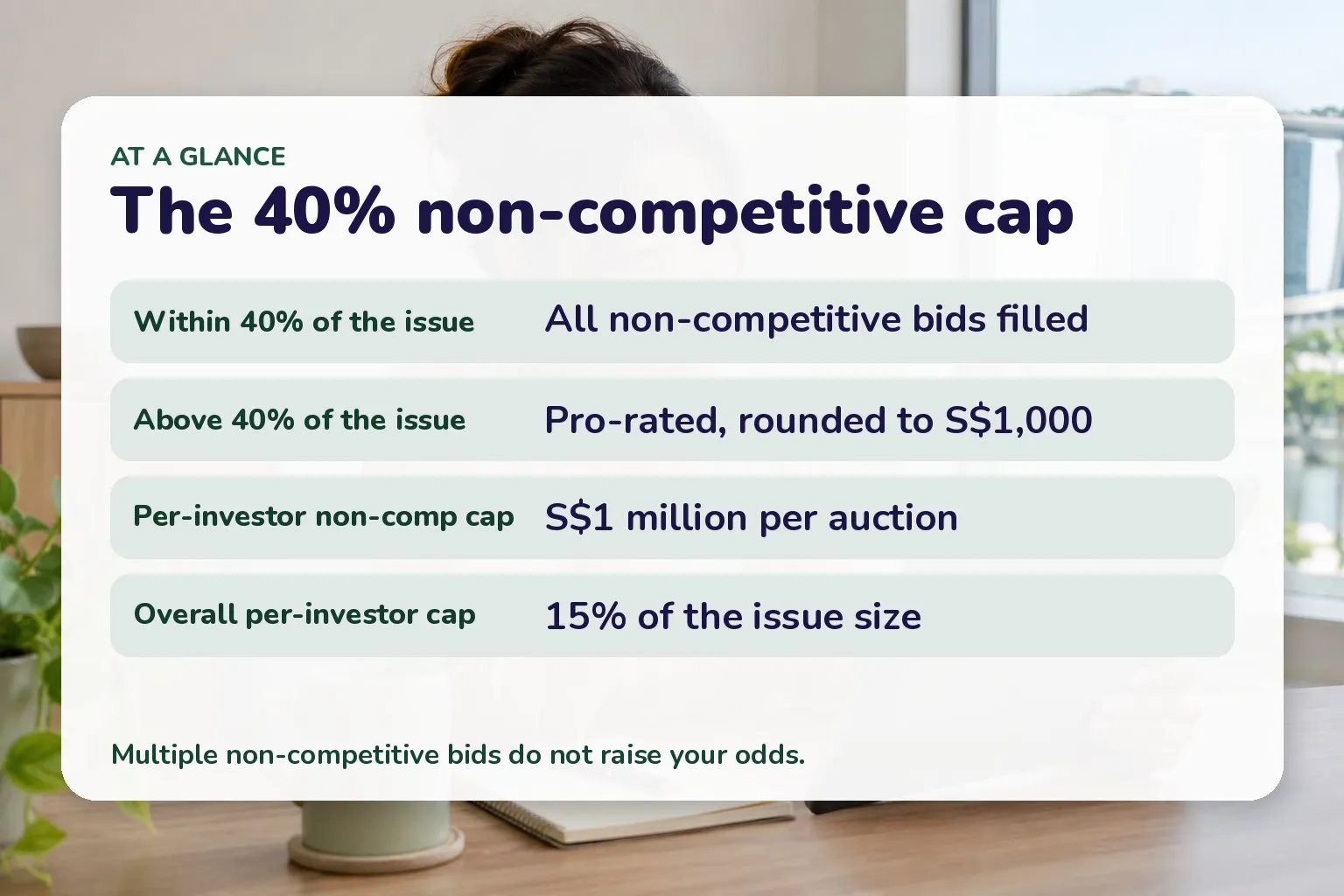
How the non-competitive cap and per-investor limits work. Source: MAS, Nov 2026.
For a cash bid that is partly filled, you receive a combined refund of the un-allotted amount plus the discount on the face value you did get.
Limits per investor
Two caps apply to each individual at each T-bill auction:
- Non-competitive: up to S$1 million per auction.
- Overall: the sum of your competitive and non-competitive allotments is capped at 15% of the issue size.
Splitting one amount into several non-competitive applications does not improve your odds: allotment looks at your aggregate amount, not the number of applications. The minimum bid either way is S$1,000, in multiples of S$1,000, and you can pay with cash, SRS or CPF.
What a recent auction looked like
The 6-month T-bill auctioned on 22 October 2026 (issue BS26121N, maturing 27 April 2027) cleared at a cut-off yield of 1.95% (median 1.90%, average 1.83%), a cut-off price of about S$99.028 per S$100. Non-competitive bids were 100% allotted, while competitive bids placed exactly at the 1.95% cut-off received about 34.96%. The auction drew a bid-to-cover of 1.87. Results differ every auction and are not a forecast of the next one — compare tenors and yields in SGS bonds vs T-bills and watch for reopenings.
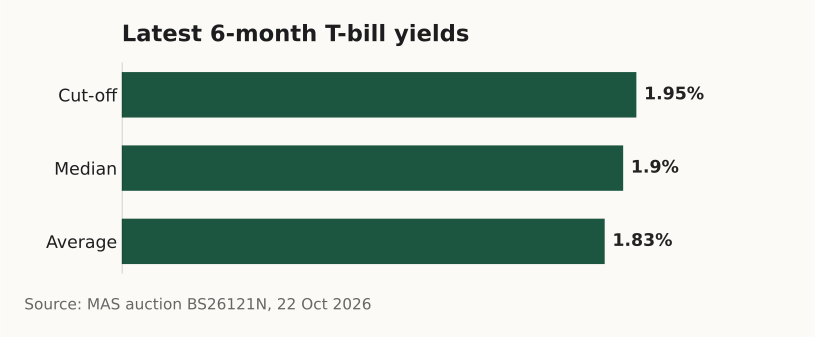
6-month T-bill yields at the 22 Oct 2026 auction (BS26121N). Source: MAS.
Frequently asked questions
Do I get the yield I bid, or the cut-off? The cut-off. In a uniform-price auction every successful applicant — competitive or non-competitive — is allotted at the same cut-off yield, regardless of the yield they entered.
How do I guarantee I get my full amount? Place a competitive bid at a yield comfortably below the likely cut-off; bids below the cut-off are filled in full. The trade-off is that you must guess a yield under the cut-off, and a bid above it is refunded in full.
Why was my non-competitive bid only partly filled? Because total non-competitive demand exceeded 40% of the issue that month, so all non-competitive bids were pro-rated. It can also happen to a competitive bid placed exactly at the cut-off.
Can I submit both types? You can submit multiple competitive applications, and you may also bid non-competitively, but your combined allotment is capped at 15% of the issue and S$1 million for the non-competitive portion.
Does the bid type affect my tax or redemption? No. T-bills pay no coupon — your return is the discount — and the interest is tax-exempt for individuals either way. Neither type can be redeemed early; you hold to maturity or sell on the secondary market. See T-bill vs fixed deposit and using CPF-OA to buy T-bills.
What do the median and average yields in the results mean? They describe how competitive bidders behaved, not what you are paid. The median yield is the yield at the midpoint of successful competitive applications, and the average yield is the amount-weighted average of their yields — both sit at or below the cut-off. At the 22 October 2026 auction the median was 1.90% and the average 1.83%, against the 1.95% cut-off. They are information only; every successful applicant is still allotted at the cut-off yield.
Related
- How to buy Singapore T-bills
- SGS bonds vs T-bills
- T-bill reopening vs new issue
- T-bill yield calculator
General information on T-bill auction bidding, not financial advice. Auction results change every issue; confirm current figures with MAS before you apply.
Sources
- T-bills FAQs (bid types, allotment, worked examples) — Monetary Authority of Singapore (as of 4 November 2026)
- T-bills: Information for Individuals — Monetary Authority of Singapore (as of 4 November 2026)
- How SGS Auctions Are Conducted — Monetary Authority of Singapore (as of 4 November 2026)
- Buy SGS Bonds and T-bills at Auction: For Individuals — Monetary Authority of Singapore (as of 4 November 2026)
- Auction: T-bill — Monetary Authority of Singapore (as of 4 November 2026)
- Treasury Bills auction results (listbondsandbills API, BS26121N) — Monetary Authority of Singapore (as of 4 November 2026)