Endowment Plans in Singapore: Read Before You Buy

An endowment plan is a long-term insurance savings product, not a deposit. Part of each premium buys cover and the rest is invested, so only part of the payout is guaranteed and you can get back less than you paid if you stop early.
On this page11 sections · tap to jump
- 01What an endowment plan actually is
- 02Why it is not a fixed deposit
- 03Guaranteed vs non-guaranteed: the split that matters
- 04Participating vs non-participating
- 05What the illustrated returns really mean
- 06Surrendering early: the expensive mistake
- 07The 14-day free-look period
- 08Is your money protected
- 09When an endowment plan can still fit
- 10A checklist before you commit
- 11Frequently asked questions
An endowment plan — often sold as an “insurance savings plan” — is one of the most commonly offered products when you walk into a bank branch or meet a financial adviser with cash to park. It promises savings plus some protection. But it is an insurance policy, not a deposit, and the difference decides how much you actually keep. MoneySense, the national financial education programme, puts it bluntly: endowment products are “often marketed as a savings plan to help you meet a specific financial goal”, yet “unlike deposits, you may not get back what you put in.” This guide explains what you are really committing to before you sign.
What an endowment plan actually is
An endowment plan is a life insurance policy that runs for a fixed term — commonly 10, 15 or 20 years — and pays out a lump sum at the end, or earlier if the insured person dies. You pay premiums (either over the full term or over a shorter “limited pay” period), and the insurer splits that money: “A part of your premiums goes towards insurance coverage, while the rest is invested and subject to risk.” That split is the whole story. A bank fixed deposit puts 100% of your money to work earning interest; an endowment plan spends part of each dollar on insurance and costs before anything is invested.
Because of that, an endowment “typically requires higher premium than term products for the same level of sum assured” — the sum assured being the amount paid out “when an insured event such as death or total permanent disability occurs.” You are buying a bundled product: a savings pot and a modest insurance payout, wrapped together.
Why it is not a fixed deposit
This is the single most important point, and MoneySense makes it directly: “Endowment products are sometimes incorrectly marketed as fixed deposits.” They are not comparable in three ways. A fixed deposit returns your full principal plus a rate agreed upfront; an endowment may return less than you paid, especially early on. A deposit is liquid within its short tenor; an endowment locks you in for many years. And a deposit is covered by bank deposit insurance, while an endowment is not (more on that below).
Guaranteed vs non-guaranteed: the split that matters
Every endowment illustration shows two layers of value. Guaranteed benefits are the minimum the insurer is contractually committed to pay if you hold the policy to maturity. Non-guaranteed benefits are bonuses or dividends on top, which “depend mainly on the investment performance of the participating fund.” MoneySense is explicit that “a portion of the total illustrated cash values for participating plans and ILPs is not guaranteed”, and that “Some benefits of a life policy may not be guaranteed.”
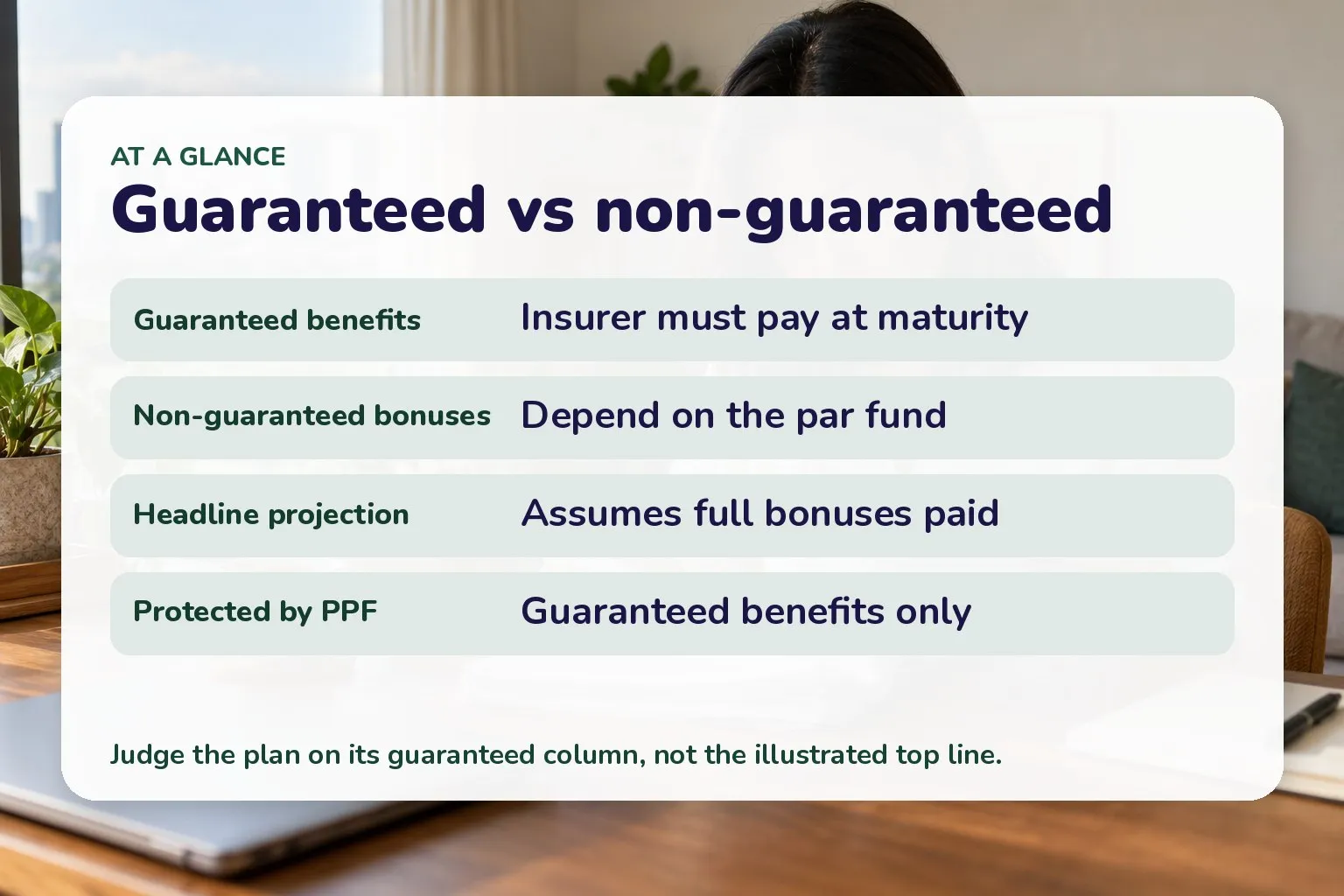
How an endowment payout splits. Source: MoneySense and SDIC, November 2026.
The trap is reading the big headline number — which usually assumes the full projected bonus — as if it were promised. It is not. In some plans the guaranteed maturity value is actually lower than the total premiums you will pay; the projection only climbs above your outlay once non-guaranteed bonuses are added, and those can be cut.
Participating vs non-participating
Endowment plans come in two main forms, and the label tells you where the risk sits:
- Participating (par) plans share in the profits of the insurer’s participating fund, paid as bonuses or dividends. These bonuses “are not guaranteed as they depend mainly on the investment performance of the participating fund.” Once a bonus is declared and vested, it is locked in — but future bonuses are not.
- Non-participating plans pay no bonuses: “A non-participating policy only provides guaranteed benefits and is not entitled to bonuses.” What you see is what you get — more certain, usually a lower headline.
Most “insurance savings plans” marketed for returns are participating, which is exactly why the projected figure is uncertain.
What the illustrated returns really mean
When an adviser shows you a projection, the growth assumptions are not the insurer’s own forecast — they are standardised caps set by the industry so you can compare plans on the same basis. Insurers illustrate participating policies at two scenarios, and since 1 July 2021 the LIA guidance caps them: “The upper illustration rate will be capped at 4.25% p.a. and the lower illustration rate will be capped at 3.00% p.a. respectively.” The lower rate “must be at least 1.25% p.a. below the upper illustration rate”, and “This is a reduction from the previous caps of 4.75% p.a. and 3.25% p.a. set by the Association.”
Two things follow. First, these are illustration assumptions, not targets: the LIA states insurers’ “illustration rates should not be higher than the insurer’s view of the investment returns achievable over the lifetime of the par policies.” Second — and this surprises people — the return to you is well below the fund’s illustrated 3.00% or 4.25%, because charges, insurance costs and distribution expenses are deducted along the way. Your benefit illustration shows this as the “effect of deductions”; read that row, not just the final figure.
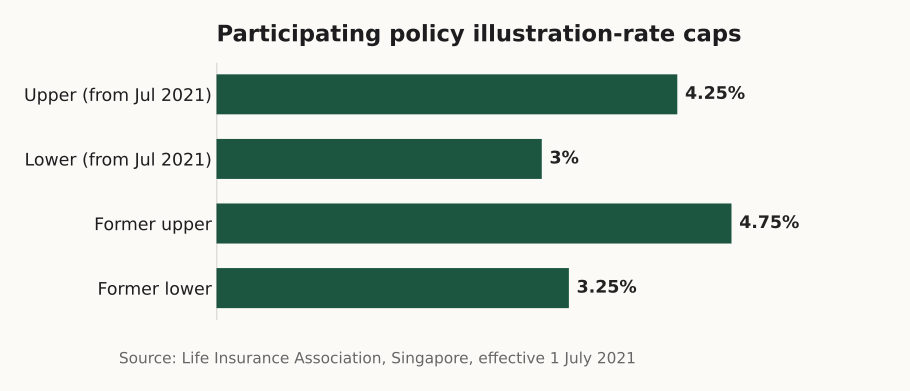
Standardised illustration-rate caps for SGD participating policies. Source: Life Insurance Association, Singapore, effective 1 July 2021.
Surrendering early: the expensive mistake
The biggest risk to your money is not the market — it is stopping early. MoneySense advises you to “Prepare to commit to the period of the policy; early termination may result in losses.” In the early years the surrender value (what you get if you cancel) is typically far below the premiums you have paid, because upfront insurance and distribution costs come out first. The year your surrender value first exceeds total premiums paid is the break-even point, and for many savings-type plans it is a decade or more into the policy.
If you are tempted to borrow against the plan instead of surrendering, note that a policy loan is not free: “If you take a loan from your cash value, it has to be repaid with interest, making it harder for your money to grow.”
The 14-day free-look period
If you have just signed and are having second thoughts, you have a short, valuable window. “All life insurance companies grant a 14-day free-look period that starts from the day you receive the policy documents.” Cancel within it and “the insurance company will refund all your premiums less medical and other expenses they have paid.”
Is your money protected
Here two separate schemes matter, and conflating them is a common mistake. Bank deposit insurance under the SDIC covers “deposits in SGD held in standard savings, current or fixed deposit accounts” up to S$100,000 — but “Some deposits or bank products are not covered”, and an insurance policy is not a deposit at all.
Instead, life policies fall under the separate Policy Owners’ Protection (PPF) Scheme, also run by the SDIC. If a member insurer fails, “you are entitled to be paid compensation for the guaranteed benefits payable under your life-insured policy”, subject to caps — a “Cap of S$500,000 for the aggregated guaranteed sum assured and S$100,000 for aggregated guaranteed surrender value per life assured per insurer.”
When an endowment plan can still fit
An endowment is not a bad product — it is a mismatched one when bought purely for yield. It can suit someone who wants a disciplined, long-horizon savings commitment and values the modest insurance payout, and who is confident they can keep paying for the full term. MoneySense’s own test is the right one: “Think twice before buying an endowment product to build your savings if you do not need the insurance coverage.”
If your goal is pure savings with flexibility or certainty, compare the alternatives first: a fixed deposit or a Singapore Savings Bond for a known, liquid return, a money market fund for parking cash you may need, an SRS-based plan for tax relief, or a high-interest savings account if your banking habits clear its conditions. If you want higher deposit rates and can take on currency risk, read our foreign currency fixed deposit guide — but note it, too, is not deposit-insured.
A checklist before you commit
- Separate the need. Do you actually want the insurance cover, or only the savings? If only savings, reconsider.
- Read the guaranteed column. Compare the guaranteed maturity value with the total premiums you will pay. If it is lower, you are relying entirely on non-guaranteed bonuses.
- Find the break-even year. In the surrender-value table, note when the value first exceeds premiums paid — and whether you can realistically hold that long.
- Treat the projection as a range. The 4.25% and 3.00% figures are assumptions; your net return is lower after the effect of deductions.
- Check the free-look. You have 14 days from receiving the documents to cancel for a refund less costs.
- Know the protection. Only guaranteed benefits are covered by the PPF scheme, up to the caps above — not projected bonuses, and not under bank deposit insurance.
Frequently asked questions
Is an endowment plan the same as a fixed deposit? No. A fixed deposit returns your full principal plus a set rate and is covered by deposit insurance. An endowment is a life insurance policy where part of your premium buys cover, only part of the payout is guaranteed, and you can get back less than you paid if you stop early.
What do the 4.25% and 3.00% figures mean? They are the standardised upper and lower illustration-rate caps insurers must use to project participating-policy values. They are assumptions for comparison, not promised returns, and your actual return is lower after charges.
Will I get all my premiums back at maturity? Not necessarily. Only the guaranteed benefits are certain; whether the total reaches your premiums paid often depends on non-guaranteed bonuses. Check the guaranteed column of your policy illustration.
Can I cancel after signing? Yes, within the 14-day free-look period that starts when you receive the policy documents. The insurer refunds your premiums less expenses it has already paid.
Is my endowment protected if the insurer collapses? The guaranteed benefits are, under the SDIC-run Policy Owners’ Protection Scheme — up to S$500,000 of guaranteed sum assured and S$100,000 of guaranteed surrender value per life assured per insurer. Projected bonuses are not covered.
Related
- How fixed deposit rates compare in Singapore
- Foreign currency fixed deposits explained
- What SDIC deposit insurance covers
- Money market funds: a plain guide
General information on endowment and insurance savings plans, not financial advice. Figures are from MoneySense, the LIA and the SDIC as of the dates shown; read your own policy illustration and check your position before buying or surrendering a policy.
Sources
- Understanding endowment insurance — MoneySense (MAS) (as of November 2026)
- Interpreting your insurance documents (free-look, policy illustration) — MoneySense (MAS) (as of November 2026)
- Buying life insurance online (things to note) — MoneySense (MAS) (as of November 2026)
- Life insurance industry revising caps on participating policy illustrations (illustration rates) — Life Insurance Association, Singapore (as of effective 1 July 2021)
- Policy Owners' Protection Scheme — PPF entitlement and caps — Singapore Deposit Insurance Corporation (as of November 2026)
- Understanding deposit insurance (what SDIC does and does not cover) — MoneySense (MAS) (as of November 2026)