Foreign Currency Fixed Deposits in Singapore

A foreign currency fixed deposit locks cash in a currency like USD or AUD for a set term at a higher headline rate. But the SGD value swings with the exchange rate, and these deposits are not covered by Singapore's deposit insurance.
On this page9 sections · tap to jump
- 01What a foreign currency fixed deposit is
- 02Why the rates look higher
- 03The real catch: currency risk
- 04Early withdrawal and conversion costs
- 05Currencies, minimums and tenors
- 06Not covered by deposit insurance
- 07Foreign currency vs SGD fixed deposit
- 08Who it suits — and who should avoid it
- 09Frequently asked questions
A foreign currency fixed deposit lets you lock a lump sum in a currency other than the Singapore dollar — USD, AUD, GBP and others — for a set term, at an interest rate that often looks far higher than any Singapore-dollar deposit. The catch is that the headline rate is only part of the story: your money’s value back in SGD rises and falls with the exchange rate, and these deposits sit outside Singapore’s deposit-insurance safety net. This guide explains how they work, who offers them, and when the higher rate is worth the risk.
What a foreign currency fixed deposit is
Mechanically it works like an ordinary fixed deposit: you place a fixed sum for a chosen tenor and earn a rate agreed upfront, with interest paid at maturity. The difference is the currency. DBS, for example, lets you “Choose from 9 foreign currencies: USD, GBP, AUD, CAD, NZD, JPY, CNH, HKD & EUR” with tenors up to 12 months. If you already hold SGD, the bank converts it into the foreign currency when you place the deposit, and converts it back when you withdraw — and each of those conversions happens at the prevailing exchange rate.
That single fact changes everything about the risk. With an SGD deposit, the amount you get back is certain. With a foreign currency deposit, the amount of Singapore dollars you get back is not, because it depends on where the exchange rate sits at maturity.
Why the rates look higher
Foreign currency deposits pay more because the home interest rates of those currencies are higher. US-dollar rates, in particular, have sat well above Singapore-dollar deposit rates, so a USD deposit can advertise a materially bigger number. CIMB’s online promotion, for instance, shows USD rates from 1 November 2026 of 3.70% for one month, 4.00% for three, 4.20% for six and 4.50% for twelve months; its AUD rates run 4.00%, 4.40%, 4.60% and 4.60% across the same tenors. OCBC’s promotional US-dollar time deposit pays around 4.00% for three months and 4.15% for six (on a minimum of US$20,000 of fresh funds).
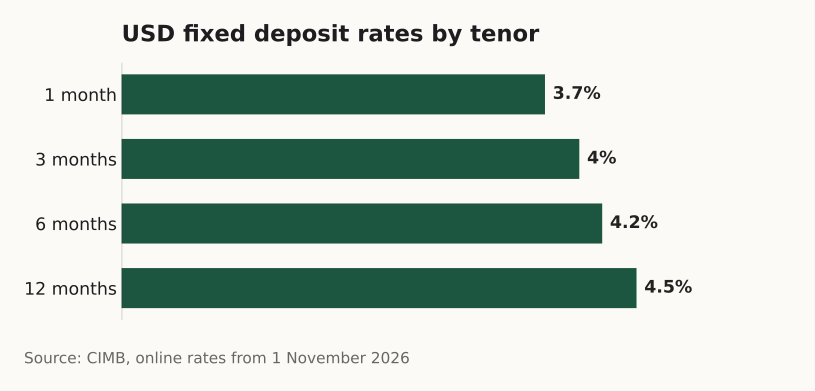
One bank’s advertised USD online rates, rising with tenor. Source: CIMB, online rates from 1 November 2026.
Those figures sit far above the best broadly available Singapore-dollar fixed deposit rates. That gap is the whole appeal — and also the warning sign, because a higher interest rate on a currency usually reflects that the market expects that currency to weaken over time.
The real catch: currency risk
The extra interest means nothing if the currency moves against you. Every bank says so plainly. OCBC states that “Foreign currency deposits are subject to exchange rate fluctuations that may provide opportunities and risks.” DBS notes that “foreign currency deposits are subject to exchange rates which may give rise to capital gains or losses”, and HL Bank flags that “Investing in foreign currencies is subject to exchange rate risk.”
Early withdrawal and conversion costs
Two further costs erode the headline rate. First, early withdrawal is punished. DBS states that “For premature withdrawals of foreign currency Fixed Deposits, no interest will be payable”, and HL Bank’s terms say that “Effective 2 January 2025, interest is not payable for any premature withdrawals of fixed deposit.” UOB warns that an early-withdrawal fee may apply and that “Foreign currency conversion is based on prevailing exchange rate and subjected to exchange rate fluctuations, which may result in you receiving an amount different from the original amount.”
Second, the conversion spread. Banks buy and sell a currency at slightly different rates, and you cross that spread twice — once going in, once coming out. Even if the exchange rate were unchanged, the round-trip spread alone can leave you with fewer Singapore dollars, which is why a short-tenor foreign deposit rarely pays off after costs.
Currencies, minimums and tenors
Minimum placements are higher than for a small SGD deposit, and they vary widely by bank. DBS takes a “minimum amount is S$5,000 equivalent” for a foreign currency deposit; OCBC asks for “$5,000 in AUD, CAD, EUR, GBP, NZD, USD currencies”; UOB sets a minimum of “USD 5,000” (5,000 units) for major currencies; CIMB’s online rates “apply to a minimum of 10,000 units in their respective currencies”; and HL Bank requires a “Minimum deposit of S$50,000 for 1 month placement and above in the respective currency.” Tenors typically range from one to twelve months.
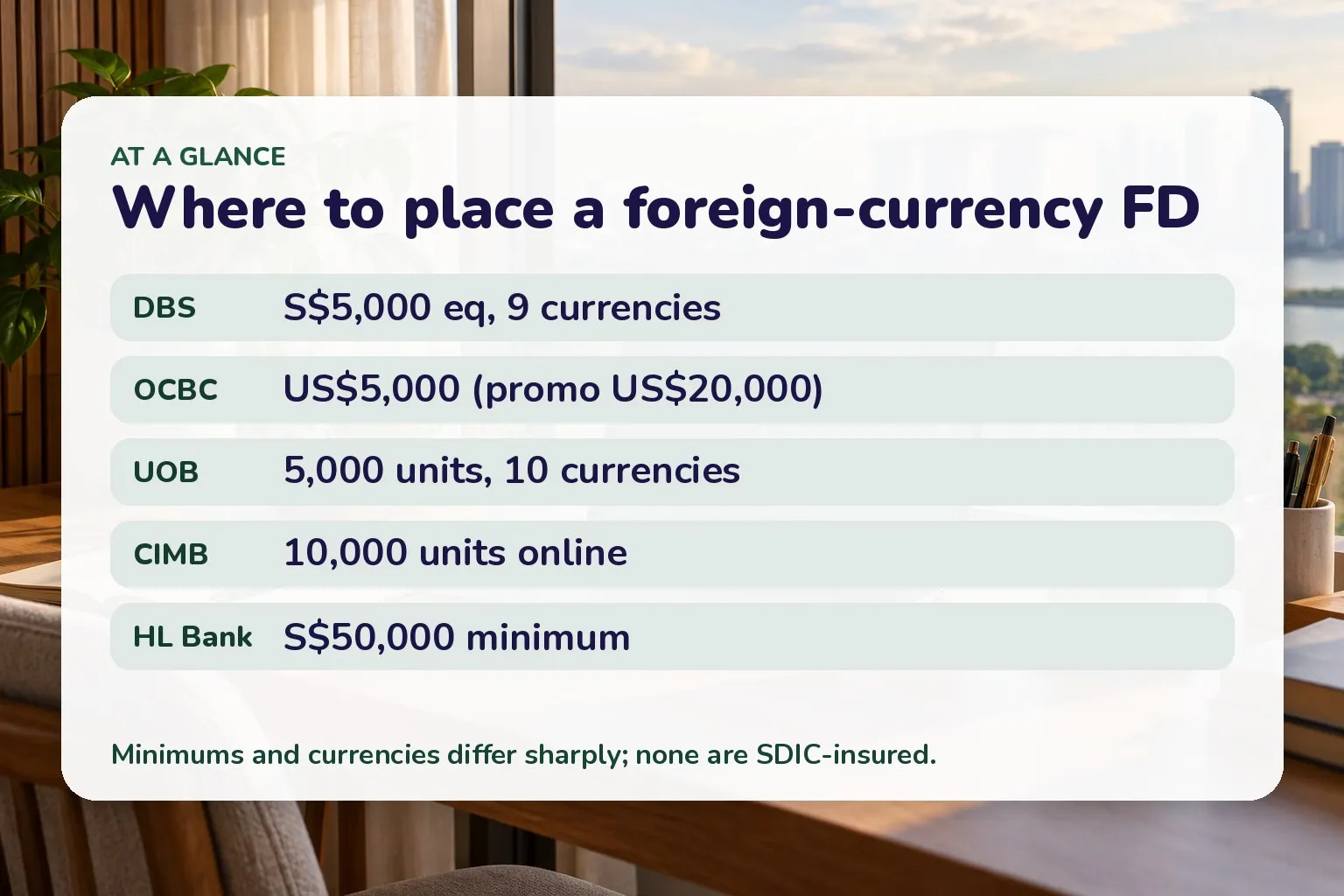
Minimum placements by bank. Source: each bank’s foreign currency deposit pages, November 2026.
Not covered by deposit insurance
This is where a foreign currency deposit differs most from an SGD one. The Deposit Insurance Scheme “covers deposits in SGD held in standard savings, current or fixed deposit accounts” up to S$100,000 per depositor per bank — but foreign currency deposits are explicitly excluded. MoneySense lists “Foreign currency deposits” among products “not covered by deposit insurance”, and the SDIC explains why: “Foreign currency deposits and structured deposits are similar to investment products where the investor is required to assume higher risk for the potentially higher return.” The banks repeat this in their own disclosures; UOB’s reads that “Foreign currency deposits, dual currency investments, structured deposits and other investment products are not insured.”
Foreign currency vs SGD fixed deposit
Set side by side, the trade-off is clear: a foreign currency deposit offers a higher rate and optional exposure to a currency you may want, in exchange for exchange-rate risk and no deposit insurance. An SGD fixed deposit offers a lower but certain return, full SDIC cover up to S$100,000, and no conversion costs. For cash you simply want to grow safely, the certainty usually wins; for money you already hold in, or will spend in, a foreign currency, the deposit can make sense.
If your aim is flexible, low-risk SGD returns rather than currency exposure, weigh the alternatives first — a money market fund for cash you may need soon, a high-interest savings account if you meet its conditions, or a Singapore Savings Bond for a flexible, government-backed option. And if you are being offered an “insurance savings plan” as a higher-yield alternative, read our endowment plan guide first, because that too is neither a deposit nor deposit-insured.
Who it suits — and who should avoid it
A foreign currency fixed deposit fits you if you already hold the currency (say, USD from overseas income), plan to spend it (an overseas property, tuition or a move), or are deliberately taking a considered view on a currency and can leave the money untouched for the term. It is a poor fit if this is your emergency fund or core savings, if you would be converting SGD purely to chase the rate, or if you might need the cash early. Before placing one, confirm the current rate and minimum, check the tenor matches when you will need the money, and ask the bank for its buy/sell conversion rates so you can see the spread you will cross.
Frequently asked questions
Is a foreign currency fixed deposit covered by SDIC? No. Deposit insurance covers only Singapore-dollar deposits up to S$100,000 per depositor per bank. Foreign currency deposits are excluded and treated as higher-risk, investment-type products.
Can I lose money even though the interest rate is positive? Yes. Your return in SGD is the interest earned plus or minus the exchange-rate change. If the currency weakens against the SGD by more than the interest, you get back fewer Singapore dollars than you put in.
What is the minimum to open one? It varies by bank — commonly the equivalent of S$5,000 (DBS, OCBC, UOB), 10,000 units for CIMB’s online rates, and up to S$50,000 at HL Bank.
What happens if I withdraw early? Most banks pay little or no interest on a premature foreign currency withdrawal — DBS pays none — and you still convert back at the prevailing rate, so you bear the exchange-rate move and spread.
Why are USD or AUD rates so much higher than SGD? Because those currencies’ home interest rates are higher. A higher rate often reflects market expectations that the currency may weaken, which is the risk you take on.
Related
- How SGD fixed deposit rates compare
- What SDIC deposit insurance covers
- Endowment and insurance savings plans: read first
- Money market funds: a plain guide
General information on foreign currency fixed deposits, not financial advice. Rates, minimums and conditions change frequently and currency values can fall as well as rise; confirm the current figures on each bank’s official page before you place a deposit.
Sources
- Understanding deposit insurance (what SDIC does and does not cover) — MoneySense (MAS) (as of November 2026)
- Deposit Insurance Scheme — FAQs — Singapore Deposit Insurance Corporation (as of November 2026)
- UOB Foreign Currency Time / Fixed Deposit — United Overseas Bank (as of November 2026)
- DBS Fixed Deposit placement and premature withdrawal — DBS Bank (as of November 2026)
- CIMB Foreign Currency Fixed Deposit Account (online rates) — CIMB Bank Singapore (as of online rates from 1 November 2026)
- OCBC Time Deposit (foreign currency rates and minimums) — OCBC Bank (as of November 2026)
- HL Bank Foreign Currency Fixed Deposit — HL Bank Singapore (as of November 2026)