Topping Up to the CPF Enhanced Retirement Sum

From age 55 you can top up your CPF Retirement Account to the Enhanced Retirement Sum — S$440,800 in 2026 — for the highest CPF LIFE payouts, an estimated S$3,440 a month. Top-ups are irreversible.
The Enhanced Retirement Sum (ERS) is the largest amount CPF lets you set aside in your Retirement Account for monthly payouts — and topping up to it is how members chase the highest possible CPF LIFE income for life. For 2026 the ERS is S$440,800. This guide explains who can top up to it, how much extra it pays, where the tax relief stops, and the trade-offs to weigh before you lock the money away.
What the Enhanced Retirement Sum is
The ERS is one of CPF’s three retirement-sum reference points, alongside the Basic and Full Retirement Sums. It is the maximum you can hold in your Retirement Account, and CPF sets it at double the current Full Retirement Sum. For 2026 the ERS is S$440,800; it rose from S$426,000 in 2025 and CPF projects S$456,400 for 2027. The more you keep in the Retirement Account, the higher your lifelong payout — so the ERS exists for members who want to turn more of their savings into guaranteed retirement income rather than leave it elsewhere.
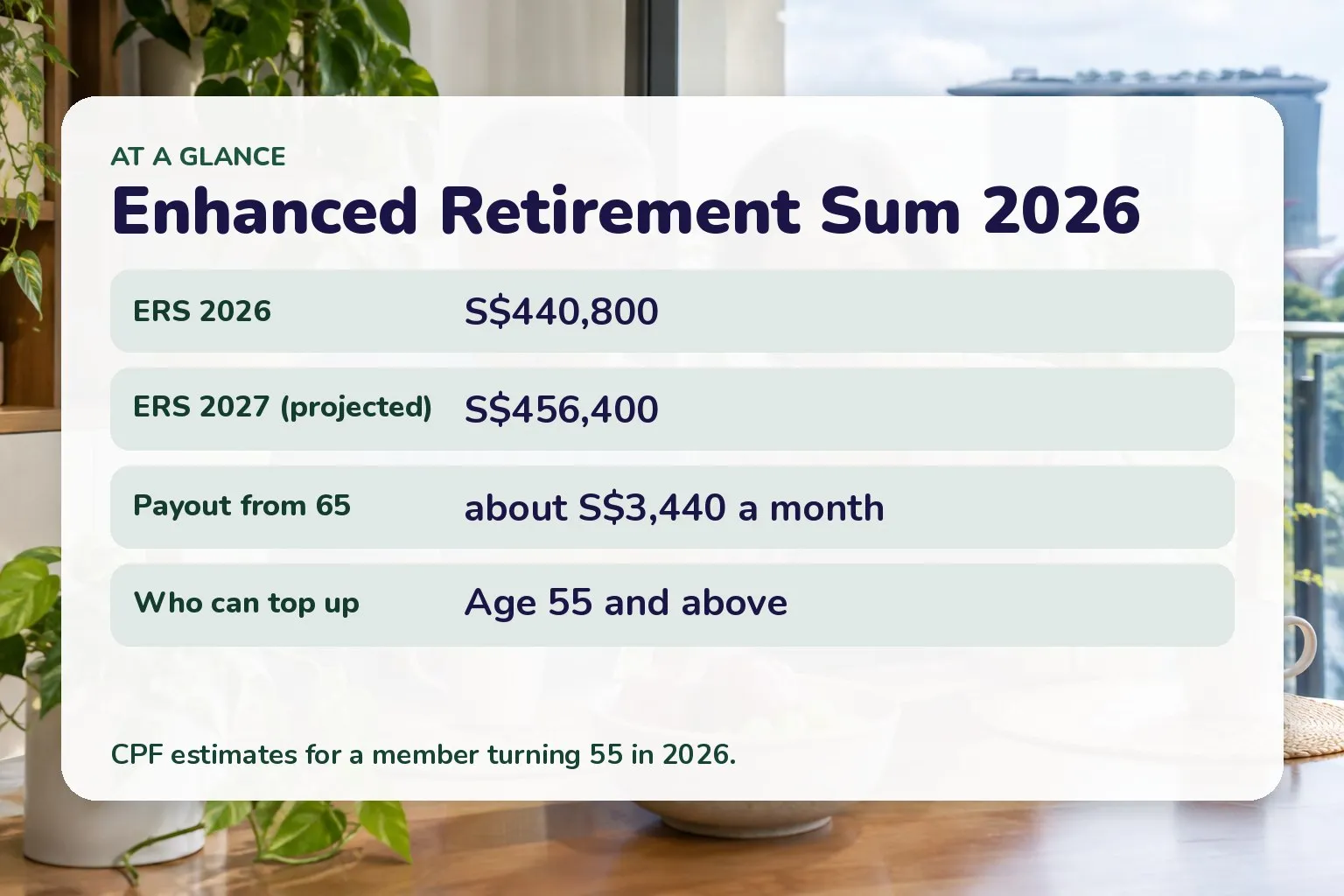
The 2026 Enhanced Retirement Sum at a glance. Source: CPF Board.
Who can top up, and when
Topping up to the ERS is for members aged 55 and above. From 55 you can, in CPF’s words, top up your Retirement Account “up to the current year’s Enhanced Retirement Sum (ERS) of $440,800 for higher payouts.” Below 55 there is no Retirement Account yet and the ceiling for top-ups and transfers is the Full Retirement Sum, not the ERS.
Because “the ERS increases every January,” this is not a one-time move: each year the ceiling lifts, so you can make a further top-up annually and keep raising your payout, regardless of the year you turned 55.
The payout boost
More in the Retirement Account means a larger CPF LIFE payout. CPF’s own estimates for a member turning 55 in 2026 show how the three sums compare:
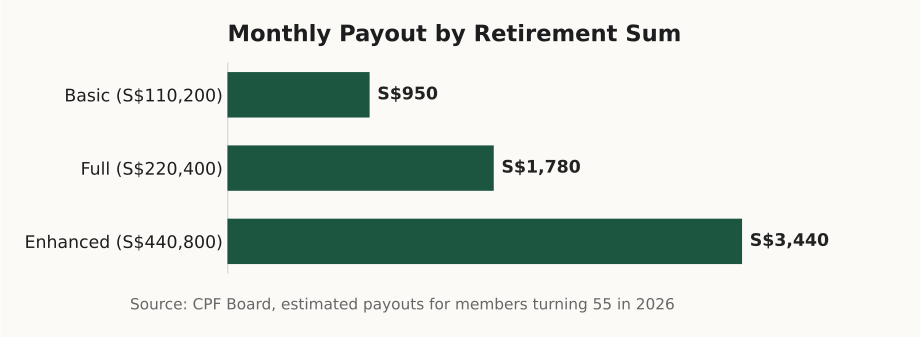
Estimated CPF LIFE payout from age 65 by retirement sum. Source: CPF Board (estimates, members turning 55 in 2026).
| Retirement sum (2026) | Savings set aside at 55 | Estimated payout from 65 |
|---|---|---|
| Basic Retirement Sum | S$110,200 | S$950 a month |
| Full Retirement Sum | S$220,400 | S$1,780 a month |
| Enhanced Retirement Sum | S$440,800 | S$3,440 a month |
Reaching the ERS gives an estimated S$3,440 a month for life from age 65 — roughly double the Full Retirement Sum payout, from double the savings. CPF labels these figures estimates for members who turn 55 in 2026; your own payout depends on your CPF LIFE plan and the age you start payouts, which you can explore in CPF LIFE payouts explained.
The money is not idle while it waits. CPF pays interest “of up to 6% per annum on retirement savings” on the first tiers of balances — built on the 4% floor on Retirement Account monies plus extra interest — so a top-up made earlier compounds for several years before payouts begin.
Tax relief: only up to the Full sum
This is the catch most people miss. A cash top-up can earn income tax relief of “up to $16,000 for cash top-ups made to yourself and your loved ones in each calendar year” (up to S$8,000 for yourself and S$8,000 for family). But the relievable amount is “capped at the current year’s Full Retirement Sum (FRS).” Once your Retirement Account savings “have reached the Full Retirement Sum (FRS), you will not be eligible for the CPF Cash Top-up Relief.”
In plain terms: the slice of your top-up that takes you from the FRS up to the ERS gives no extra tax relief. You still get the higher payout — you just do not get a tax break on that upper portion. For the full mechanics of top-up relief and timing, see CPF top-ups: returns and tax relief.
Cash top-up vs CPF transfer
There are two ways to raise your Retirement Account towards the ERS, and they are taxed differently:
- Cash top-up. New cash into the Retirement Account. This is the only route that can earn tax relief (up to the FRS limit).
- CPF transfer. Moving your existing CPF savings across — for example, members aged 55 and above “can transfer your OA savings to your Retirement Account (RA).” Transfers “do not qualify for tax relief and the matching grant under the Matched Retirement Savings Scheme,” but they still raise your payout and move money from the OA’s lower rate to the Retirement Account’s higher one.
If you have surplus Ordinary Account savings you will not need, a transfer lifts your payout without spending new cash; if you have spare cash and taxable income, a cash top-up adds a tax break on top. The mechanics of OA transfers are covered in CPF OA and SA: how interest stacks.
Before you top up: the catches
The payout boost is real, but so are the lock-ins:
- Irreversible. CPF is blunt: “Top-ups (both cash top-ups and CPF transfers) are irreversible” and “cannot be withdrawn for any other purposes.” Only commit money you are sure you will not need.
- No relief above the FRS. As above, the stretch to the ERS does not add tax relief.
- Locked for payouts. The money funds monthly payouts from your payout age; it is not an emergency fund. What you can and cannot withdraw at 55 is set out in CPF withdrawal rules at 55.
How to top up
You top up through CPF’s own channels with Singpass — there is no separate claim to file:
- Log in to the CPF website or app and open the cash top-up and CPF transfer service.
- Choose a cash top-up (for possible relief) or a CPF transfer, and the recipient.
- Pay a one-time cash top-up by PayNow QR, or set up recurring top-ups or transfers to spread them across the year.
- Check your room on the CPF Retirement Dashboard, which shows how much more you can add up to the current ERS.
Who it suits (and who should not)
Stretching to the ERS tends to suit members 55 and over who have savings beyond their own needs, want a guaranteed CPF-rate return, and value a larger lifelong payout over liquidity. It makes less sense if you may need the cash, if you have not yet built separate emergency and medical reserves, or if the top-up is purely for tax relief — because above the FRS there is none. If you are still weighing CPF against other options, the broader picture is in retirement planning with CPF and SRS.
Frequently asked questions
Can someone under 55 top up to the ERS? No. Before 55 your top-up and transfer ceiling is the Full Retirement Sum; the ERS applies only from age 55 once your Retirement Account exists.
Does topping up to the ERS give tax relief? Only up to the Full Retirement Sum. The portion from the FRS to the ERS raises your payout but earns no further Cash Top-up Relief.
Will my payout really be S$3,440 a month? That is CPF’s estimate for a member turning 55 in 2026 who sets aside the ERS; your actual payout depends on your CPF LIFE plan and the age you start payouts.
Can I top up a bit more each year? Yes. Because the ERS rises every January, you can make a further top-up each year up to the new ceiling for an even higher payout.
Can I undo a top-up if my circumstances change? No. CPF states top-ups and transfers are irreversible and cannot be withdrawn for other purposes.
General information on CPF retirement top-ups, not financial advice. The ERS, sums and estimated payouts change each year; confirm the current figures and your own relievable room with CPF before you act.
Sources
- Top up to enjoy higher retirement payouts — Central Provident Fund Board (as of 8 November 2026)
- What is the CPF retirement sum? (2026 sums and estimated payouts) — Central Provident Fund Board (as of 8 November 2026)
- What is the Enhanced Retirement Sum (ERS)? — Central Provident Fund Board (as of 8 November 2026)
- Central Provident Fund (CPF) Cash Top-up Relief — Inland Revenue Authority of Singapore (as of 8 November 2026)