Retirement Planning in Singapore: CPF and SRS

Retirement planning in Singapore starts by working out how much you need — a rough benchmark is two-thirds of your last salary — then building toward it with CPF LIFE as the base, SRS and CPF top-ups for tax relief, and your own savings and investments.
Retirement planning in Singapore has a reassuring backbone: most of the heavy lifting is already done by CPF, which turns a lifetime of contributions into a monthly income you cannot outlive. The job is to work out whether that base is enough, and to fill any gap with the tools built for it — SRS, CPF top-ups, and your own savings and investments. This guide lays out a simple four-step plan, with every figure from MoneySense, the CPF Board and IRAS.
A simple four-step plan
MoneySense frames retirement planning around CPF, SRS, income options and legacy planning. Boiled down, the practical sequence is: (1) work out how much you need, (2) see what CPF LIFE already provides, (3) close the gap with top-ups and SRS, and (4) assemble the income streams you will draw on. Work through them in order — there is no point optimising SRS before you know your target.
Step 1: Work out how much you need
Start with a rough target. MoneySense suggests “a spending benchmark of roughly two-thirds of your last drawn monthly salary,” or, on the income-replacement method, to “aim for two-thirds to three-quarters of your income to live comfortably.” Whichever you use, you then multiply by the years you expect to spend in retirement.
Two numbers shape the sum. The first is your retirement age: the minimum statutory retirement age is 64 from 1 July 2026 (MOM), but your desired retirement age may differ. The second is inflation — MoneySense warns you “must factor in inflation, or the rising cost of living,” because “you will not be able to buy as much in the future with the same amount of money that you do today.” A target that ignores inflation understates what you actually need.
Step 2: Count on CPF LIFE as the base
CPF LIFE is a national annuity that pays you monthly for life, and for most Singaporeans it is the foundation everything else sits on. How much it pays depends on how much is in your Retirement Account (RA), which CPF measures against three retirement sums: the Basic (BRS), Full (FRS) and Enhanced (ERS). As CPF puts it, the retirement sum “is a reference point that provides an indication of how much you need to save to meet your desired monthly payouts.”
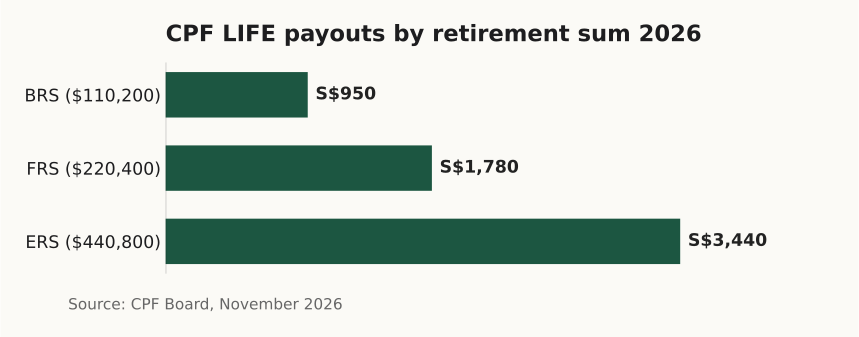
Estimated monthly payouts from age 65 for members turning 55 in 2026. Source: CPF Board, November 2026.
For members turning 55 in 2026, the Board’s figures are: a BRS of $110,200 giving an estimated $950 a month from age 65; an FRS of $220,400 giving about $1,780; and the current ERS of $440,800 giving roughly $3,440. (These estimates are “based on the CPF LIFE Standard Plan and CPF interest rate of 4%.”) At 55 “the savings from your Special Account (SA), followed by Ordinary Account (OA), will be transferred to a newly opened Retirement Account (RA),” capped at the FRS.
Two things matter for planning. First, the sum “depends on the time you turn age 55 and is fixed for the rest of your life” — so plan around your own cohort’s figure, which CPF announces years ahead. Second, automatic inclusion in CPF LIFE needs a floor: “if you are born in 1958 or after and have at least $60,000 in your Retirement Account when you start your monthly payouts, you will be automatically included.” The full mechanics are in our guide to CPF LIFE payouts and the retirement sums.
Step 3: Close the gap
If the CPF LIFE base falls short of your Step 1 target, there are three official ways to lift it — two of which also cut your tax.
Top up your CPF. Cash top-ups to your RA (up to the current ERS) buy higher payouts and tax relief: “you will also enjoy tax relief of up to $16,000 a year if you make cash top-ups to both yourself and your loved ones.” The appeal is the return — CPF’s retirement savings carry a “4% floor rate for interest earned on all Special, MediSave and Retirement savings until 31 December 2027,” and once you turn 55 the RA “can earn up to 5% interest per annum” with the extra interest the Government pays “on the first $60,000 of your combined balances.” Lower-income members can get a hand: the Matched Retirement Savings Scheme gives “a dollar-for-dollar grant (up to an annual cap of $2,000, with a lifetime cap of $20,000)” — see matched retirement savings and how the CPF interest rates stack up.
Use the SRS. The Supplementary Retirement Scheme “is a voluntary scheme to encourage individuals to save for retirement, over and above their CPF savings,” where “only 50% of the withdrawals from SRS are taxable at retirement.” Each dollar you put in reduces your taxable income by a dollar, and gains “accumulate tax-free” until you withdraw. The yearly maximum contribution is $15,300 for Singapore Citizens and PRs and $35,700 for foreigners, and you “can only have 1 SRS account,” with relief counted inside the $80,000 personal income tax relief cap. The catch worth stressing: SRS is designed to be invested, not left as idle cash — read the full rules in our SRS account guide.
Invest the rest. Beyond the tax-sheltered accounts, ordinary investing fills the remainder of the gap. MoneySense notes investing “can help you to grow your retirement nest egg, but it is not without risk,” and suggests rebalancing “to more conservative investments as you near retirement.”
Step 4: Build your income mix
Retirement income rarely comes from one place. MoneySense lists the menu plainly: “you can receive a retirement income from CPF LIFE, by investing through the SRS, from your investments and by monetising your property,” plus cash savings, annuities and even part-time work.
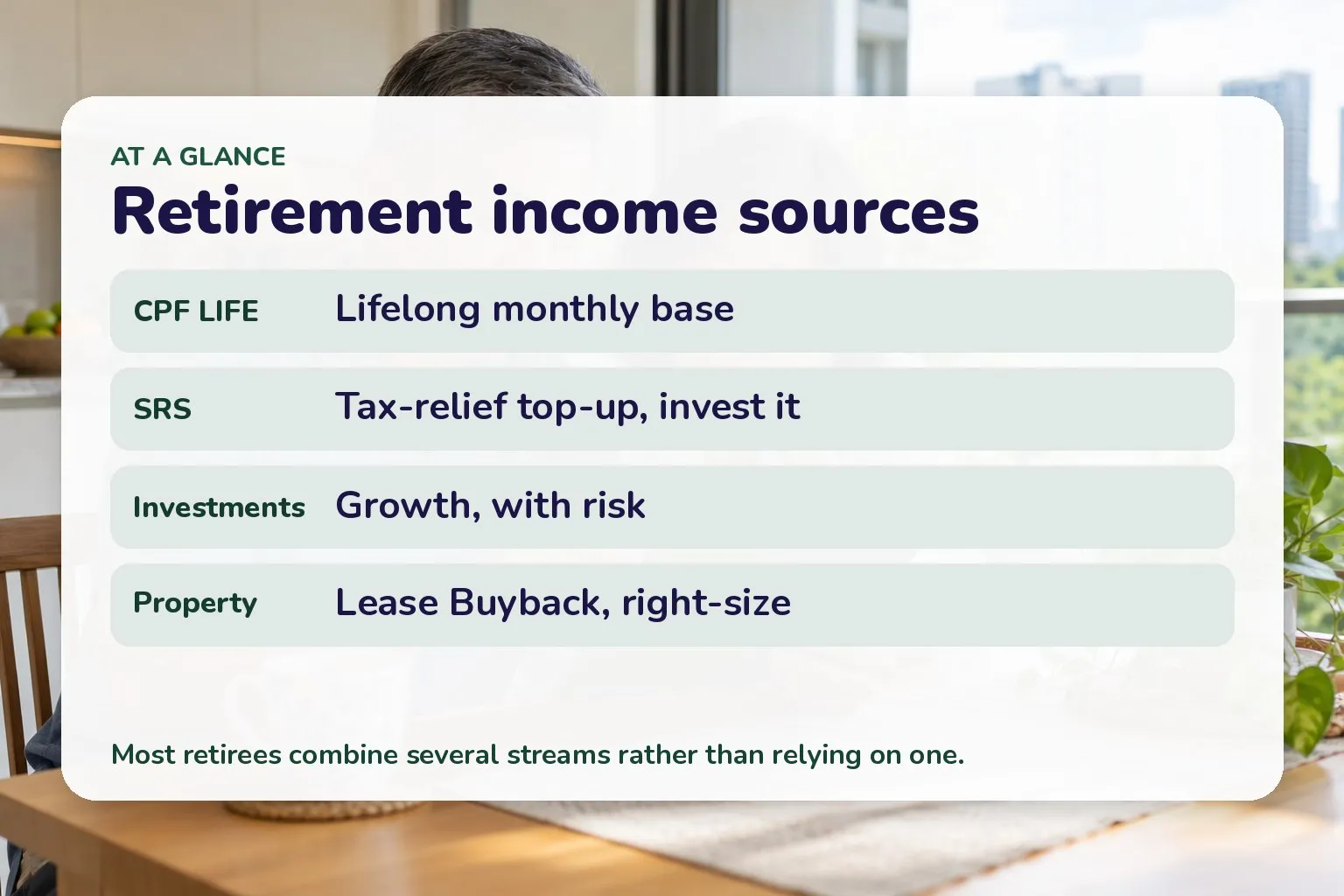
The main retirement income streams MoneySense lists. Source: MoneySense (MAS), November 2026.
Your home can play a part too. If you own an HDB flat, the “Lease Buyback Scheme (LBS) … allows you to sell part of your flat’s lease back to it,” with the proceeds used “to top up your CPF Retirement Account, from which you will get a steady income from CPF LIFE” — you keep living there. Right-sizing to a smaller flat and the Silver Housing Bonus work similarly.
Finally, plan the drawdown. MoneySense recommends a “bucket” approach — “allocate your investments according to the short-, medium- and long-term,” keeping liquid, conservative holdings for near-term spending and growth assets for later years. And remember that after 55 you can “withdraw up to $5,000” from CPF for an immediate need, “or more if you have set aside the required retirement sum.”
Frequently asked questions
How much do I need to retire in Singapore? There is no single figure. MoneySense suggests targeting two-thirds to three-quarters of your pre-retirement income, multiplied by your expected years in retirement and adjusted for inflation. Your lifestyle and life expectancy decide the rest.
When do CPF LIFE payouts start? You can begin payouts from age 65. You are automatically included in CPF LIFE if you were born in 1958 or later and have at least $60,000 in your Retirement Account when payouts start.
Is SRS or a CPF top-up better? They do different jobs. CPF top-ups earn the CPF floor rate and lock the money most tightly; SRS is flexible on investments and taxes only 50% of retirement withdrawals. Both give tax relief within the $80,000 cap, and many savers use both.
What happens to my CPF at 55? A Retirement Account is created and your Special Account, then Ordinary Account, savings transfer into it up to the Full Retirement Sum. That balance sets your future CPF LIFE payout.
Can I retire on CPF LIFE alone? The Basic and Full Retirement Sums are reference points for basic and “ideal” needs respectively; whether they suit you depends on your Step 1 target. If they fall short, Steps 3 and 4 are how you close the gap.
General information on retirement planning, not financial advice. Rates, sums and tax rules are set by the CPF Board, MoneySense and IRAS and can change; confirm your own figures with CPF and IRAS before acting.
Sources
- Retirement planning (CPF, SRS, income options) — MoneySense (MAS) (as of November 2026)
- Determine your retirement needs — MoneySense (MAS) (as of November 2026)
- What is the CPF retirement sum? (2026 sums and payouts) — Central Provident Fund Board (as of November 2026)
- Options for your retirement income — MoneySense (MAS) (as of November 2026)
- SRS contributions and tax relief — Inland Revenue Authority of Singapore (as of November 2026)
- Earning CPF interest (extra interest, 4% floor) — Central Provident Fund Board (as of November 2026)