Matched Retirement Savings Scheme (MRSS) Explained

The Matched Retirement Savings Scheme gives eligible lower-income Singaporeans a dollar-for-dollar government grant on cash top-ups to their CPF Retirement Account — up to $2,000 a year and $20,000 over a lifetime. There is no need to apply.
On this page11 sections · tap to jump
- 01What the MRSS is
- 02How much the grant is worth
- 03Who qualifies in 2026
- 04What changed in 2025 and 2026
- 05The tax-relief trade-off
- 06Who can do the topping up
- 07How to get the grant (no application)
- 08Deadlines that decide the grant
- 09MRSS vs the Matched MediSave Scheme
- 10A worked example (illustrative)
- 11Frequently asked questions
The Matched Retirement Savings Scheme (MRSS) is the Government’s way of rewarding retirement top-ups for Singaporeans who have less set aside: for every dollar of cash topped up to an eligible member’s CPF Retirement Account (RA), the Government adds a matching dollar. The match is capped at $2,000 a year and $20,000 over a lifetime. You do not apply — CPF assesses your eligibility automatically every year. Here is exactly how it works in 2026, who qualifies, and the two catches to plan around.
What the MRSS is
MRSS is a targeted top-up booster, not a free hand-out to everyone. Launched in 2021, it gives eligible seniors — and, from 2026, eligible Singaporeans with disabilities of all ages — a dollar-for-dollar matching grant on cash top-ups to their Retirement Account. Put in $1,000 and, if you qualify, the Government adds $1,000; put in the full $2,000 and the match is another $2,000.
The point is reach: around 750,000 Singaporeans are eligible for the expanded scheme in 2026. Take-up has climbed sharply since the scheme was enlarged — CPF credited $456 million in matching grants to more than 250,000 members for top-ups received in 2025, up from $61 million to 103,000 members in 2024.
How much the grant is worth
The maths is simple and fixed:
- Annual cap: the match is up to $2,000 each year. To collect the full match you need to top up at least $2,000 of cash in the year.
- Lifetime cap: the match is limited to $20,000 in total across your lifetime — reached after ten full years at the annual cap.
Because the grant lands in your RA, it compounds. CPF’s own illustration: topping up $2,000 a year from age 55 to 65 grows an RA by $48,000 (your $20,000 of top-ups, $20,000 of grants, plus interest) and, on the CPF LIFE Standard Plan, adds about $260 to the monthly payout — a labelled illustrative figure that varies by individual. For an eligible person with a disability who can start much earlier, the effect is larger: CPF estimates $2,000 a year from age 25 grows savings by about $110,000 by 65.
Who qualifies in 2026
You are eligible for MRSS in a given year if you are a Singapore Citizen residing in Singapore and meet all of the following, assessed as at 31 December of the year:
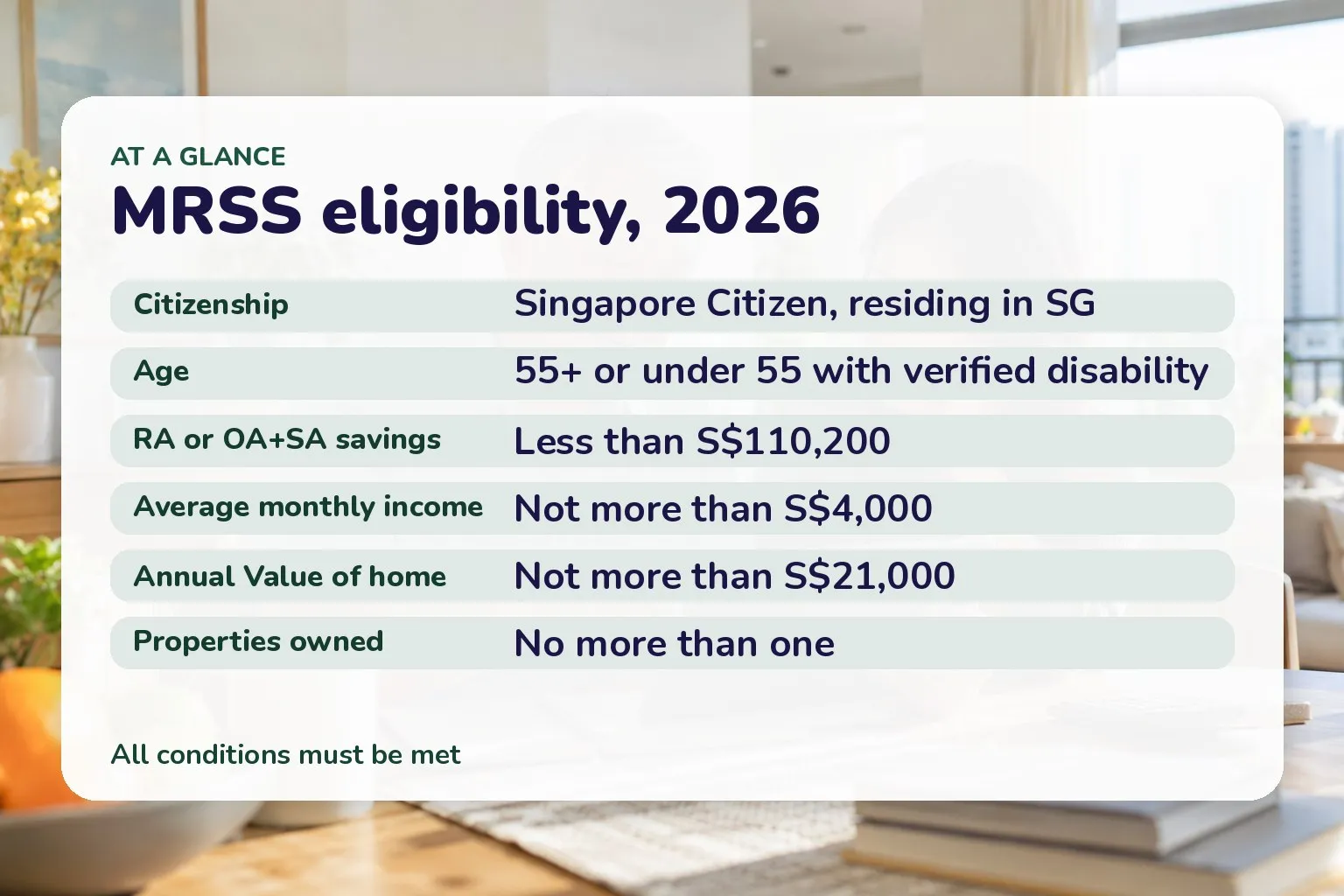
The five MRSS conditions for 2026 — all must be met. Source: CPF Board.
| Criterion | 2026 requirement |
|---|---|
| Age | 55 and above; or below 55 with disability status verified with MSF |
| Retirement Account (or OA + SA) savings | Less than $110,200 |
| Average monthly income | Not more than $4,000 |
| Annual Value of residence | Not more than $21,000 |
| Property ownership | Own not more than one property |
Two details trip people up. First, the balance test uses your RA savings excluding the interest already earned (if your RA is not yet created, CPF looks at your Ordinary and Special Account savings instead). Second, every condition must be satisfied — clearing four of five is not enough. For how that RA balance relates to the official targets, see CPF retirement sums: BRS, FRS and ERS.
What changed in 2025 and 2026
MRSS used to be far smaller. Two waves of enhancement reshaped it:
- From 1 January 2025: the matching cap jumped from $600 a year to $2,000 a year (with the new $20,000 lifetime cap), and the old age ceiling of 70 was removed so any eligible member aged 55 and above can benefit.
- From 1 January 2026: the scheme was expanded to eligible Singaporeans with disabilities of all ages, whose matched top-ups can go into the Retirement or Special Account so they benefit from decades of compounding.
The tax-relief trade-off
This is the main catch. A cash top-up normally earns income tax relief, but a top-up that attracts the MRSS matching grant is not eligible for tax relief — the grant is the benefit instead. In practice this rarely hurts the people MRSS targets, because their income often sits below or near the tax-free threshold, so the relief would have been worth little anyway.
What you keep: you can still receive up to $16,000 a year in tax relief on cash top-ups that do not receive the matching grant — for example, top-ups beyond the matched $2,000, or top-ups you make for a family member who is not MRSS-eligible. The relief and the grant simply do not apply to the same dollars. The relief side is worked through in CPF top-ups: returns and tax relief.
Who can do the topping up
You do not have to fund your own top-up. CPF allows the cash to come from yourself, your loved ones, your employer, or members of the community including caregivers — and the matching grant still goes to the eligible member’s account. That makes MRSS a practical way for an adult child to boost a lower-income parent’s retirement income: the parent qualifies, the child pays, and the Government matches.
How to get the grant (no application)
There is no form to submit for the scheme itself — eligibility is assessed automatically each year, and CPF notifies eligible members by email or post, generally by end February. The steps are:
- Check your status on the CPF Retirement Dashboard (Singpass login), under the matching-grant section, or wait for CPF’s notification.
- Make the cash top-up to the Retirement Account through CPF’s channels (CPF website or app) during the year.
- Mind the deadline (below) so the top-up counts for that year.
- Receive the match automatically — CPF credits it to your Retirement or Special Account by end February of the following year.
Deadlines that decide the grant
Timing is strict and easy to miss:
- One-time top-up by PayNow: must be submitted by 31 December of the eligibility year.
- Recurring top-up by GIRO: must be set up by 31 October of the eligibility year.
MRSS vs the Matched MediSave Scheme
From 2026 there is a sister scheme, the Matched MediSave Scheme (MMSS), running as a five-year pilot. It works the same dollar-for-dollar way but targets healthcare savings:
| Feature | MRSS | MMSS |
|---|---|---|
| What it boosts | Retirement savings (RA, or SA) | MediSave (MA) for healthcare |
| Annual match | Up to $2,000 | Up to $1,000 |
| Age | 55+ (or under 55 with verified disability) | 55 to 70 |
| Balance test (2026) | RA/OSA below $110,200 | MA below $39,500 |
The income, Annual Value and property conditions are the same for both, and you can qualify for both at once. If your MediSave needs attention too, see what you can use MediSave for.
A worked example (illustrative)
Frequently asked questions
Do I need to apply for MRSS? No. There is no application for the scheme — your eligibility is assessed automatically every year, and CPF notifies eligible members by email or post, generally by end February.
Where do I check if I qualify? Log in to your CPF Retirement Dashboard with Singpass; it shows your MRSS status under the matching-grant section.
Can I get both the matching grant and tax relief on the same top-up? No. A top-up that earns the MRSS grant is not eligible for tax relief. You can still claim relief (up to $16,000 a year) on separate top-ups that do not receive the grant.
What if my top-up is less than $2,000? You still get a dollar-for-dollar match on whatever you top up, up to the $2,000 annual cap — a $1,200 top-up draws a $1,200 grant.
Does the matching grant count towards my balance for next year’s eligibility? The eligibility test looks at your RA savings excluding interest earned; confirm your own figure on the Retirement Dashboard, as a rising balance can eventually take you past the $110,200 threshold.
Related
- CPF Retirement Account (RA) explained
- CPF retirement sums: BRS, FRS and ERS
- CPF top-ups: returns and tax relief
- CPF LIFE payouts: how they work
General information on the Matched Retirement Savings Scheme, not financial advice. Caps, thresholds and eligibility rules change; confirm the current figures with the CPF Board and your own status on the CPF Retirement Dashboard before you act.
Sources
- Matching grant for retirement (MRSS eligibility and crediting) — Central Provident Fund Board (as of 2 November 2026)
- Matched Retirement Savings Scheme (MRSS) – what you need to know — Central Provident Fund Board (as of 2 November 2026)
- More Singaporeans eligible for matching Government grants (26 Jan 2026 news release) — Central Provident Fund Board (as of 2 November 2026)
- Enjoy dollar-for-dollar matching grants with MRSS and MMSS — Central Provident Fund Board (as of 2 November 2026)
- CPF changes in 2025 and how they benefit you — Central Provident Fund Board (as of 2 November 2026)
- What are the CPF interest rates? — Central Provident Fund Board (as of 2 November 2026)