CPF Retirement Account (RA) Explained

Your CPF Retirement Account (RA) is created automatically on your 55th birthday. Savings move from your Special then Ordinary Account up to the Full Retirement Sum — $220,400 in 2026 — and later fund your CPF LIFE monthly payouts for life.
On this page9 sections · tap to jump
Your CPF Retirement Account (RA) is the account that turns decades of CPF saving into a monthly income for life. It does not exist while you are working — it is created on your 55th birthday, filled from your other CPF accounts, and later used to pay your CPF LIFE payouts. This guide explains how the RA forms, where the money comes from, what it earns, what you can take out, and how it eventually pays you — every rule and figure from the CPF Board.
What the Retirement Account is
The RA is a dedicated retirement pot. Unlike the Ordinary Account (OA), which you can tap for housing and other needs, the RA is ring-fenced: its savings earn the same long-term interest rate as the Special Account and are used to provide your monthly payouts in retirement. Think of it as the bridge between your savings years and your payout years.
It is also where the headline “retirement sum” lives. The amount set aside in the RA at 55 — measured against the Basic, Full and Enhanced Retirement Sums — determines how large your payouts will be. Those sums are covered in detail in CPF retirement sums: BRS, FRS and ERS; this page is about the account that holds them.
How your RA is created at 55
On your 55th birthday CPF opens the RA automatically and moves money into it, up to your Full Retirement Sum (FRS) — $220,400 for members turning 55 in 2026. The transfer follows a fixed order:
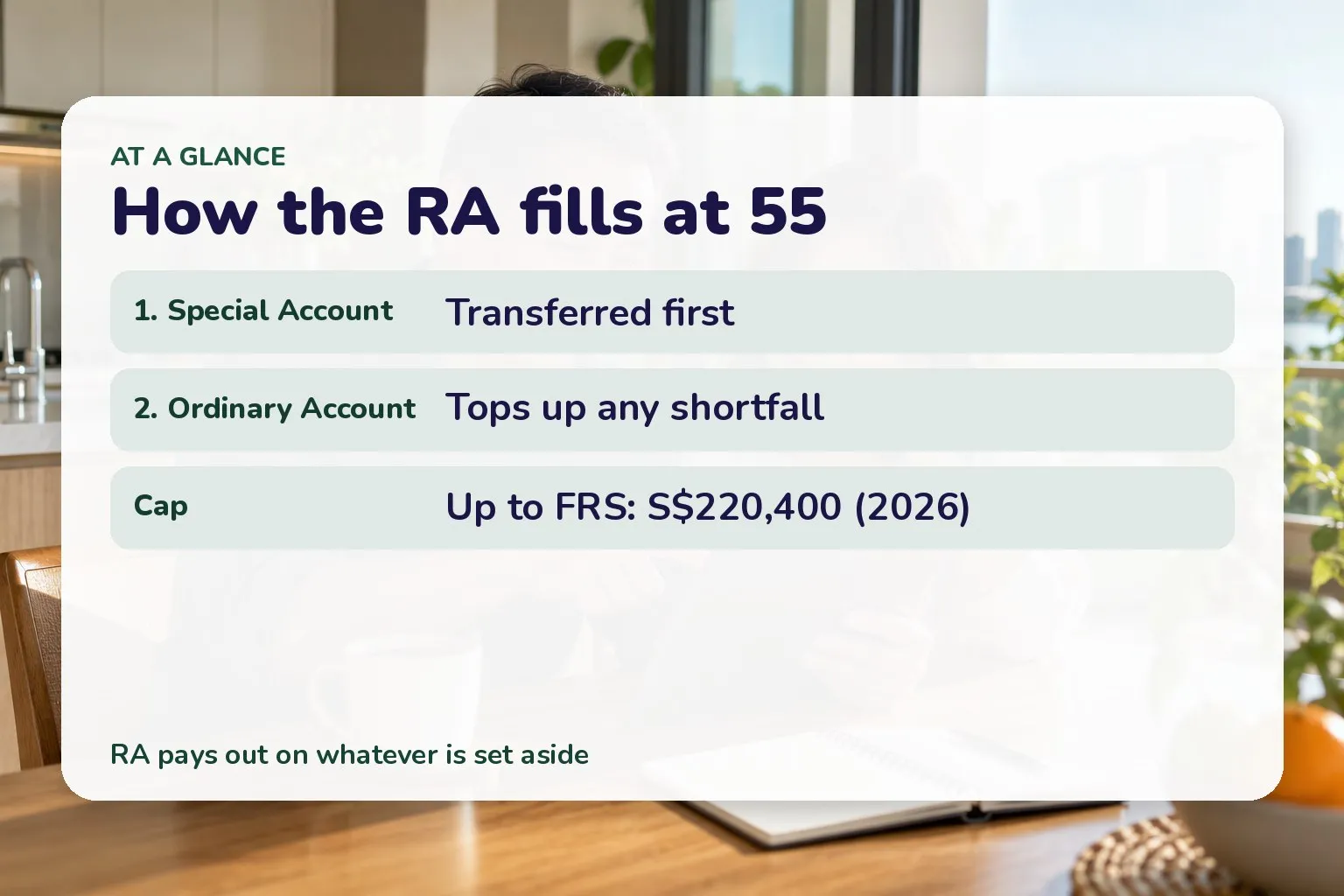
How the RA is filled at 55, in order, up to the 2026 Full Retirement Sum. Source: CPF Board.
- Special Account first. Your SA savings are transferred to the RA first, because SA money was always meant for retirement.
- Ordinary Account next. If your SA alone cannot reach the FRS, OA savings top up the difference.
The amount is capped at the FRS as a reference point for how much you might need. You do not have to “hit” the FRS to get payouts — the RA pays out on whatever is inside it — but the more that is set aside, the larger the monthly income.
Your Special Account closes
Here is the change that catches recent cohorts out: after the transfer, your Special Account is closed, and any remaining SA savings are moved to your Ordinary Account. The SA ceased to exist for members aged 55 and above from 2025, so from 55 you effectively hold three accounts — RA, OA and MediSave.
What you can take out at 55
Turning 55 unlocks withdrawals, within limits:
- Savings above the FRS stay in your Ordinary Account and are withdrawable — you can take them in cash whenever you like, or leave them to keep earning interest.
- If you cannot set aside the full sum, you can still withdraw up to $5,000 for immediate needs after 55; you can withdraw more only once you have set aside the required retirement sum in your RA.
What the RA earns
The RA earns CPF’s long-term rate, which is why it is the best-paying of your CPF accounts:
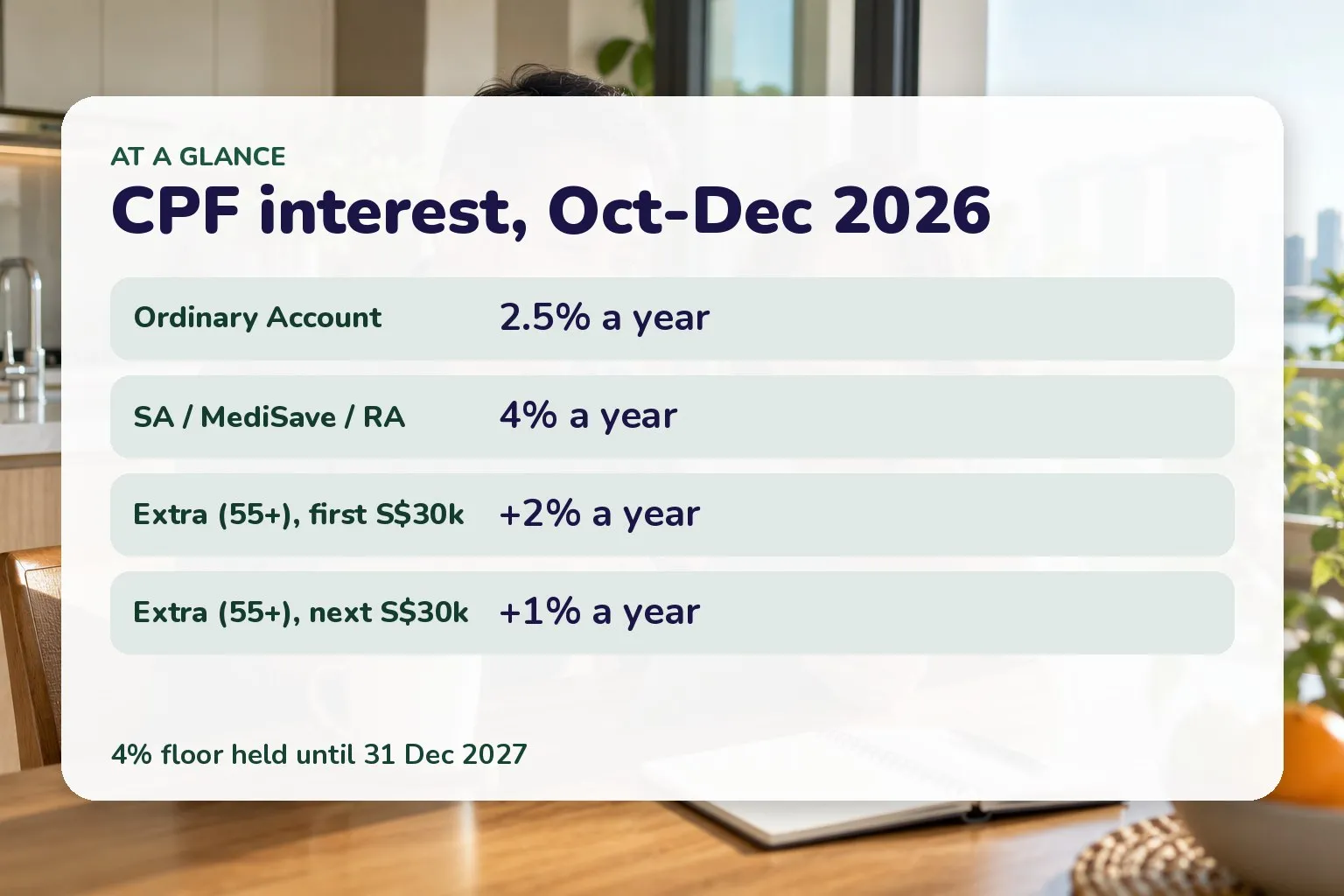
CPF interest rates for 1 Oct-31 Dec 2026, with extra interest for members aged 55 and above. Source: CPF Board.
- Base rate: for 1 October to 31 December 2026, the Special, MediSave and Retirement Accounts pay 4% per annum, versus 2.5% on the OA. The 4% floor is guaranteed until 31 December 2027.
- Extra interest: members aged 55 and above earn an extra 2% on the first $30,000 and an extra 1% on the next $30,000 of their combined CPF balances (the amount counted from the OA is capped at $20,000).
Because the extra interest is weighted to the first tiers of your balance, and because for members 55 and above the extra interest earned on OA savings is paid into the RA, the RA can effectively earn up to 6% on its lowest tier. That is a risk-free, Government-set return that no bank deposit matches.
Topping up and transferring into the RA
The RA is not frozen at 55 — you can keep building it:
- Top up to the Enhanced Retirement Sum (ERS). From 55 you can add cash or transfer OA savings to the RA up to the current ERS — $440,800 in 2026 — for a higher payout. The ERS is not tied to your cohort; it rises every January ($456,400 in 2027), so you can top up a little more each year.
- Standing transfers. You can set up monthly recurring CPF transfers from your OA to your RA so new contributions keep earning the higher RA rate instead of sitting in the OA.
- Contributions after 55. If you keep working, the share of CPF contributions that used to go to the SA is now directed to the RA up to the FRS, then to the OA once the FRS is met.
How the RA pays you: CPF LIFE
The RA is the funding source for CPF LIFE, the national annuity that provides monthly payouts no matter how long you live. When you start payouts, your RA savings are used to pay the CPF LIFE premium, and you receive income for life.
- When: the payout eligibility age is 65; you may start any time from 65 to 70. Deferring raises your payout by up to 7% for each year you wait, up to about 35% if you start at 70.
- How much: for the 2026 cohort on the Standard Plan, CPF estimates about $950 a month at the BRS ($110,200), $1,780 at the FRS ($220,400) and roughly $3,440 at the ERS ($440,800) — illustrative figures that vary by individual.
- Inclusion: if you were born in 1958 or later and have at least $60,000 in your RA when payouts start, you are automatically included in CPF LIFE.
The three plans (Standard, Escalating, Basic) and how the premiums work are explained in CPF LIFE payouts: how they work.
A worked example (illustrative)
Frequently asked questions
How is the Retirement Account different from the retirement sum? The RA is the account; the retirement sum (BRS/FRS/ERS) is the target amount of savings set aside inside it. The sum decides the payout; the account holds the money.
Does my Ordinary Account close at 55 too? No — only the Special Account closes. The OA stays open, keeps earning 2.5%, and holds any savings above the FRS, which you can withdraw.
Can I withdraw my whole Retirement Account at 55? No. The RA is reserved to fund your lifelong payouts. You can withdraw savings above the FRS (held in the OA) and, if you fall short of the sum, up to $5,000 for immediate needs.
What interest does the RA pay right now? 4% per annum for 1 October to 31 December 2026, with extra interest of up to 2% on the first $30,000 of combined balances for members 55 and above. The 4% floor is guaranteed until 31 December 2027.
Can I still grow my RA after 55? Yes — top up with cash or transfer from your OA up to the current Enhanced Retirement Sum ($440,800 in 2026), and set up recurring OA-to-RA transfers to keep earning the higher rate.
Related
- CPF retirement sums: BRS, FRS and ERS
- CPF LIFE payouts: how they work
- Matched Retirement Savings Scheme explained
- CPF interest rates explained
General information on the CPF Retirement Account, not financial advice. Payout figures are CPF Board estimates that change with your balance, plan and start age; confirm your own figures on the CPF website before you act.
Sources
- Reaching age 55 (RA creation, transfers, withdrawals) — Central Provident Fund Board (as of 2 November 2026)
- What happens to my CPF savings when I turn 55? — Central Provident Fund Board (as of 2 November 2026)
- What is the CPF retirement sum? (2026 sums and payouts) — Central Provident Fund Board (as of 2 November 2026)
- Which accounts will my contributions go to after 55 and SA closure? — Central Provident Fund Board (as of 2 November 2026)
- Earning CPF interest (rates for 1 Oct–31 Dec 2026, 4% floor) — Central Provident Fund Board (as of 2 November 2026)
- How much extra interest can I earn on my CPF savings? — Central Provident Fund Board (as of 2 November 2026)
- What is the CPF LIFE payout age? — Central Provident Fund Board (as of 2 November 2026)
- Retirement income (withdrawals for immediate needs) — Central Provident Fund Board (as of 2 November 2026)