CPF Investment Scheme (CPFIS) Explained

The CPF Investment Scheme lets you invest OA savings above S$20,000 and SA savings above S$40,000 in approved products — aiming to beat the 2.5% OA and 4% SA floor rates, at the risk of losing some or all of the money.
The CPF Investment Scheme (CPFIS) lets you invest part of your CPF savings in approved products — shares, funds, bonds, T-bills and more — to aim for returns higher than the interest CPF pays. It comes in two arms: CPFIS-OA for Ordinary Account savings and CPFIS-SA for Special Account savings. You can invest OA money only above a S$20,000 set-aside and SA money only above S$40,000, and you must be 18 or older, not a bankrupt, and have completed a Self-Awareness Questionnaire. The catch is plain: unlike CPF interest, these investments can lose value. This guide covers who qualifies, what you can buy, the limits, the fees, and whether it is worth it. Every figure is from the CPF Board.
What CPFIS is
CPFIS, introduced in 1986, lets you channel OA and SA savings into a range of approved financial products to try to grow your retirement savings faster than CPF’s own interest rates — if you are willing to take on investment risk. It is widely used: as at 30 September 2025, S$21.4 billion of OA and SA savings were held in CPFIS investments.
The scheme’s purpose is potential, not promise. The whole point is to earn more than the CPF floor rates, but the CPF Board is blunt that all investments carry risk and you could lose part or all of what you put in.
The two arms: CPFIS-OA and CPFIS-SA
CPFIS has two components, and they are not equal.
- CPFIS-OA uses your Ordinary Account savings and has the widest product range.
- CPFIS-SA uses your Special Account savings and is deliberately restricted to lower-risk products.
The reason is that SA money is earmarked for retirement and earns a higher floor rate already, so CPF limits the risk you can take with it. In practice, SA savings cannot be used for individual shares, property funds (REITs), corporate bonds or gold — only for selected lower-risk unit trusts, investment-linked policies, ETFs, government bonds, T-bills, fixed deposits, annuities and endowments.
Who can invest
CPFIS opens an answer-first checklist: you qualify only if you meet every condition. You can invest under CPFIS if you:
- are at least 18 years old;
- are not an undischarged bankrupt;
- have more than S$20,000 in your OA, and/or more than S$40,000 in your SA; and
- have completed the Self-Awareness Questionnaire (SAQ).
The SAQ has been mandatory for new investors since 1 October 2018. It is a short, free questionnaire that checks you understand the risks and costs before you commit CPF savings — it does not stop you investing, but it makes sure the decision is informed.
How much you can invest
You cannot invest every dollar. CPF requires you to keep a floor in each account first:
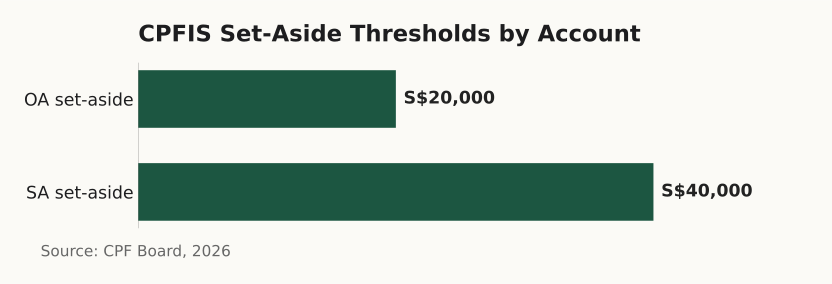
The minimum you must keep in each account before investing under CPFIS. Source: CPF Board, 2026.
- CPFIS-OA: you can invest only the amount above S$20,000 in your OA.
- CPFIS-SA: you can invest only the amount above S$40,000 in your SA.
These set-asides exist so that core sum keeps earning CPF interest (including the extra interest on your first balances) rather than being exposed to markets.
On top of that, two sub-limits cap the riskier assets, both measured against your investible savings (your OA balance plus any CPF already withdrawn for investment and education):
- Stock limit — 35% of investible savings for shares, property funds (REITs) and corporate bonds;
- Gold limit — 10% of investible savings for gold.
What you can invest in
CPFIS-OA offers the broad menu; CPFIS-SA a narrower one. The table shows the split.
| Product | CPFIS-OA | CPFIS-SA |
|---|---|---|
| Fixed deposits, SGS bonds, T-bills, statutory board bonds | Yes | Yes |
| Annuities, endowment policies | Yes | Yes |
| Unit trusts, ETFs, investment-linked policies | Yes | Selected lower-risk only |
| Fund management accounts | Yes | No |
| Shares, property funds (REITs), corporate bonds | Yes (within 35% stock limit) | No |
| Gold | Yes (within 10% gold limit) | No |
Among the simpler building blocks are Treasury Bills (T-bills) — short-term government bills of 6 months or 1 year, issued at a discount to face value — and Singapore Government Securities (SGS) bonds of 2 to 50 years, which pay fixed coupons but can lose value if sold before maturity. Both are also available outside CPFIS; see our guide to T-bills and how to apply for an SSB and our fixed deposit rates page for the cash alternatives.
The costs
Fees matter because they come off returns that are not guaranteed. CPFIS caps the main charges:
| Fee | Cap |
|---|---|
| Wrap fee (advisory/platform) | 0.4% per year of portfolio value |
| Total expense ratio (fund) | 0.35%–1.75% per year, by risk category |
| Broker’s commission (exchange-traded) | 0.25%–0.28% of trade, minimum S$25 |
A portfolio earning, say, 5% before costs but paying a 0.4% wrap fee and a 1% expense ratio keeps only about 3.6% — below the 4% that SA savings earn risk-free. That is why fees, not just headline returns, decide whether CPFIS beats simply leaving the money in CPF.
How to start investing
The route depends on which arm you use.
- Complete the SAQ at cpf.gov.sg if you have not already.
- For CPFIS-OA: open a CPF Investment Account with one of the three agent banks — DBS, OCBC or UOB — then buy or sell through the product providers.
- For CPFIS-SA: you do not need a CPF Investment Account; approach the product providers directly to transact.
- Monitor your holdings through the Investment dashboard in your CPF account.
What happens at 55
At 55, a Retirement Account is created and your access to CPFIS changes. You can withdraw your CPFIS-OA and CPFIS-SA investments (and the cash in your Investment Account) only after setting aside the Full Retirement Sum (FRS) in your RA — which can be met with cash, or cash plus property. If you have not set aside the FRS, you cannot withdraw the holdings, though you can still sell them inside the scheme.
For members 55 and above whose SA has closed, existing CPFIS-SA investments can be held until sold or matured; on sale or maturity the proceeds go to the RA up to the FRS, with any remainder to the OA. You can keep investing under CPFIS-OA beyond 55 if you have set aside the FRS, but the first S$20,000 of your OA still cannot be invested. Note too that transferring exchange-traded holdings to a personal CDP account on withdrawal costs S$10 (excluding GST) per counter.
Is it worth it
CPFIS suits a minority of members, not everyone. The CPF Board says you should invest your CPF savings only if you can afford the risk of losing part or all of them, have funds beyond your basic retirement needs, and have the time and expertise to monitor investments so they actually outperform the risk-free CPF rates. With the OA at 2.5% and the SA/RA at a 4% floor (extended to 31 December 2027), the bar an investment must clear after fees is not trivial.
One more planning note: CPFIS holdings and the cash in your Investment Account are not covered by a CPF nomination — they form part of your estate instead. If you invest, read our CPF nomination guide so those assets are directed the way you intend.
Frequently asked questions
Can I invest all of my OA and SA savings? No. You must keep S$20,000 in your OA and S$40,000 in your SA; only amounts above those can be invested, with further stock (35%) and gold (10%) limits.
Can I buy individual shares with my SA money? No. Shares, REITs, corporate bonds and gold can only be bought with OA savings under CPFIS-OA, not with SA savings.
Do I need a special account to start? For CPFIS-OA, yes — a CPF Investment Account with DBS, OCBC or UOB. For CPFIS-SA, no account is needed; you deal with product providers directly.
Is CPFIS-SA still available? Yes, for members under 55. The Special Account closed for members aged 55 and above on 19 January 2025, but under-55 members still have an SA and can invest above the S$40,000 set-aside.
Will CPFIS beat leaving my money in CPF? It might, but it is not guaranteed. After fees, an investment has to clear the 2.5% OA or 4% SA floor rates, and it can also lose money.
Related
- CPF interest rates explained
- CPF nomination: why and how
- How to apply for an SSB
- Fixed deposit rates in Singapore
General information on the CPF Investment Scheme, not financial advice. Thresholds, limits, fee caps and rules are set by the CPF Board and change over time; confirm the current figures with the CPF Board before investing.
Sources
- CPF Investment Scheme: what you need to know about CPFIS — Central Provident Fund Board (as of November 2026)
- Investing your CPF savings — Central Provident Fund Board (as of November 2026)
- Instruments that can be invested under CPFIS (PDF) — Central Provident Fund Board (as of November 2026)
- I am aged 55 and above. What happens to my CPFIS-SA after my SA is closed? — Central Provident Fund Board (as of November 2026)
- Government extends 4% interest rate floor on SMRA monies until 31 December 2027 — Central Provident Fund Board (as of November 2026)
- Can I continue to invest under the CPF Investment Schemes beyond age 55? — Central Provident Fund Board (as of November 2026)