CPF LIFE Plans Compared: Escalating, Standard, Basic

All three CPF LIFE plans pay for life. Escalating starts lower but rises 2% a year to beat inflation; Standard pays a level amount; Basic is a lower legacy option. For most people the choice is Escalating versus Standard.
CPF LIFE pays you a monthly income for life, but it is not one scheme — it is three plans with the same guarantee and very different payout shapes. The Escalating Plan starts lower and climbs 2% a year; the Standard Plan pays a level amount; the Basic Plan starts lower still and fades over time. The decision is not which plan is “best” but which payout shape fits the retirement you expect. This guide sets the three side by side, names the plan that suits each kind of retiree, and shows how they diverge over a long retirement — every rule from the CPF Board. For the mechanics of how CPF LIFE turns your savings into income, see how CPF LIFE payouts work.
Quick verdict
For most members the real contest is Escalating versus Standard; the Basic Plan is a legacy option that rarely wins today.
- Best for a long retirement and rising prices: the Escalating Plan. Payouts start lower but grow 2% every year for life, so they overtake the Standard Plan’s level amount partway through retirement and keep climbing. If you expect 20-plus years of payouts, this is the plan that protects your spending power.
- Runner-up, and best for a steady early budget: the Standard Plan. It pays a higher, flat amount from day one and is the simplest to budget around. It is also the default CPF places you on if you never choose. The catch is that inflation quietly erodes what that fixed sum buys.
- Best only in narrow cases: the Basic Plan. It ties up far less of your Retirement Account as premium and can leave a larger bequest early on, but its payouts are lower and fall further once your combined CPF balances drop below $60,000.
Who should skip the Escalating Plan: anyone who needs the most income in their first retirement decade — its early payouts are visibly lower than Standard. Who should skip the Basic Plan: almost everyone who expects an average or long lifespan, because its falling payouts work against you exactly when you are oldest.
The three plans at a glance
| Plan | Payout shape | Premium taken from RA | Suits |
|---|---|---|---|
| Escalating | Starts lower, rises 2% a year for life | Entire RA balance at the start | Long retirements, inflation worry |
| Standard (default) | Level for life | Entire RA balance at the start | Simple, steady budgeting |
| Basic | Starts lower, falls below $60,000 balances | Only about 10-20% of RA | Larger early bequest, modest needs |
The CPF Board is blunt about the shapes. The Escalating Plan has “monthly payouts that start lower initially, but grow by 2% a year for life”; the Standard Plan “offers steady monthly payouts” but “does not protect you against inflation”; and the Basic Plan’s payouts “start low and fall progressively when your CPF balances fall below $60,000”.
Escalating Plan
The Escalating Plan trades a lower starting payout for a rising one. Payouts grow 2% every year for life, which CPF says “generally helps you maintain your desired retirement lifestyle even as the prices of items increase over the years”. Like the Standard Plan, it takes your whole Retirement Account balance as the premium when payouts start.
Why does the 2% matter? CPF’s own inflation illustration: if your monthly expenditure is $1,000 today, “you may need about $1,500 monthly payouts to maintain the same lifestyle in 20 years’ time”. A level payout stays flat in that window; an escalating one keeps climbing to help close that gap. Because the increases compound, the Escalating Plan begins below the Standard Plan but eventually pays more each month, then keeps pulling ahead — which is why it tends to deliver the most total income over a long retirement.
Standard Plan
The Standard Plan pays a steady, level amount for life and is the simplest to plan around. Your entire Retirement Account becomes the premium at the start, and the monthly figure never changes. CPF notes payouts “start higher than the Escalating Plan, but will eventually become lower than the Escalating Plan” — the mirror image of the escalating trade-off.
Its weakness is inflation: a fixed payout buys less each year as prices rise, so you adjust your spending downward over time. It is the right pick if you value a predictable budget now, expect other income to cover later years, or simply prefer certainty to a rising-but-lower start. It is also the safety net — if you never choose a plan, CPF places you on the Standard Plan at 70.
Basic Plan
The Basic Plan works differently under the hood. Only about 10 to 20% of your Retirement Account is taken as premium at the start; the rest stays in your RA and funds your payouts until later in retirement, after which payments come from the pooled Lifelong Income Fund. Because more of your money stays in the RA earning interest for longer, the Basic Plan can leave a larger bequest earlier in retirement.
The downside is baked in: payouts are lower than the Standard Plan’s, and they “get progressively lower when your combined CPF balances eventually fall below $60,000”. CPF describes it as an “original plan carried over from the time CPF LIFE was first introduced in 2009” — a legacy choice. For most people planning for a long life, falling payouts in old age are the opposite of what an annuity is for.
Where your premium goes
For the Escalating and Standard Plans, “the savings in your Retirement Account (RA) will be deducted as the annuity premium when you start your payouts”. For the Basic Plan, only “about 10 to 20% of your savings in your RA will be deducted”. Either way, your payouts are “first paid from your CPF LIFE premiums”, and “when your CPF LIFE premium is depleted, you will continue to receive the monthly payouts from the pooled interest that has been accumulated, no matter how long you live”.
That pooling is the longevity guarantee, and it is identical across plans. The premium also keeps earning CPF interest — risk-free returns of up to 6% a year on the first tranches of your balances, built on a 4% floor — which is why CPF LIFE can pay more than simply drawing down the same lump sum yourself. To understand the interest that powers these payouts, see how CPF interest rates work.
How much each plan pays
CPF publishes payout estimates against the retirement sums, which are reference points, not entry requirements. For members turning 55 in 2026, on the Standard Plan at 4% interest, estimated payouts from age 65 are:
| Retirement sum | 2026 amount | Estimated payout from 65 |
|---|---|---|
| Basic Retirement Sum (BRS) | $110,200 | about $950 / month |
| Full Retirement Sum (FRS) | $220,400 | about $1,780 / month |
| Enhanced Retirement Sum (ERS) | $440,800 | about $3,440 / month |
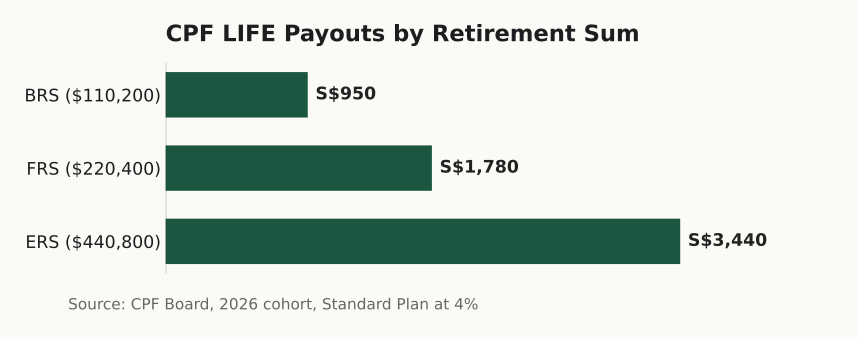
Estimated monthly payouts from age 65 for members turning 55 in 2026, Standard Plan at 4% interest. Source: CPF Board.
These are Standard Plan figures. On the Escalating Plan the first payout would be lower than the numbers above and then rise 2% a year; on the Basic Plan it would be lower and later fall. CPF does not publish a single escalating-versus-standard dollar figure because it depends on your balance and start age, so use the CPF payout estimator and your Retirement Dashboard for your own numbers. For what the sums themselves mean, see the 2026 retirement sums explained.
When payouts start and deferring
Plan choice and start age are separate decisions. Your payout eligibility age is 65, but you can start “anytime from age 65 to 70 years old, allowing your savings more time to accumulate more interest”. Each year you defer lifts your payout — a lever that works on top of whichever plan you pick. Deferring suits members who do not need the income at 65 and expect a long retirement; it compounds especially well with the Escalating Plan’s own growth. For how this fits a wider plan, see retirement planning with CPF and SRS.
A simple way to decide
- Expect a long retirement or worried about prices? Lean Escalating — its rising payout is built for exactly that.
- Want the highest, simplest income from day one? Standard — a level amount you can budget around, and the default if you do nothing.
- Only considering Basic for a bequest? Re-check: all plans leave a bequest, and Basic’s falling payouts usually cost more than the extra early bequest is worth.
- Want a bigger payout on any plan? Build your RA before payouts start with a cash top-up or CPF transfer, or defer towards 70.
Frequently asked questions
Can I change my CPF LIFE plan later? You can switch from the older Basic, Balanced, Plus or Income plans to the Standard or Escalating Plan, but check your options before payouts begin, as changes are limited once they start.
Which plan gives the most money overall? Over a long retirement the Escalating Plan usually pays the most in total because its 2% annual rises compound; over a short one the Standard Plan’s higher early payouts win. Your lifespan is the swing factor.
Is the Basic Plan ever the right choice? Rarely today. It suits someone with modest income needs who places unusual weight on a larger early bequest and expects a shorter retirement — but its payouts fall when you are oldest.
What if I don’t pick a plan? With at least $60,000 in your Retirement Account, CPF places you on the Standard Plan and begins payouts at 70.
Do all three protect me if I live very long? Yes. All three pay for life from the pooled Lifelong Income Fund once your own premium is used up; only the payout shape differs.
Related
General information on CPF LIFE, not financial advice. Payout figures are CPF Board estimates and change with your balance, plan, start age and interest; confirm your own figures on the CPF website.
Sources
- Receive lifelong monthly payouts with CPF LIFE — Central Provident Fund Board (as of November 2026)
- Key facts of CPF LIFE you should know — Central Provident Fund Board (as of November 2026)
- CPF LIFE premiums: how does it work? — Central Provident Fund Board (as of November 2026)
- What is the CPF retirement sum? (2026 sums and estimated payouts) — Central Provident Fund Board (as of November 2026)
- What are the CPF LIFE plans available and which is the right plan for me? (CPF-sourced) — Central Provident Fund Board (via ask.gov.sg) (as of November 2026)