SSB vs Fixed Deposit: Which Is Better?

For safe savings you may still want to reach within a few years, a Singapore Savings Bond usually wins: redeem any month with no penalty, and its rate steps up. A top fixed deposit can pay a higher locked rate over 6–12 months if you can commit.
A Singapore Savings Bond (SSB) and a bank fixed deposit are both low-risk homes for Singapore-dollar savings, but they are built for different savers. An SSB rewards patience and keeps you free to exit any month; a fixed deposit locks a rate you know upfront, as long as you leave the money alone. Which is “better” depends on how long you can commit and how sure you are of the timing — here is how to decide, with today’s rates and the maths.
How each one works
The two set your return in opposite ways.
- An SSB is a Government bond for individuals with a 10-year maturity and a step-up coupon: the rate “steps up each year”, starting low and rising, paid every six months. You can “always get your investment amount back in full with no capital loss”, and you can redeem in any month, with no penalty. Each monthly issue sets its own rates — see Singapore Savings Bonds explained.
- A fixed deposit is a bank product with a fixed maturity: you agree to leave a sum for a set term and the bank fixes the rate upfront. MoneySense’s feature table marks a fixed deposit as having a fixed maturity and, unlike a savings account, not withdrawable anytime.
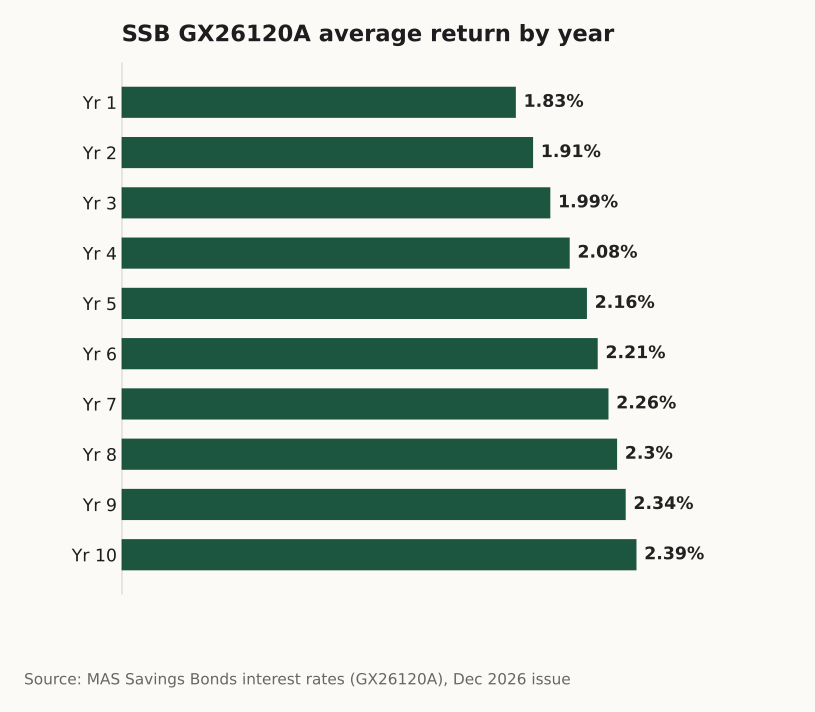
Average return per year if you redeem the December 2026 SSB (GX26120A) at the end of each year, from 1.83% to 2.39% p.a. Source: MAS. Past issues’ rates don’t predict future ones.
Which pays more right now
It depends on how long you hold. The SSB open for application now (issue GX26120A, December 2026) pays a year-1 return of 1.83%, rising to a 10-year average of 2.39% p.a. as the step-up kicks in. A fixed deposit, by contrast, hands you one locked rate for the term:
- A sharp promotion currently tops the SSB’s first year: Hong Leong Finance advertises 2.08% p.a. for 8 months on fresh funds of S$20,000 (rates as of 23 October 2026), with up to 1.90% for 6, 9 or 12 months.
- A plain board rate, by contrast, is far lower — often only a fraction of a promotional rate. That gap is why the promo, not a bank’s standing board rate, is the fair benchmark to set against an SSB.
So over a single short term a strong FD promo can out-pay the SSB’s early years; over several years the SSB’s rising average pulls ahead of a board-rate deposit, and you keep the freedom to leave. The live T-bill and SSB figures in the box above show where rates sit the week you buy. For the full bank tables, see the fixed deposit rates page.
Side by side
| Feature | Singapore Savings Bond | Fixed deposit |
|---|---|---|
| Who backs it | Singapore Government directly | A bank, insured by SDIC if it fails |
| How the rate is set | Steps up each year; fixed for your issue at purchase | Fixed by the bank when you place it |
| Current rate | GX26120A: 1.83% year 1, 2.39% 10-yr avg | HLF promo 2.08% (8 mth); board rates far lower |
| Early exit | Redeem any month, no penalty, S$2 fee | Often no or reduced interest, sometimes a fee |
| Minimum | S$500, multiples of S$500 | Set by the bank; promos often need S$20,000 fresh funds |
| Maximum | S$200,000 total per person | No national cap; only S$100,000 is SDIC-insured per bank |
| Funds accepted | Cash or SRS; not CPF | Cash; some banks via CPFIS/SRS, varies |
| Can you lose capital | No | No, if within SDIC cover and held to maturity |
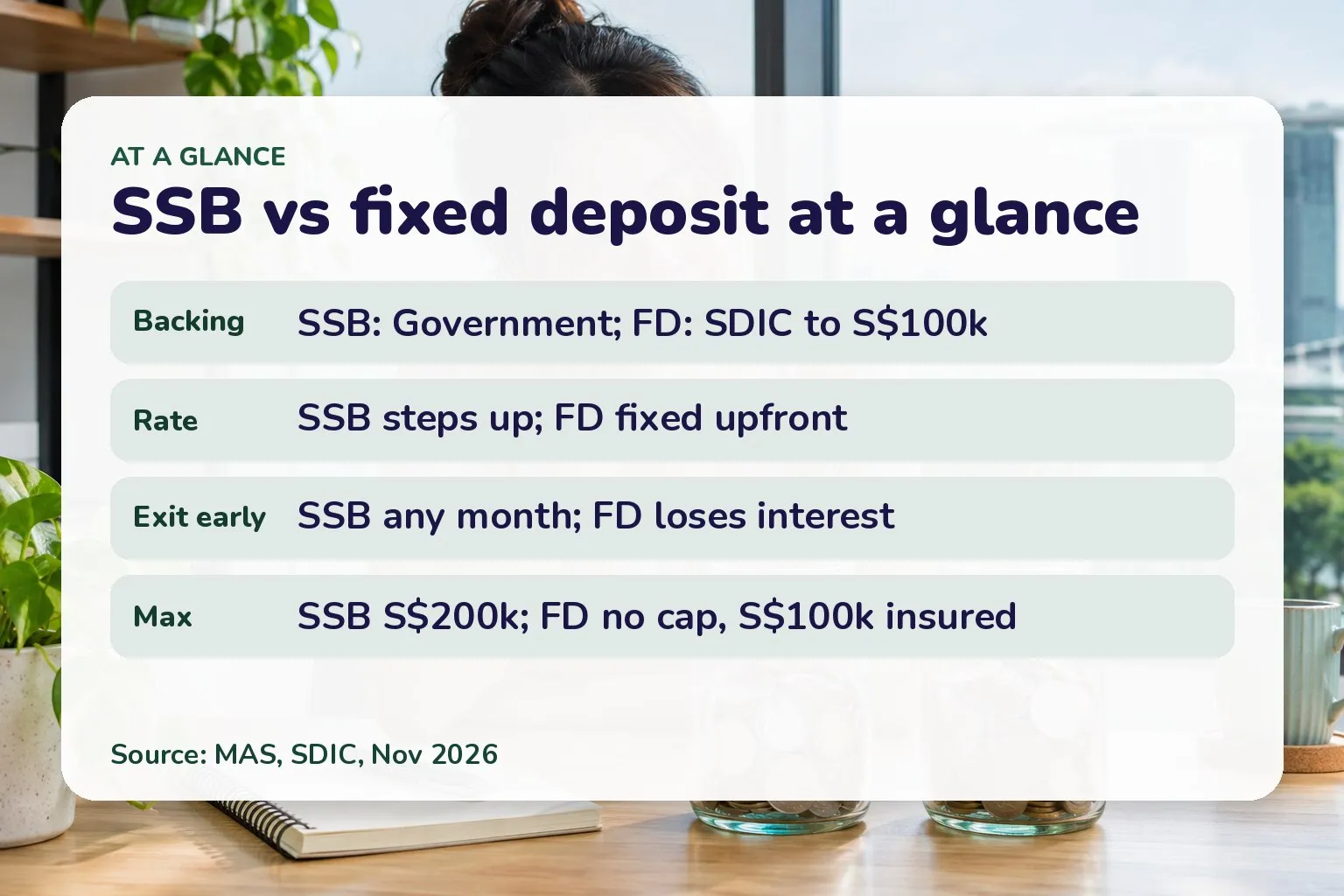
SSB vs fixed deposit on the points that usually decide the choice. Source: MAS, SDIC, Nov 2026.
Liquidity: the real difference
This is where the two part ways. An SSB can be redeemed in any month — you get your principal plus accrued interest “by the 2nd business day of the following month”, for a S$2 fee, and you never lose capital. A fixed deposit is designed to be left: MoneySense warns that on an early withdrawal “you may receive no interest or suffer partial loss of interest on the deposit. In some cases, you may also need to pay a fee which could potentially result in you receiving less than the initial deposit placed.”
How safe is each
Both sit at the low-risk end, but the protection is structured differently, and it matters for larger sums.
- An SSB is a direct obligation of the Singapore Government; there is no dollar ceiling on that backing, and you redeem at face value, so there is no market-price risk.
- A fixed deposit relies on the bank, backed by SDIC if it fails: “all of your insured deposits with that member are aggregated and insured up to S$100,000 by the Singapore Deposit Insurance Corporation.” Above S$100,000 at one bank, only the first S$100,000 is covered — read how SDIC deposit insurance works.
In practice, if you are placing more than S$100,000, an SSB (up to its S$200,000 cap) carries full Government backing on the whole sum, while an equal FD at one bank leaves the excess uninsured.
A worked example
Say you have S$20,000 you would like kept safe for about two years, but you are not completely sure you will not need it sooner.
- SSB (GX26120A): held two years, the average return is about 1.91% p.a., roughly S$764 over the two years — and you could redeem in any month in between without losing capital.
- Fixed deposit: lock the 2.08% 8-month promo and you earn about S$20,000 x 2.08% x 8/12 = about S$277 for those eight months, but then the money must be reinvested at whatever rate prevails — possibly a 1% board rate — and you cannot touch it mid-term without forfeiting interest.
Here the SSB gives a slightly higher two-year return and keeps your exit open; the FD only wins if you are certain of the timing and can re-lock at good rates. The figures are illustrative — SSB issues and FD promos both change, so check current rates before you act. You can line all three up in the compare FD, T-bill and SSB tool.
Who should pick which
Pick the SSB if you want capital-safe savings you can still reach, you may hold for a few years, you value the step-up, or you are placing a large sum you want fully Government-backed. Pick a fixed deposit if you have a lump sum you can lock for a known short term and a promotion is paying clearly more than the SSB’s early years — and you are sure you will not need the cash before maturity.
Who should not pick the SSB (the overall winner): anyone chasing the single highest rate over a short, fixed horizon, where a top FD promo or a T-bill can pay more; and anyone who can only fund with CPF, since SSBs do not accept CPF. The fixed deposit is the better pick there — the runner-up overall, but the winner for a locked short-term commitment.
Frequently asked questions
Can I use CPF or SRS to buy either? An SSB accepts cash or SRS but not CPF. Fixed deposits are a cash product; some banks offer them through CPFIS or SRS, but availability and rates vary, so confirm with the bank.
Is my money ever at risk of loss? An SSB always returns your capital in full. A fixed deposit returns your capital if the bank stays solvent, and SDIC insures eligible Singapore-dollar deposits up to S$100,000 per depositor per Scheme member if it does not.
What does it cost to get out early? An SSB redemption costs a S$2 bank fee and returns principal plus accrued interest the next month. Breaking a fixed deposit early can mean little or no interest and sometimes a fee.
Which gives a higher rate over 10 years? The SSB’s average return rises toward its 10-year figure (2.39% p.a. for GX26120A), which a rolling series of board-rate deposits would struggle to match — though a fixed deposit’s rate is certain while future SSB issues are not.
Is there a limit to how much I can hold? An SSB is capped at S$200,000 per person across all issues. A fixed deposit has no national cap, but only S$100,000 per bank is SDIC-insured.
Related
- Singapore Savings Bonds explained
- How to apply for SSB (and redeem)
- Fixed deposit rates in Singapore
- T-bill vs fixed deposit
General information on SSBs and fixed deposits, not financial advice. Rates are set per SSB issue and per bank promotion and change frequently; confirm the current figures on the MAS and bank pages before you commit.
Sources
- Singapore Savings Bonds (overview) — Monetary Authority of Singapore (as of 7 November 2026)
- Products for Individuals (SGS bonds, T-bills, Savings Bonds compared) — Monetary Authority of Singapore (as of 7 November 2026)
- Investing in Savings Bonds — How to Redeem — Monetary Authority of Singapore (as of 7 November 2026)
- Savings Bonds interest rates (savingbondsinterest API, GX26120A) — Monetary Authority of Singapore (as of 7 November 2026)
- Understanding bank accounts (fixed deposit features and early withdrawal) — MoneySense (MAS) (as of 7 November 2026)
- Deposit Insurance Scheme coverage — Singapore Deposit Insurance Corporation (as of 7 November 2026)
- Hong Leong Finance Fixed Deposit promotion (8-month 2.08%) — Hong Leong Finance (as of 23 October 2026)