Self-Employed CPF and MediSave Contributions

If your net trade income tops S$6,000 a year, MediSave contributions are compulsory for self-employed Singaporeans and PRs — 4% to 10.5% of income by age, capped per year — and they earn full income tax relief.
Working for yourself in Singapore does not take you out of the CPF system — it changes which part applies. If you are self-employed, there is no employer paying into your Ordinary or Special Account, so the one contribution the law still asks of you is to your MediSave Account, to build healthcare savings. This guide covers when that is compulsory, how much you pay in 2026, the deadlines, the tax relief, and the voluntary top-ups you can add on your own terms.
Which CPF contributions are compulsory
For the self-employed, only MediSave contributions are compulsory. The CPF Board’s Self-Employed Scheme exists, in its own words, to encourage self-employed persons “to save for retirement and healthcare needs, in the absence of regular MediSave contributions from an employer.” There are no mandatory Ordinary or Special Account contributions when you are self-employed; paying into those accounts is voluntary and covered further down.
If you are both an employee and self-employed, the CPF your employer deducts from your salary is separate — you still owe MediSave on your self-employed income on top of it.
Who has to contribute
You must make compulsory MediSave contributions once you receive CPF’s notice if you are a self-employed person who is a Singapore Citizen or Permanent Resident and your net trade income is more than S$6,000 for the year. Net trade income is “your gross trade income minus all allowable business expenses, capital allowances and trade losses” — the same figure IRAS assesses, so there is no separate CPF computation.
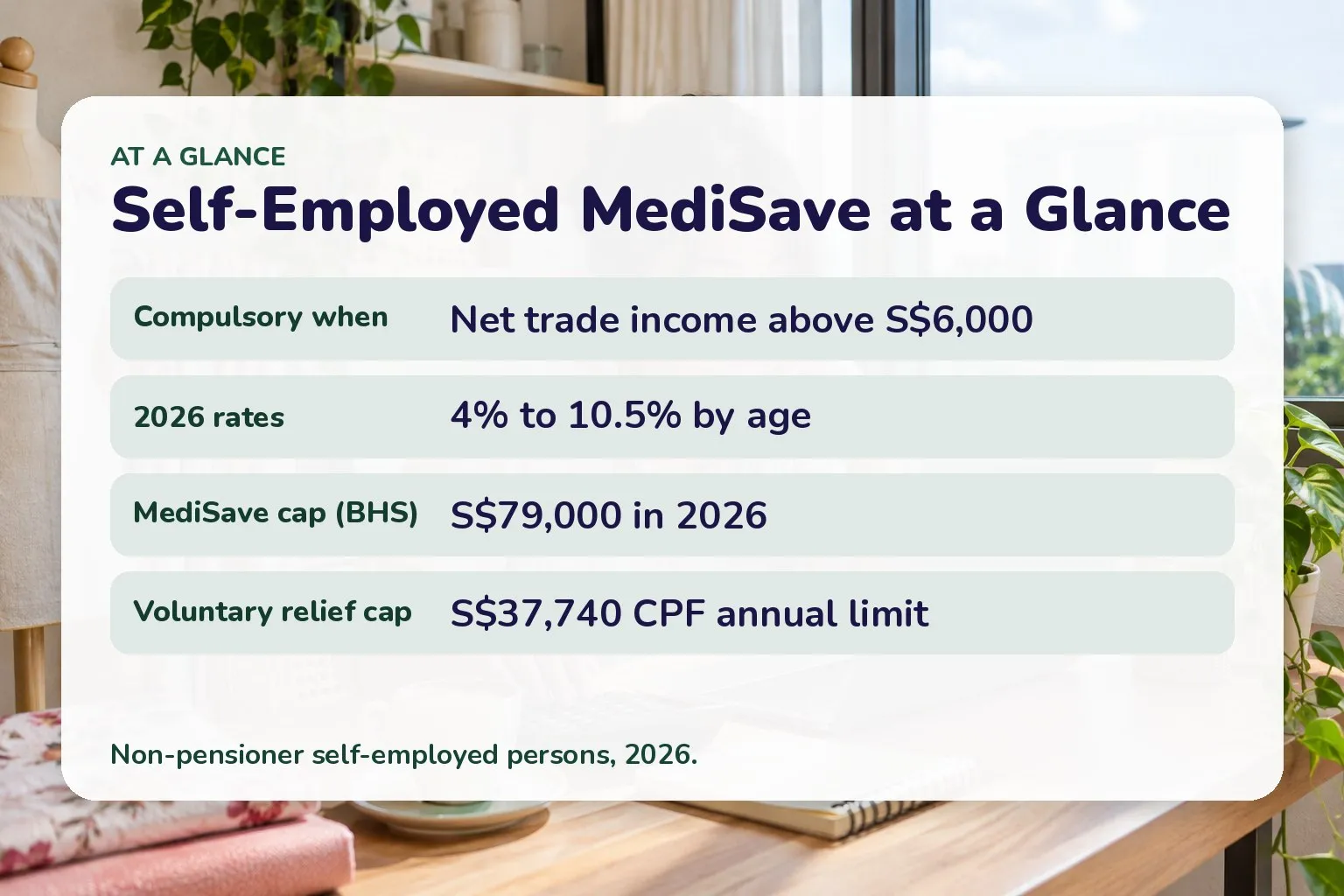
Key figures for self-employed MediSave. Source: CPF Board and IRAS, 2026.
Two edge cases matter:
- Platform workers. From work year 2025, net earnings from platform work that operators declare to CPF are excluded from the net trade income used here, because those are handled under the platform-worker CPF rules instead.
- Below the threshold. If your net trade income is S$6,000 or less in a year, no compulsory MediSave is due for that year — though you can still contribute voluntarily.
How much you pay (2026 rates)
Your MediSave amount “depends on your age and net trade income” — it is a percentage of net trade income, rising with both, up to a yearly cap. The table below is the 2026 rate schedule for non-pensioners (pensioners use a separate, lower table). Age is taken as at 1 January.
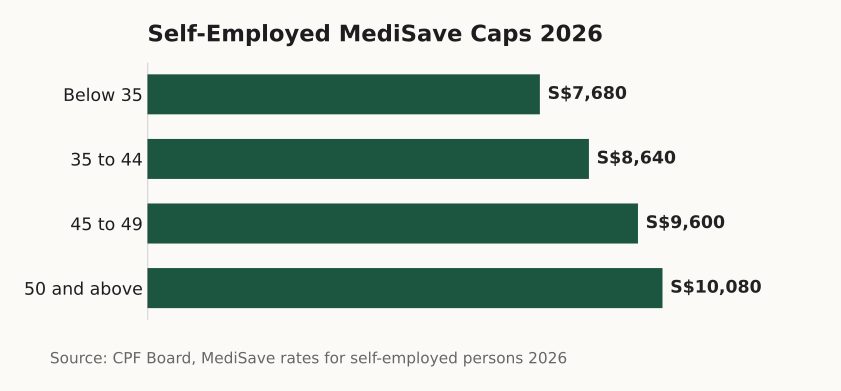
Maximum yearly MediSave contribution by age band, 2026 (non-pensioner). Source: CPF Board.
| Net trade income (2026) | Below 35 | 35 to 44 | 45 to 49 | 50 and above |
|---|---|---|---|---|
| Above S$6,000 to S$12,000 | 4.00% | 4.50% | 5.00% | 5.25% |
| Above S$12,000 to S$18,000 | phased 4% to 8% | phased 4.5% to 9% | phased 5% to 10% | phased 5.25% to 10.5% |
| Above S$18,000 | 8.00% | 9.00% | 10.00% | 10.50% |
| Maximum a year | S$7,680 | S$8,640 | S$9,600 | S$10,080 |
The middle income band is phased in: between S$12,000 and S$18,000 the effective rate climbs gradually from the lower-band rate to the full top-band rate, so there is no sudden jump. Above S$18,000 the top percentage applies until you hit the age-based annual cap.
When and how to pay
You are billed only after you file your tax return and IRAS assesses your income. CPF then issues a “Notice of CPF Contributions for Self-employed Persons” (since 1 November 2024 this statement comes directly from the CPF Board, not IRAS). The contribution “must be paid in full to CPF Board within 30 days from the date of issuance” of that notice.
If a lump sum is hard to manage, you have two softer routes:
- GIRO instalments — spread the year’s MediSave across monthly payments instead of one bill.
- Contribute-As-You-Earn (CAYE) — CPF’s CAYE service “helps SEPs contribute to their MediSave as they earn,” deducting a share when buyers or service-buyers pay you, so there is less to settle at assessment time.
You can pay the notice amount online via your CPF account, PayNow or GIRO. Check the exact figure with CPF’s Self-Employed MediSave Contribution Calculator before you pay.
Tax relief for the self-employed
Compulsory MediSave is not just a cost — it lowers your tax. As the CPF Board puts it, a self-employed person “can enjoy full tax relief on your mandatory MediSave contributions.” IRAS confirms the recent change: from YA 2026, you are “allowed tax relief on the full amount of compulsory MediSave contributions made in the preceding year, without any capping restrictions” — before, this relief was limited to the lower of 37% of income or the CPF annual limit.
The relief reduces your chargeable income, so it only helps if you have tax to pay, and it sits within your overall personal relief cap. For how CPF rates and interest fit the bigger savings picture, see CPF interest rates explained and how employees’ rates differ in CPF contribution rates by age.
Voluntary contributions on top
Beyond compulsory MediSave, you can voluntarily contribute more to grow retirement and healthcare savings:
- Voluntary MediSave top-ups add to the same account (useful up to the Basic Healthcare Sum).
- Voluntary contributions to all three accounts spread money across your Ordinary, Special and MediSave Accounts by the standard allocation.
For the self-employed, tax relief on these voluntary contributions is capped at the lowest of “37% of your net trade income assessed; or CPF annual limit of $37,740; or Actual amount of voluntary CPF contributed.” Note the compulsory MediSave relief (now uncapped) is separate from this voluntary cap. If your goal is purely tax relief, weigh a Retirement Sum Topping-Up cash top-up or an SRS account as well — each has its own rules and limits. What your MediSave can later pay for is covered in MediSave uses explained.
When contributions stop or can be capped
Two ceilings can reduce or pause what you owe:
- The Basic Healthcare Sum (BHS). MediSave is capped at the BHS — S$79,000 for 2026. Once your MediSave hits it, no further MediSave contributions are required; the BHS is “fixed for the rest of their lives” once you reach age 65.
- High employment income. If you also hold a job and your total employment income (excluding additional wages) exceeds 12 times the monthly CPF salary ceiling for the year, you “can apply to CPF Board to limit your MediSave contributions.” For 2026 onwards, CPF sets that qualifying income at S$96,000; confirm the current figure on CPF’s limit-application page.
Frequently asked questions
Do I pay CPF if I only freelance part-time? The S$6,000 net trade income test applies to self-employed income whether the work is full-time or part-time; once your net trade income passes S$6,000, compulsory MediSave is due.
I made a loss this year — do I still owe MediSave? No. With net trade income of S$6,000 or less (including a loss), there is no compulsory MediSave for that year.
Can I contribute to my Ordinary or Special Account as self-employed? Not compulsorily, but you can make voluntary contributions to all three accounts; only the amounts within the CPF annual limit of S$37,740 attract relief, and it is shared with your compulsory contributions.
Does paying MediSave count towards my retirement sum? MediSave builds healthcare savings, not your Retirement Account directly; to lift retirement payouts you would use RSTU cash top-ups or, later, transfers — see CPF retirement sums: BRS, FRS and ERS.
When exactly is payment due? Within 30 days of the date on your CPF notice, unless you are on a GIRO instalment plan or paying through CAYE.
General information on CPF for the self-employed, not financial or tax advice. Rates, caps and the Basic Healthcare Sum change; confirm the current figures and your own amount with CPF and IRAS before you act.
Sources
- Saving as a self-employed person (Self-Employed Scheme) — Central Provident Fund Board (as of 8 November 2026)
- Compulsory and voluntary MediSave contributions — Inland Revenue Authority of Singapore (as of 8 November 2026)
- CPF relief for self-employed / employee who is also self-employed — Inland Revenue Authority of Singapore (as of 8 November 2026)
- MediSave contribution rates for self-employed persons — 2026 (PDF) — Central Provident Fund Board (as of 8 November 2026)
- Conditions for applying to limit MediSave payable as a self-employed person — Central Provident Fund Board (as of 8 November 2026)