How We Track and Verify Rates: Our Methodology

Our rate methodology pulls every figure from a primary source: MAS for T-bill, SGS and SSB yields, the CPF Board for CPF rates, and each bank's own page for deposit rates. Each number carries the date we read it so you can check it yourself.
Every figure on this site is meant to be checkable. This page is our rate methodology in plain terms: for each rate we track, which official source it comes from, how and when that source publishes it, and how you can open the same page and confirm the number yourself. For the shorter version of our editorial process, see how we research and update.
The sources behind each rate
We separate government-set rates, which come from a single authoritative feed, from bank rates, which each bank sets and publishes itself.
| Rate | Where it comes from | Tier |
|---|---|---|
| T-bill and SGS bond yields | MAS auction results | Official |
| Singapore Savings Bond rates | MAS Savings Bonds issue data | Official |
| CPF interest rates | CPF Board | Official |
| SORA benchmark | MAS | Official |
| Fixed deposit and savings promo rates | Each bank’s own rate page | Primary (the provider) |
| Deposit protection limit | SDIC | Official |
T-bills and SGS bonds
T-bill and SGS bond yields are set at auction, not fixed by anyone in advance, so we take them from the MAS auction results after each auction settles. A T-bill has “No coupon. Issued at a discount to the face value”, and the headline figure is the cut-off yield: “You will get the bond at the cut-off yield”, which is “the highest accepted yield of successful competitive bids.” That is the single rate every successful bidder is allotted at, so it is the number we publish and date to the auction day — for example, the 6-month T-bill BS26121N cut off at 1.95% at its 22 Oct 2026 auction. For the mechanics of bidding, see how to buy Singapore T-bills and the difference between a new issue and a reopened bond.
Singapore Savings Bonds
SSB figures change on a fixed monthly cycle, which makes them easy to date. “A new Savings Bond will be issued every month”, and MAS announces each issue’s rates “on the 1st business day of each month”. The rates are built so the average return is “linked to the yield of an SGS of a corresponding tenor”, and they are “published on the Savings Bonds website” and “in local newspapers”. We read each new issue when it opens and label it with that issue’s code and month; see how to apply for an SSB for the application window.
CPF interest rates
CPF rates are legislated and reviewed on a quarterly cycle, so we take them directly from the CPF Board’s interest-rate page and date them to the quarter. For the current quarter the Ordinary Account pays an “Interest rate from 1 October 2026 to 31 December 2026: 2.5% per annum”, which is “Reviewed quarterly, this rate is computed based on the 3-month average of major local banks’ interest rates” and is “subject to the legislated minimum interest of 2.5% per annum.” The Retirement Account pays 4% per annum, computed on the “12-month average yield of 10-year Singapore Government Securities (10YSGS) plus 1%” and “subject to the current floor interest rate of 4% per annum.” We explain these in full in CPF interest rates explained.
SORA and bank rates
SORA, the benchmark behind many floating-rate loans and some deposit products, is published by MAS: “SORA is computed based on actual transactions” and is “published on the MAS website the next business day at 9am.” We take it from that feed and date it to the business day it covers; read more in SORA explained.
Bank fixed-deposit and savings-account rates are the one group with no single official feed — each bank sets and advertises its own. We read them from the bank’s own rate page, record the date, and re-check them on a monthly cycle because promotional rates often move within the same week. That is why our fixed deposit rates page and savings accounts comparison always show an “as of” date rather than a single evergreen number.
How often each rate changes
A figure’s date is only useful if you know its refresh clock. These are the cadences we track to:
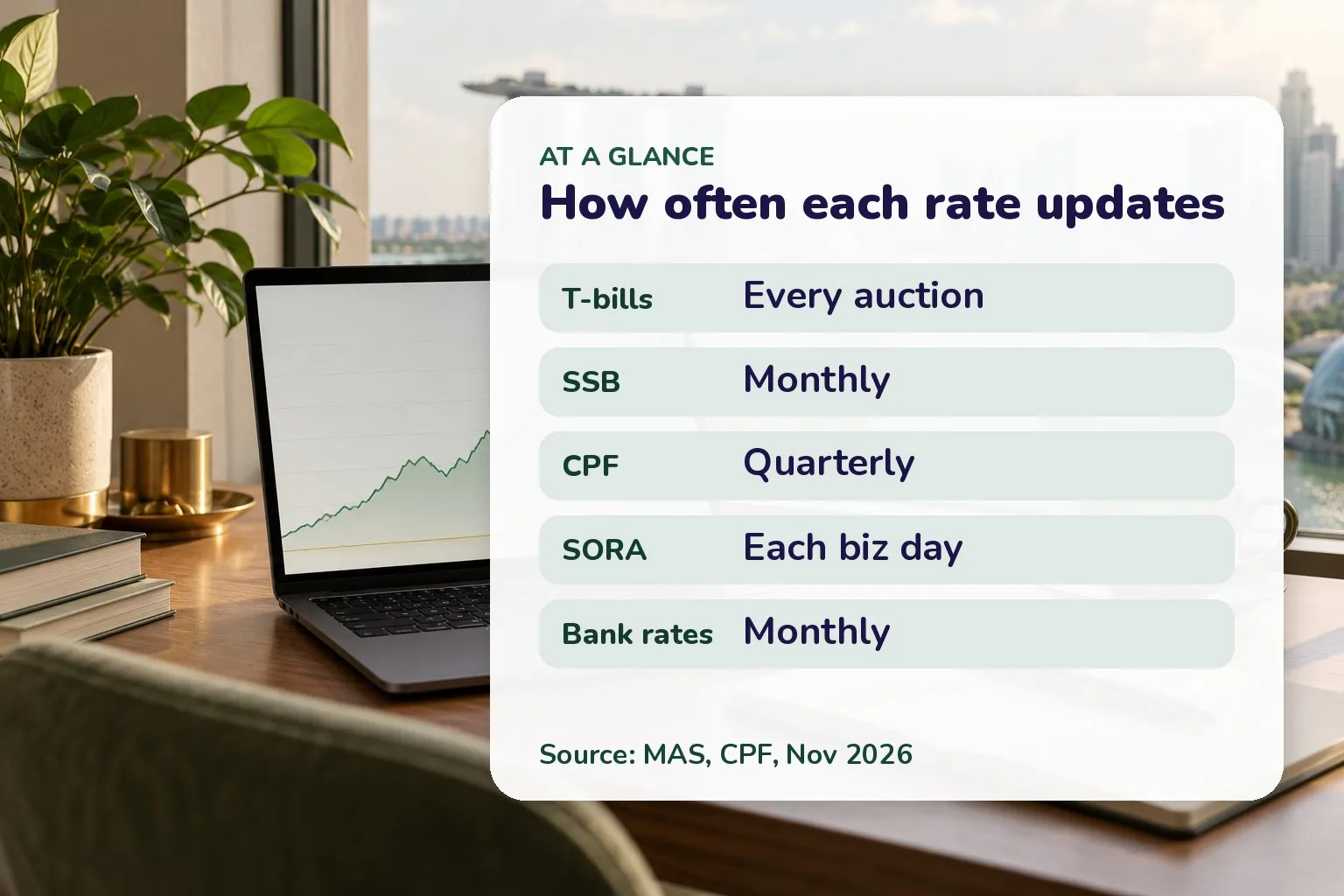
How current each figure is, by source. Source: MAS, CPF.
- T-bill and SGS yields — every auction (roughly fortnightly for the 6-month T-bill), read from the MAS results.
- SSB — monthly, on the first business day, when the new issue opens.
- CPF — quarterly, when the CPF Board publishes the next quarter’s rates.
- SORA — every business day at 9am for the previous day.
- Bank FD and savings — no fixed schedule; re-checked monthly and whenever a bank changes its page.
How to verify any number yourself
You never have to take our figure on trust. Every page ends with a Sources section listing each official page with a link and an “as of” date. To confirm a number:
- Open the linked source for that figure.
- Find the same rate on the official page (the MAS auction result, the CPF rate table, the bank’s rate sheet).
- Compare it to the date we showed. If the source has since moved, the source wins — tell us and we will update.
For deposit safety, we also point to the SDIC rules rather than summarising them loosely: eligible deposits are “insured for up to S$100,000 in aggregate per depositor per Scheme member”, a figure we take from SDIC and nowhere else.
Why every figure is dated
Rates are time-sensitive, so a number without a date is close to useless. Attaching the date we read each figure does two things: it tells you how much to trust the number today, and it lets our automated checks flag a page whose figures have gone stale so we can refresh them. It is the same reason we never write “best rate” as a fact — only “the best rate we recorded on this date”.
What we do not do
Our finance pages are comparisons and official rules, not personal advice. We do not rank products by any commercial arrangement, we do not tell you which account to open, and we do not publish return “projections”. Where a figure cannot be tied to a source, we leave it out and tell you where to look. Found something wrong or out of date? Our corrections page explains how to flag it.
Frequently asked questions
Do you use live official data? Yes, where a feed exists. T-bill, SGS and SSB figures come from MAS data and the published auction results; CPF and SORA from their official pages. Bank promo rates are read and dated by hand.
Why are some figures a few weeks old? Because that is when the source last published. A CPF rate holds for a quarter; a T-bill yield holds until the next auction. The date tells you which applies.
Are the government rates guaranteed to stay the same? No. Auction yields change every auction, SSB rates change monthly, and CPF rates are reviewed quarterly. We date every figure for exactly this reason.
What if I find a wrong number? Tell us through the corrections page. We check it against the official source and fix it there, which updates the page.
General information on our sourcing and update process, not financial advice. Always confirm a rate on its official source, linked on each page, before you act on it.
Sources
- How SGS Auctions Are Conducted — Monetary Authority of Singapore (as of 3 November 2026)
- T-bills: Information for Individuals — Monetary Authority of Singapore (as of 3 November 2026)
- Singapore Savings Bonds (overview) — Monetary Authority of Singapore (as of 3 November 2026)
- CPF interest rates (earning attractive interest) — Central Provident Fund Board (as of 3 November 2026)
- Singapore Overnight Rate Average (SORA) — Monetary Authority of Singapore (as of 3 November 2026)
- Deposit Insurance Scheme — FAQs — Singapore Deposit Insurance Corporation (as of 3 November 2026)
- Bonds and Bills auction results (listbondsandbills API) — Monetary Authority of Singapore (as of 3 November 2026)