Using SRS Funds to Buy Singapore T-Bills

You buy T-bills with SRS money by applying through your SRS operator bank — DBS/POSB, OCBC or UOB — at a MAS auction. The minimum is S$1,000, the full bid is debited when you apply, and at maturity the proceeds return to your SRS account.
On this page9 sections · tap to jump
Money paid into your Supplementary Retirement Scheme (SRS) account does not grow by itself — the scheme is designed for you to invest it. A Singapore T-bill is one of the simplest, lowest-risk places to put that cash: it is backed by the Government, needs no view on markets, and you apply through the same bank that holds your SRS account. This guide covers who can do it, the exact steps, where the money goes at maturity, and how the SRS wrapper changes the tax picture.
Can you buy T-bills with SRS money?
Yes. MAS lists SRS as an accepted funding source for T-bills alongside cash and CPF: on its T-bill page the answer to “Buy with SRS and CPF” is simply “Yes”. You bid at the same auction as everyone else, at the same minimum of S$1,000, in multiples of S$1,000, and you are allotted at the same uniform cut-off yield. The only thing that differs is the account you apply from and where the money sits before and after.
T-bills come in 6-month and 1-year tenors and pay no coupon — they are “issued at a discount to the face value”, and you receive the full face value at maturity, with the gap being your entire return. The current cut-off yields are in the live box above; for the mechanics of bidding, see how to buy Singapore T-bills.
Why deploy SRS cash into T-bills
The SRS gives you tax relief when you pay in, but the Ministry of Finance is explicit that the point afterwards is to “grow your savings by investing” — the instrument list runs to “Shares, unit trusts, bonds, fixed deposits” and more. Cash left sitting in the account is not put to work. A T-bill is an easy first step for that idle balance: Government-backed, a fixed short horizon, and no ongoing management.
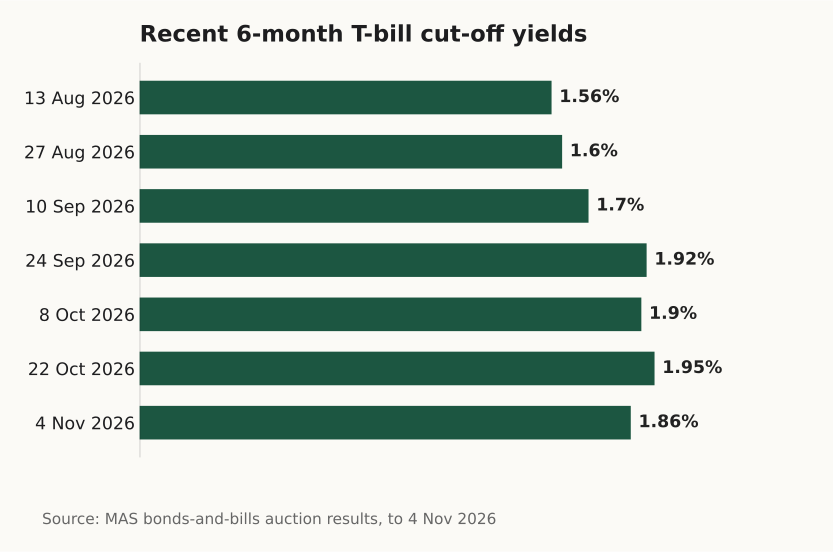
6-month T-bill cut-off yields at recent auctions, the return your SRS cash would have locked in. Source: MAS, to 4 Nov 2026. Past yields don’t predict future ones.
What you need before you start
Two things: an SRS account, and enough cash already in it.
- An SRS account with one of the three operators. MAS states that for an SRS application “you will need an SRS account with one of the three SRS operators (DBS/POSB, OCBC, and UOB)”. You can hold only one SRS account at a time (IRAS), so you apply through whichever operator holds yours.
- Funds inside the SRS account. A bid draws only on your SRS cash balance — you cannot route outside money straight into a T-bill. If the balance is short, contribute first. The annual contribution cap is S$15,300 for citizens and PRs and S$35,700 for foreigners, and you can pay in “anytime and as often as you like by 31 December each year”.
How to buy a T-bill with SRS, step by step
- Check the issuance calendar on the MAS website for the next auction. 6-month T-bills are auctioned fortnightly and the 1-year about once a quarter.
- Apply through your SRS operator. You “submit an application via your SRS Operator” — DBS/POSB through internet banking or the mobile app, OCBC through internet banking or the app, and UOB “through UOB’s Internet banking portal.” There is no ATM route for SRS.
- Choose your bid type and amount. A non-competitive bid takes only the amount and accepts the cut-off yield; a competitive bid names the highest yield you will accept. Most individuals use non-competitive — see competitive vs non-competitive bids. Enter the amount in multiples of S$1,000.
- Know when the money leaves. For a new T-bill issue “the full bid amount will be debited from your account at the point of application.” If your bid is unsuccessful or invalid, it is refunded to your SRS account, usually “1 to 2 business days after the auction day.”
- Check the result and your holding. Aggregate results appear about an hour after the auction closes; the T-bill is “issued 3 business days after the results are announced.” Your holding then shows in the statement from your SRS operator.
What happens at maturity
A T-bill has no coupon, so nothing happens in between — then at maturity you are repaid the full face value, and because you paid with SRS, the proceeds return to your SRS account, not to your personal bank account. From there the cash sits in the wrapper again, ready to roll into the next auction or another SRS investment. If you want the step-by-step on reinvesting, see what happens when your T-bill matures.
How SRS changes the tax picture
This is where an SRS T-bill differs from a cash one, and it cuts both ways.
- The upside is the contribution, not the T-bill. SRS relief lowers your taxable income in the year you pay in, and “investment returns are tax-free before withdrawal.” A T-bill’s return already compounds untaxed inside SRS — so the tax win you are really banking is the relief on the contribution, not anything special about the bill.
- The money stays locked. Buying a T-bill does not change SRS withdrawal rules. Withdraw on or after the statutory retirement age that applied when you made your first contribution (64 from 1 July 2026) and “only 50% of the withdrawals from SRS are taxable”, spread over up to 10 years. Withdraw earlier and, per the Ministry of Finance, “withdrawals are fully taxable and incur a 5% penalty.”
SRS vs cash vs CPF for T-bills
The T-bill itself is identical; the account decides the trade-offs.
| Funding | Where you apply | Where the money lives | The catch |
|---|---|---|---|
| SRS | Your SRS operator’s internet banking/app | Your SRS account | Proceeds stay locked in SRS until retirement rules allow withdrawal |
| Cash | DBS/POSB, OCBC or UOB ATM, internet banking or app | Linked bank account via CDP | Needs an individual CDP account with Direct Crediting Service |
| CPF-OA | Your CPFIS agent bank | CPF Investment Account | The yield must beat the 2.5% OA interest you give up |
For cash buyers the comparison is simply the T-bill yield against your deposit rate. For CPF, the hurdle is higher because you forgo guaranteed CPF interest — work it through in the CPF-OA T-bill guide. For SRS, there is no interest-rate hurdle to clear, because uninvested SRS cash was doing little anyway; the only real cost is that the money remains inside the retirement wrapper.
A worked example
Say you have S$10,000 of idle cash in your SRS account and you place it in a 6-month T-bill.
At the 4 November 2026 auction the 6-month cut-off price was S$99.073 per S$100 of face value (a 1.86% cut-off yield). A S$10,000 application would cost about S$9,907, and six months later the full S$10,000 face value is credited back to your SRS account — roughly S$93 of return, earned tax-free inside the wrapper. You can run your own figures with the T-bill yield calculator. The numbers are illustrative: every auction clears at a different yield, so always check the live cut-off before you apply.
Frequently asked questions
Can I use SRS to buy SGS bonds and Savings Bonds too? Yes. SRS funds can buy SGS bonds at auction and Singapore Savings Bonds (CPF cannot buy an SSB). The application still goes through your SRS operator.
Does the T-bill pay interest into my SRS account along the way? No. T-bills are non-coupon: you buy at a discount and the full face value is repaid to your SRS account at maturity, with the difference being your return.
What if my SRS cash is not enough for the bid? You must top up your SRS account first, within the annual cap (S$15,300 for citizens/PRs, S$35,700 for foreigners), and let it clear before the application cut-off. Outside cash cannot fund an SRS bid directly.
Can I sell an SRS T-bill before maturity? T-bills can be sold on the secondary market at DBS, OCBC or UOB main branches, but the price then depends on prevailing rates and may be above or below what you paid.
Is the T-bill return taxed? There is no capital gains tax in Singapore, and inside SRS investment returns are tax-free before withdrawal; only 50% of an SRS withdrawal is taxable at retirement age, or the withdrawal is fully taxable and incurs a 5% penalty if earlier.
Related
- How to buy Singapore T-bills
- Using CPF-OA to buy T-bills
- SRS account: tax relief and returns
- SSB vs fixed deposit: which is better?
General information on using SRS funds to buy T-bills, not financial advice. Yields change at every auction and SRS rules can change; confirm the current figures and your operator’s process with MAS, IRAS and your bank before applying.
Sources
- T-bills: Information for Individuals — Monetary Authority of Singapore (as of 7 November 2026)
- Buy SGS Bonds and T-bills at Auction: For Individuals — Monetary Authority of Singapore (as of 7 November 2026)
- Products for Individuals (SGS bonds, T-bills, Savings Bonds compared) — Monetary Authority of Singapore (as of 7 November 2026)
- Treasury Bills auction results (listbondsandbills API, BS26122V) — Monetary Authority of Singapore (as of 7 November 2026)
- SRS contributions and tax relief — Inland Revenue Authority of Singapore (as of 7 November 2026)
- Tax on SRS withdrawals (10-year window, retirement age) — Inland Revenue Authority of Singapore (as of 7 November 2026)
- Supplementary Retirement Scheme (overview) — Ministry of Finance (as of 7 November 2026)